


Reports
The Paris Agreement on Climate Change adopted in December 2015 provides the transport sector with a clear sense of ambition and direction to a "net zero-emission" economy.
Proposed Avenues for NDCs
2016
Author(s): Gota S, Peet K, Windisch E, Bongardt D, Eichhorst U
NDCs represent a unique opportunity to increase bold mitigation and adaptation measures in transport and other sectors as all Parties to the UNFCCC are communicating their commitments to reduce emissions and increase resilience on sectorial scales in the context of the UNFCCC system.

This report describes Shell’s understanding of the transition to a lower-carbon energy system. It explains how the organization is driving its business strategy in the context of climate-related risks and opportunities.

Potential low carbon fuel supply to the Pacific Coast region of North America
2015
Author(s): Malins C, Lutsey N, Galarza S, Shao Z, Searle S, Chudziak C, Berg M
Evaluates potential low-carbon fuel deployment in the 2015–2030 timeframe and finds that the policy goals of British Columbia, California, Oregon, and Washington are simultaneously achievable.
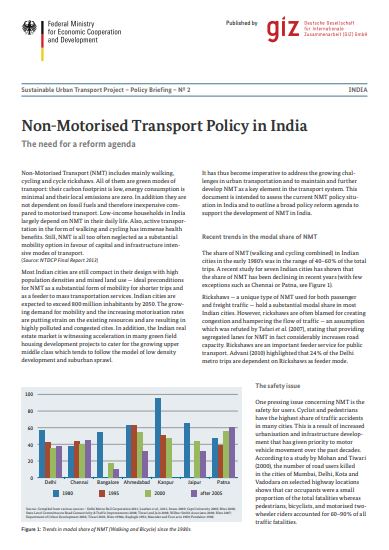
Non-Motorised Transport Policy in India
2015
Author(s): Deutsche Gesellschaft für Internationale Zusammenarbeit (GIZ) GmbH
This publication gives an overview of recent trends in the modal share of NMT in India, as well as a snapshot of current NMT policy in India and related issues such safety.

This report assesses the 20th Conference of the Parties (COP20) of the United Nations Framework Convention on Climate Change (UNFCCC) in Lima, Peru in December 2014, as viewed through the lens of sustainable transport.

The transport sector now accounts for about 23% (7.3 Gt) of annual global energy-related CO2 emissions (32 Gt). This is a significant rise over the last few decades, and to achieve a two-degree scenario CO2 emissions from transport would need to decline to 5.7 Gt annually.

Renewable energy continued to grow in 2014 in parallel with global energy consumption and falling oil prices. Despite rising energy use, global CO2 emissions associated with energy consumption remained stable over the course of the year while the global economy grew.

Intended Nationally Determined Contributions (INDCs) are poised to play an integral role in the negotiations leading up to COP21. INDCs are intended to communicate country targets and strategies to reduce carbon emissions particularly in transport sector.

This study is an extension of ICCT’s work benchmarking U.S. airline fuel efficiency on domestic operations since 2010.