Policies/Regulations
Goa Electric Mobility Promotion Policy 2021- Draft
2021
Publisher/Organisation: Government of Goa
The government of Goa has issued the draft ‘Goa Electric Mobility Promotion Policy, 2021’ for the adoption of electric vehicles and to cut down the carbon emissions making the state greener.
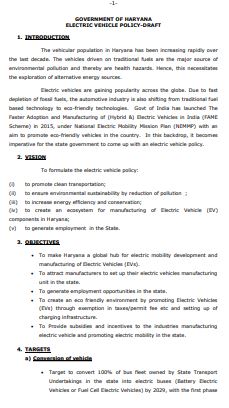
Haryana Electric Vehicle Policy-Draft
2021
Publisher/Organisation: Government of Haryana
The vehicular population in Haryana has been increasing rapidly over the last decade. The vehicles driven on traditional fuels are the major source of environmental pollution and thereby are health hazards.
Assam Electric Vehicle Policy 2021
2021
Publisher/Organisation: Government of Assam
The state government of Assam notified the Electric Vehicle (EV) Policy of Assam, 2021, which will be in effect over a five-year period until 2026. During this period, the policy aims to achieve 25 percent penetration of EVs in the total number of vehicle registrations.
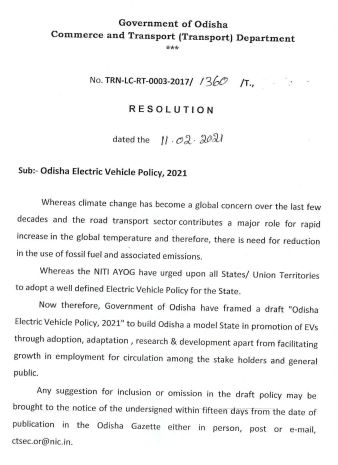
Odisha Electric Vehicle Policy, 2021
2021
Publisher/Organisation: Commerce and Transport (Transport) Department, Government of Odisha
Government of Odisha has framed a draft "Odisha Electric Vehicle Policy, 2021" to build Odisha a model State in promotion of EVs through adoption, adaptation , research & development apart from facilitating growth in employment for circulation among the stake holders and general public.
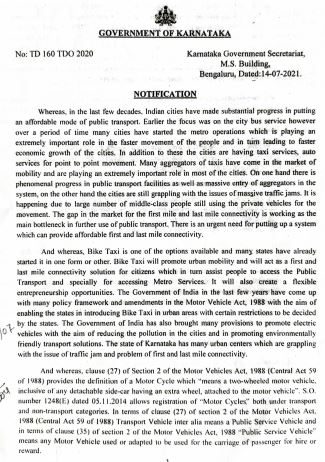
Karnataka Electric Bike Taxi Scheme 2021
2021
Publisher/Organisation: Governor of Karnataka
The main objective of the Electric Bike Taxi Scheme 2021 is to reduce the travel time and inconvenience faced by the public, travelling from their homes to bus stands, railway and metro services, especially Bengaluru. Karnataka Electric Bike Taxi Scheme 2021 will serve as a bridge between public transport and daily travellers.
Battery Waste Management Rules, 2020
2020
Publisher/Organisation: Ministry of Environment, Forest and Climate Change (MoEFCC)
This notification of Draft Battery Waste Management Rules, 2020 was published by the Ministry of Environment, Forest and Climate Change (MoEFCC) on 20th February 2020.
Telangana Electric Vehicle & Energy Storage Policy 2020-2030
2020
Publisher/Organisation: IT Electronics & Communications Department, Government of Telangana
The ‘Telangana Electric Vehicle & Energy Storage Policy 2020-2030’ builds upon FAME II scheme being implemented since April 2019 by Department of Heavy Industries, Govt. of India, where it also suggested States offer fiscal and non-fiscal incentives to further improve the use case for adoption of EVs.
.JPG)
New Energy Vehicle Industry Development Plan (2021-2035)
2020
Publisher/Organisation: Deutsche Gesellschaft für Internationale Zusammenarbeit (GIZ)
This Policy Brief document is the translation of the original policy New Energy Vehicle Industry Development Plan (2021-2035) into the English language (provided by Sebastian Ibold, Xia Yun and Xiao Shuyue of Deutsche Gesellschaft für Internationale Zusammenarbeit (GIZ) GmbH) and published on November 02, 2020.
.JPG)
Constitution of Apex Committee for Implementation of Paris Agreement (AIPA)
2020
Publisher/Organisation: Ministry of Environment, Forest and Climate Change (MoEFCC)
The Ministry of Environment, Forest and Climate Change released this notification on 27th November 2020 listing the members of the ‘Apex Committee for Implementation of Paris Agreement (AIPA)’ as constituted by the Central Government. All the activities and functions of the Apex Committee are duly mentioned in this notification.
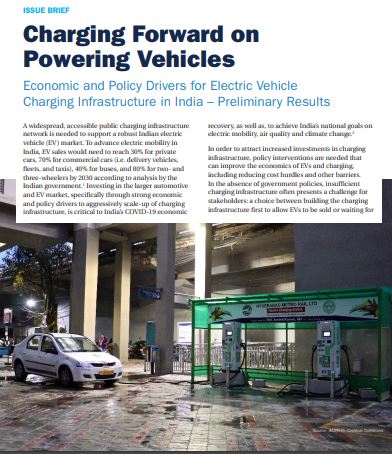
Charging forward on powering vehicles: economic and policy drivers for electric vehicle charging infrastructure in India – preliminary results
2020
Publisher/Organisation: Natural Resources Defense Council (NRDC)
In order to attract increased investments in charging infrastructure, policy interventions are needed that can improve the economics of EVs and charge, including reducing cost hurdles and other barriers. In the absence of government policies, insufficient charging infrastructure often presents a challenge for stakeholders. This factsheet presents recommendations on economic and policy drivers for scaling-up EV charging infrastructure to support a robust EV market in India for 2-wheelers, 3-wheelers, ride-hailing vehicles, and private buses. The preliminary results and findings presented in this factsheet are based on the model analysis of the Hyderabad EV ride-hailing taxi example. The analysis and policy recommendations from this example are indicative of the other vehicle segments. Since the analysis was conducted in 2019 and before the COVID-19 pandemic, some of the vehicle segment use cases have had reduced ridership, such as shared mobility and ride-hailing taxis.