

Research Papers/Articles

Green Transport: A Way Forward for Environmental Sustainability
2018
Author(s): Malik Y, Prakash N, Kapoor A
The Indian government has set an ambitious target for reducing the import of fossil fuels by 10% and introducing an all-electric car fleet by 2030. The Government of India launched the National Electric Mobility Mission Plan (NEMMP) 2020 in 2013 to promote Electric Vehicles (EVs) in India.

Incentivizing Smart Charging: Modeling Charging Tariffs for Electric Vehicles in German and French Electricity Markets
2018
Author(s): Ensslen A, Ringler P, Dörr L, Jochem P, Zimmermann F, Fichtner W
Over the past few years, registration figures of plug-in electric vehicles have increased rapidly in industrialized countries. This could cause considerable mid- to long-term effects on electricity markets. To tackle potential challenges specific to electric power systems, the authors develop a load-shift-incentivizing electricity tariff that is suitable for electric vehicle users and analyze the tariff scheme in three parts.

Beyond Road Vehicles: Survey of Zero-Emission Technology Options Across the Transport Sector
2018
Author(s): Hall D, Pavlenko N, Lutsey N
This working paper investigates recent research and ongoing projects to assess the potential of zero-emission technologies in aviation, maritime, off-road, and rail transport. The authors cover three broad technology types i.e. battery electric, plug-in hybrid, and hydrogen fuel cell.

Experiences From an E-Mobility Project in a Local Power Grid With Redox-Flow Energy Storage System. Project Report
2018
Author(s): Hommel S, Blumhagen C, Leonhardt S, Werler P, Bodach M, Zacharias L, Demmler F, Bilsing F
The project report presented would highlight the challenges and synergy impact of increasing electric mobility and renewable energy on the local power grid. In order to align local energy output and requirements, the implemented redox flow storage system was used.
Ensuring a Sustainable Supply of Raw Materials for Electric Vehicles : A Synthesis Paper on Raw Material Needs for Batteries and Fuel Cells
2018
Author(s): Agora Verkehrswende
This study examines the supply situation for raw materials required to make electric vehicle batteries and fuel cells and also incorporates the latest findings and data in this area, which have been used to calculate future raw material demand in two different scenarios.

Electric Vehicle Capitals: Accelerating the Global Transition to Electric Drive
2018
Author(s): Hall D, Cui H, Lutsey N
In this briefing, the authors highlight the continued growth in electric vehicle uptake in leading markets, focusing on the 25 metropolitan areas in the world with the highest cumulative passenger electric vehicle sales.

Effects of Battery Manufacturing on Electric Vehicle Life-Cycle Greenhouse Gas Emissions
2018
Author(s): Hall D, Lutsey N
As electric vehicles continue to become more affordable and their sales share continues to grow, it will be increasingly important to understand the life-cycle environmental impacts of the technology.
Two-stroke Autos in Bengaluru: Estimation and Status of Tailpipe Emissions
2018
Author(s): Thakur p, Pal S
Auto rickshaws play a crucial role in meeting the mobility requirements in Bengaluru city, and if switched to cleaner fuel technology-based solutions, these can contribute to the emission reduction within the city. This paper was developed by TERI and its objective is to estimate the vehicular emissions in the form of CO2, PM10, and NOx emitted by the auto-rickshaws plying in Bengaluru City.
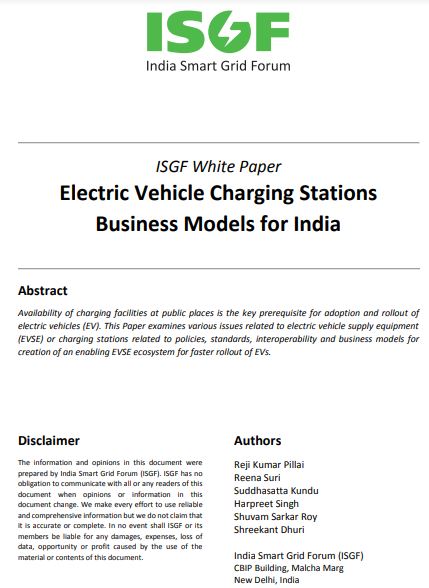
Electric Vehicle Charging Stations Business Models for India
2018
Author(s): Pillai RK, Suri R, Kundu S, Singh H, Roy SK, Dhuri S
This Paper examines various issues related to electric vehicle supply equipment (EVSE) or charging stations related to policies, standards, interoperability and business models for creation of an enabling EVSE ecosystem for faster rollout of EVs.
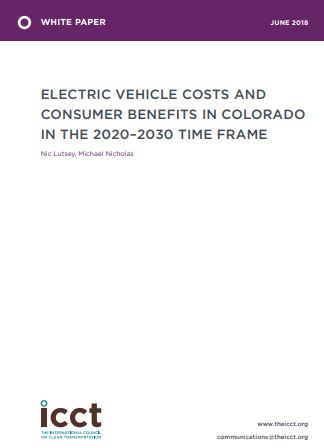
Electric Vehicle Costs and Consumer Benefits in Colorado in the 2020–2030 Time Frame
2018
Author(s): Lutsey N, Nicholas M
This study responds to two Zero-emission vehicle (ZEV) regulation questions: How quickly are electric vehicle costs declining and what are the resulting consumer benefits compared to gasoline vehicles? This paper analyzes these two questions in the context of Colorado’s potential adoption of a zero-emission vehicle regulation for new light-duty vehicles from 2023 through 2030.