



Knowledge Hub
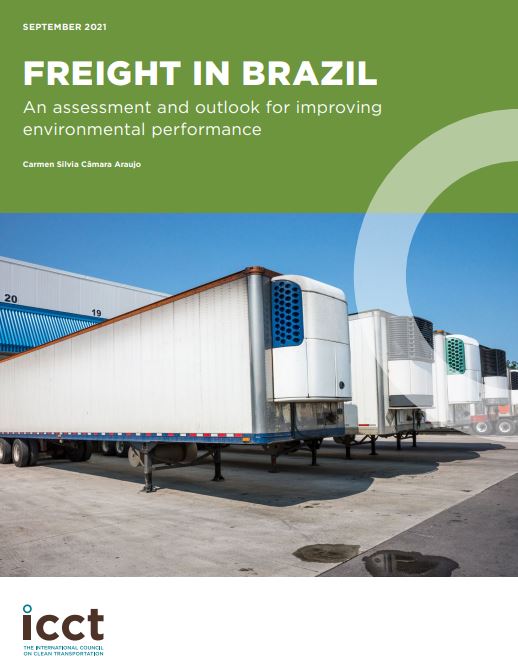
Freight in Brazil: An Assessment and Outlook for Improving Environmental Performance
2021
Author(s): Araujo Carmen Silvia C
This report is a non-exhaustive, exploratory survey of the truck market in Brazil. We considered the particularities of the road freight transportation system in an effort to evaluate possible obstacles and opportunities for the application of a green freight system similar to the EPA’s SmartWay and other initiatives related to energy efficiency and the reduction of emissions from transport.
RMI’s blog deep dives into how COP26 can pave the way for equitable mobility decarbonisation. The piece further highlights how world leaders should align target dates for an internal combustion engine (ICE) phase-out, build the infrastructure to make these targets achievable, ensure a just transition, and look beyond EVs.
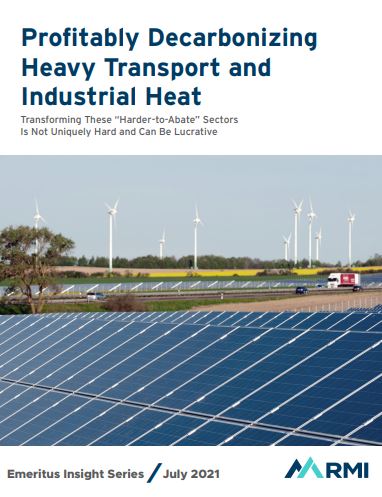
Profitably Decarbonizing Heavy Transport and Industrial Heat
2021
Author(s): Lovins Amory B.
As corporations and industries face rising public, policy, and market pressure to cut carbon emissions, the need for evidence-based solutions balancing carbon consciousness with profitability grows ever more intense.
Our Driving Habits Must be Part of the Climate Conversation
2021
Author(s): Yudkin B, Kay D, Marsh J, Tomchek J
RMI’s blog highlights how driving habits need to become a part of the climate conversations. The authors further highlight the importance on shifting the scales of convenience toward modes of transportation other than driving. This can simultaneously meet the demands of the climate crisis and improve quality of life.
Opportunities for Cleaner, More Efficient Freight Transport in India
2021
Author(s): Lakhina P, Shiledar S
In this blog, RMI authors highlight the opportunities for cleaner and more efficient freight transport in India. The recent Fast Tracking Freight report, coauthored by NITI Aayog and RMI, outlines opportunities for India to reduce the logistics costs to 10 percent of GDP, save 10 gigatons of CO2 emissions between 2020 and 2050, and reduce particulate matter and nitrogen oxide (NOx) emissions by 28 percent and 35 percent respectively over the same time frame.
Ridehailing Drivers Will Go Electric—If We Build the Charging Stations
2021
Author(s): Stone L
RMI’s blog highlights the need for building adequate charging infrastructure for ride-hailing drivers to adopt electric vehicles. The piece also proposes that electrifying ridesharing fleets, along with the right set of policies and programs can deliver enough charging demand to make it profitable to install this charging network.
In this blog, the author stresses on the need for building a robust EV charging infrastructure in the United States. In a recent report, EV Charging for All, RMI dives into the charging infrastructure needs for TNC (transportation network company) electrification, focusing on Los Angeles as a case study.

Design and Optimization of an Electric Vehicle Wireless Charging System Using Interleaved Boost Converter and Flat Solenoid Coupler
2021
Author(s): Yao Y, Gao S, Wang Y, Liu X, Zhang X, Xu D
This article proposes an EVWCS using interleaved boost converter (IBC) and flat solenoid coupler (FSC). The closed-loop control between the primary and secondary is realized by adjusting the duty cycle of the IBC.
Life-cycle Greenhouse Gas Emissions of Combustion Engine and Electric Passenger Cars and Two-wheelers in India
2021
Author(s): Bieker G
A recent ICCT study included a life-cycle assessment (LCA) of the GHG emissions of passenger cars in India. It also covered cars in China, Europe, and the United States and considered the most relevant power train types—internal combustion engine vehicles (ICEVs), including hybrid electric vehicles (HEVs); plug-in hybrid electric vehicles (PHEVs); battery electric vehicles (BEVs); and fuel cell electric vehicles (FCEVs).
Understanding the Air Quality and Health Impacts of Large-scale Vehicle Electrification in India
2021
Author(s): Sen A, Miller J, Bandivadekar A, Sharma M, Nagar Pavan K, Singh D
This is a companion to the working paper that estimated the vehicle tailpipe and power sector emissions impacts of large-scale vehicle electrification in India through 2040 under various scenarios representing plausible evolutions of the electricity grid.