



Knowledge Hub
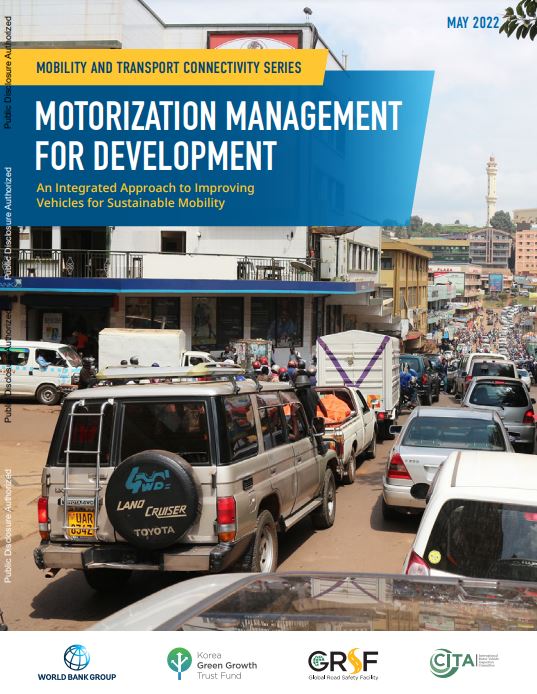
Motorization Management for Development: An Integrated Approach to Improving Vehicles for Sustainable Mobility
2022
Author(s): Roger G, Bose D, Cordeiro M, Darido G, Koupal J, Krishnan R, Neki K, Qiu Y
This report presents the World Bank’s Motorization Management (MM) framework, which is intended to support client countries in the development of policies and measures aimed at managing vehicle stocks in a proactive, phased, and systematic manner to make them safer, cleaner, and more fuel efficient. The MM framework reflects a series of policy considerations and programs that can be implemented to improve the quality of fuels and vehicles in a country’s stock.
A Review of the Life Cycle Carbon Footprint of Electric Vehicle Batteries
2022
Author(s): Li P, Xia X, Guo J
Facing increasingly severe climate change, countries and regions worldwide are actively promoting the electrification of the transportation sector and encouraging the use of electric vehicles (EVs) to replace traditional internal combustion engine vehicles (ICEVs).
Optimising the Geospatial Configuration of a Future Lithium Ion Battery Recycling Industry in the Transition to Electric Vehicles and a Circular Economy
2022
Author(s): Nguyen-Tien V, Dai Q, Harper GDJ, Anderson PA, Elliott RJR
This paper provides an economical, environmental, and geospatial analysis of a future LiB recycling industry in the UK. Hitherto, state-of-the-art assessment methods have evaluated life cycle impacts and costs but have not considered the geographical layer of the problem.
Sustainability Assessment of Electric Vehicles: Opportunities and Challenges
2022
Author(s): TERI and GIZ India
The webinar focused on the need for an integrated sustainability assessment of EVs incorporating environmental and socio-economic factors.
Which Type of Electric Vehicle Is Worth Promoting Mostly in the Context of Carbon Peaking and Carbon Neutrality? A Case Study for a Metropolis in China
2022
Author(s): Yu Y, Xu H, Cheng J, Wan F, Ju L, Liu Q, Liu J
In this study, the authors quantified and compared the GHG emissions of different powertrain vehicles in a life cycle perspective with a particular focus on energy and climate consequences for current and future integrated scenarios to facilitate carbon reduction assessment for Shanghai.

Life Cycle Assessment of Lithium Nickel Cobalt Manganese Oxide Batteries and Lithium Iron Phosphate Batteries for Electric Vehicles in China
2022
Author(s): Feng T, Guo W, Li Q, Meng Z, Liang W
In this paper, lithium nickel cobalt manganese oxide (NCM) and lithium iron phosphate (LFP) batteries, which are the most widely used in the Chinese electric vehicle market, are investigated, and the production, use, and recycling phases of power batteries are specifically analyzed based on life cycle assessment (LCA).
Life Cycle Assessment of Battery Electric Vehicles: Implications of Future Electricity Mix and Different Battery End-of-Life Management
2022
Author(s): Koroma MS, Costa D, Philippot M, Cardellini G, Hosen MS, Coosemans T, Messagie M
This study conducts a scenario-based Life Cycle Assessment (LCA) of three different scenarios combining four key parameters: future changes in the charging electricity mix, battery efficiency fade, battery refurbishment, and recycling for their collective importance on the life-cycle environmental performance of a BEV.
Environmental Impact Assessment of Second Life and Recycling for LiFePO4 Power Batteries in China
2022
Author(s): Wang Y, Tang B, Shen M, Wu Y, Qu S, Hu Y, Feng Y
To investigate the environmental benefits of end-of-life (EoL) stage for LFP batteries, two EoL management scenarios are considered in this study.

If Electric Cars Are Good for Reducing Emissions, They Could Be even Better with Electric Roads
2022
Author(s): Morfeldt J, Shoman W, Johansson DJA, Yeh S, Karlsson S
This research investigates carbon footprint impacts for full fleet electrification of Swedish passenger car travel in combination with different charging conditions, including an electric road system (ERS) that enables dynamic on-road charging.

Should India Move toward Vehicle Electrification? Assessing Life-Cycle Greenhouse Gas and Criteria Air Pollutant Emissions of Alternative and Conventional Fuel Vehicles in India
2022
Author(s): Peshin T, Sengupta S, Azevedo IML
The authors perform a state-specific life-cycle assessment of greenhouse gases (GHG) (CO2eq) and sulfur dioxide (SO2) emissions in India for representative passenger vehicles (two-wheelers, three-wheelers, four-wheelers, and buses) and technologies (internal combustion engine, battery electric, hybrid electric, and plug-in hybrid electric vehicles).