



Knowledge Hub
Life Cycle Assessment on Energy Efficiency of Hydrogen Fuel Cell Vehicle in China
2022
Author(s): Lu Q, Zhang B, Yang S, Peng Z
Based on the analysis and research achievements of domestic and foreign scholars regarding the vehicle life cycle assessment, in combination with the research data of relevant enterprises, the research has objectively assessed the well-to-wheel energy efficiency of hydrogen fuel cell vehicles and performed a comparative analysis with conventional gasoline vehicle, conventional diesel vehicle, natural gas vehicle, methanol vehicle and battery electric vehicle

Investigating Carbon Footprint and Carbon Reduction Potential Using a Cradle-to-Cradle LCA Approach on Lithium-Ion Batteries for Electric Vehicles in China
2022
Author(s): Chen Q, Lai X, Gu H, Tang X, Gao F, Han X, Zheng Y
This study investigates the carbon footprint of LIBs produced in China using a cradle-to-cradle life-cycle assessment approach.
Electric Vehicle Lithium-Ion Battery Recycled Content Standards for the US – Targets, Costs, and Environmental Impacts
2022
Author(s): Dunn J, Kendall A, Slattery M.
Lithium-ion battery recycling can decrease the life cycle environmental impacts of electric vehicles (EVs) and assist in securing domestic supply chains.
Vehicle Fleet Electrification and Its Effects on the Global Warming Potential of Highway Pavements in the United States
2022
Author(s): Barkh H, Yu A, Friend D, Shani P, Tu Q, Swei O
This study quantifies the impact of vehicle fleet changes on the global warming potential of asphalt concrete pavement systems across the United States via a comprehensive life cycle assessment model

Environmental Impact of the Second Life of an Automotive Battery: Reuse and Repurpose Based on Ageing Tests
2022
Author(s): Philippot M, Costa D, Hosen M.S, Senécat A, Brouwers E, Nanini-Maury E, Van Mierlo J, Messagie M
This study assesses a nickel manganese cobalt (NMC)–lithium titanate oxide (LTO) battery using the life cycle assessment (LCA) methodology, considering two scenarios for the second life of the battery: the reuse in an EV or its repurpose as stationary storage for energy generated from photovoltaic panels in a Belgian household.
Complete LCA of Battery Electric and Conventional Fuel Vehicles for Freight Trips
2022
Author(s): Middela MS, Mahesh S, Kancharla SR, Ramadurai G, Perme R, Sripada SK, Devi G
The authors estimate freight emissions in Chennai, India, using real-world emission factors obtained from onboard emission measurement systems and trip characteristics collected through an establishment survey.
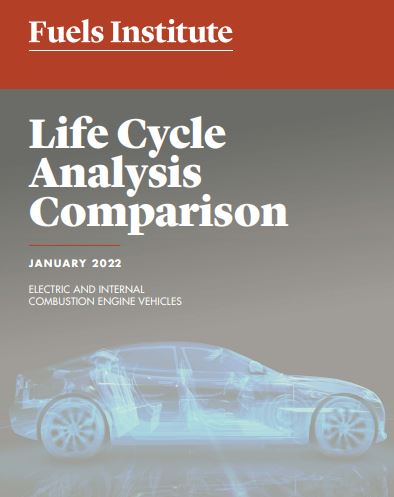
Life cycle analysis comparison: electric and internal combustion engine vehicle
2022
Author(s): Fuels Institute
Ricardo Strategic Consulting conducted a life cycle assessment study for the Fuels Institute to study the life cycle emissions and total cost of ownership of internal combustion engine (ICE) vehicles and electric vehicles. The study involved an extensive literature review of the research work in this field and a customized life cycle analysis (LCA) model development by Ricardo.
Global EV outlook 2022: securing supplies for an electric future
2022
Author(s): International Energy Agency
The increase in EV sales in 2021 was primarily led by the People’s Republic of China, which accounted for half of the growth. More vehicles were sold in China in 2021 (3.3 million) than in the entire world in 2020. Sales in Europe showed continued robust growth (up 65% to 2.3 million) after the 2020 boom, and they increased in the United States as well (to 630 000) after two years of decline.
Battery Waste Management Rules, 2022
2022
Publisher/Organisation: Government of India, Ministry of Environment, Forest and Climate Change
The Ministry of Environment, Forest and Climate Change, Government of India published the Battery Waste Management Rules, 2022 on 24th August, 2022 to ensure environmentally sound management of waste batteries. Notification of these rules is a transformative step towards implementation to promote Circular Economy in full earnest.
Electrification of Heavy-Duty Vehicles in Emerging Markets
2022
Author(s): Khan T, Yang Z
The objectives of this paper are to assess the status of zero-emission HDV deployment and policies in Emerging Markets and Developing Economies (EMDEs), evaluate the major policy levers for HDV electrification, and identify policy barriers and key recommendations for HDV electrification in the EMDEs.