



Knowledge Hub
E-Mobility: A New Era in Automotive Technology
2022
Author(s): M. Kathiresh, Kanagachidambaresan G R, Williamson S S.
This book presents the fundamental concepts of electrical and electronic systems used in automotive systems and discusses the various economic and environmental impacts of electric and hybrid electric vehicles
The Potential of 48v Hybrids in India’s Light-Duty Vehicle Market
2022
Author(s): Deo A, German J, Bandivadekar A
There is still no penalty imposed on manufacturers in India if CO2 emissions limits are exceeded. Based on the analysis presented in this report, the study suggests it would be effective to establish a penalty of ₹2,500/gCO2/km for passenger cars. This will allow the reality that some manufacturers that do not enjoy large economies of scale might have somewhat higher DMC costs, and a penalty of ₹2,500/gCO2/km would mean that using 48V hybrid technologies in vehicles will be cheaper than paying the fine.
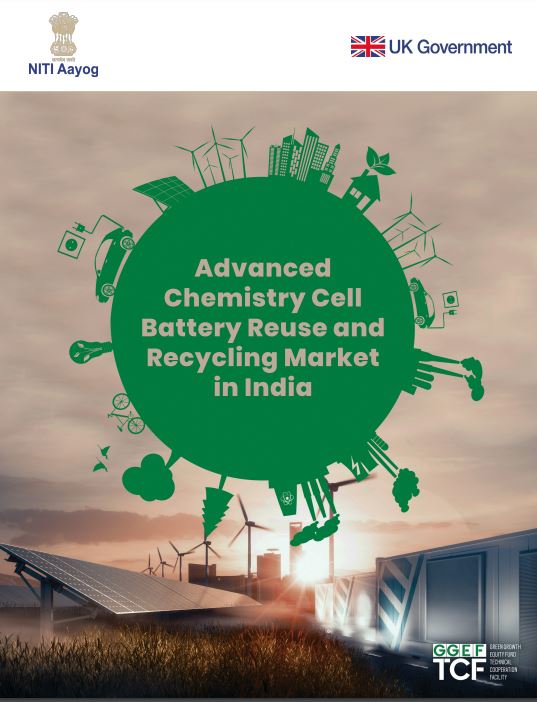
Advanced chemistry cell battery reuse and recycling market in India
2022
Author(s): Gattu A, Agrawal A, Chatterjee A, Mittal D, Khan M S, Bagdia R, Singh R, Khan S M, Singh V
Nations around the world are producing plans to achieve net zero by adopting disruptive low-emission and energy-efficient pathways to reduce dependence on fossil fuels. These pathways include electrification of the transport sector and having a higher share of renewable energy (RE) in the energy mix.
Electric Vehicle Charging Infrastructure and its Grid Integration in India: Status Quo, Critical Analysis and Way Forward
2022
Author(s): Rather Z, Nath A, Lekshmi D, Banerjee R
This study focuses on EV charging infrastructure, related policy and regulatory measures, grid integration of EVs, and the way forward for smooth EV adaption in the Indian EV ecosystem.

Electrifying Passenger Road Transport in India Requires Near-Term Electricity Grid Decarbonisation
2022
Author(s): Abdul-Manan AFN, Gordillo Zavaleta V, Agarwal AK, Kalghatgi G, Amer AA
In several non-Annex 1 nations, including India, battery-electric vehicles (BEV) have become the preferred technology solution to reduce transportation-related greenhouse gas (GHG) emissions.
Fuel Cell Drive for Urban Freight Transport in Comparison to Diesel and Battery Electric Drives: A Case Study of the Food Retailing Industry in Berlin+
2022
Author(s): Winkler JK, Grahle A, Syré AM, Martins-Turner K, Göhlich D
The option of decarbonizing urban freight transport using battery electric vehicles (BEVs) seems promising. However, there is currently a strong debate whether fuel cell electric vehicles (FCEV) might be the better solution.
Mid- and Long-Term Strategy Based on Electric Vehicle Charging Unpredictability and Ownership Estimation
2022
Author(s): Goh HH, Zong L, Zhang D, Liu H, Dai W, Lim CS, Kurniawan TA, Teo KTK, Goh KC
Predicting the charging load of electric vehicles (EVs) is critical for the safe and reliable operation of the distribution network. Analyzing an EV's random charging characteristics and the uncertainty associated with its development scale is vital to predict its charging load accurately.
Locating and Sizing Method of Electric Vehicle Charging Station Based on Improved Whale Optimization Algorithm
2022
Author(s): Cheng J, Xu J, Chen W, Song B
This research presents an Improved Whale Optimization Algorithm (IWOA) to solve the problem of poor accuracy and stability in optimizing the locating and sizing of nonconvex and nonlinear electric vehicle (EV) charging stations (CSs).
Photovoltaic–Electric Vehicles Participating in Bidding Model of Power Grid That Considers Carbon Emissions
2022
Author(s): Wen Y, Chen Y, Wang P, Rassol A, Xu S
The synergy of clean energy and electric vehicles (EVs) is highly relevant in achieving low-carbon development. To promote the coordinated development of EVs and photovoltaics (PV) under the background of open power selling, a PV–EV bidding model that considers carbon emissions based on the distributed storage and smart contract technology of a blockchain is proposed in this study.

Toward Supply Side Incentive: The Impact of Government Schemes on a Vehicle Manufacturer's Adoption of Electric Vehicles
2022
Author(s): Chen Z, Fan Z-P, Zhao X
Besides the consumer subsidy scheme, governments have recently implemented a hybrid scheme with an additional dual-credit scheme on the supply side. It is essential to understand the impact of this new practice on a vehicle manufacturer (VM) that provides gasoline vehicles (GVs) and/or electric vehicles (EVs) and the consumer and social welfare.