


Research Papers/Articles
 Is the Smallest in Europe SWOT Analysis of Opportunities and Threats.JPG)
Why Polish Market of Alternative Fuel Vehicles (AFVs) Is the Smallest in Europe? SWOT Analysis of Opportunities and Threats
2020
Author(s): Kowalska-Pyzalska A, Kott J, Kott M
A holistic approach regarding the Strengths, Weaknesses, Opportunities and Threats (SWOT) of the sector of AFVs in Poland, with particular regard to passenger electric vehicles (EVs), has been proposed to explore and evaluate the current state and to propose some future actions lines towards sustainable development in transportation.

Roadmap to an Adaptive Assembly Line for E-Axles
2020
Author(s): Abdul Hadi M, Brillinger M, Haas F, Weinzerl M
In this paper, the methodology of achieving this at low costs and the available technologies in the field of e-mobility production are described. The focus of this research lies in high adaptive and cognitive aspects in the assembly along with qualitative aspects.

The Need for Re-Strategising Climate Policies in the New-Normal Scenario
2020
Author(s): Sinha R, Ganeshan S
The authors take a brief look at the present status of India's climate commitments, the implications of these recovery packages in the post COVID-19 crises, and the road ahead for clean and green development. COVID 19 has created roadblocks with short term and long-term implications for the Indian economy, society and the world at large.

Life Cycle Assessment on the Mobility Service E-Scooter Sharing
2020
Author(s): Severengiz S, Finke S, Schelte N, Wendt N
As a new transportation option for towns, e-scooters are controversially debated. The rapid development of the e-scooter shared-use industry has raised concerns in many cities around the world about environmental sustainability and public benefits.

An Algorithm for the Ancillary Services Provision by E-Mobility-based Virtually Aggregated Mixed Units
2020
Author(s): Falabretti D, Gulotta F
The present paper deals with the provision of ancillary services to the power system through the scheduling of the charging requests of electric vehicles. The scheduling process is based on a hybridization of the Artificial Bee Colony algorithm (h-ABC).

Is E-Mobility a Panacea for Emission Mitigation? A Case Study of an Indian City
2020
Author(s): De K, Majumder S, Kumar P
Catering to the growing demand for urban mobility and emphasis on reducing air pollution in towns and cities are mutually conflicting objectives. One solution is a paradigm shift of the transportation policies from personal vehicles to public transportation system using electric buses.
Development of Ultra-Low-Friction and Zero-Leakage Mechanical Seal for High-Speed e-Mobility Shaft Sealing Applications
2020
Author(s): Tokunaga Y, Nakahara N, Itadani M
By the year 2020, EU legislation limits CO2 emissions for new passenger cars to a maximum of 95 g/km, and further reductions to 68 g/km are expected. An electric motor (e-motor) with high power density often requires shaft cooling in combination with increased rotational speeds to boost efficiency.
Economic Effects of an E-Mobility Scenario–Input Structure and Energy Consumption
2020
Author(s): Ulrich P, Lehr U
The development of a strong domestic market for E-mobility is given a high priority and it is counted as an impulse for the transformation towards a Green Economy in Germany. Replacing the combustion engine by alternative drives can trigger a variety of macroeconomic effects.
Energy Demand Assessment for Long Term Operation of Vehicles
2020
Author(s): Sitnik LJ
The work is about energy demand assessment for long term operation of vehicles in everyday conditions, with mileage measured in thousands of kilometers over a period of several years. The work concern mainly battery electric vehicles (BEVs).
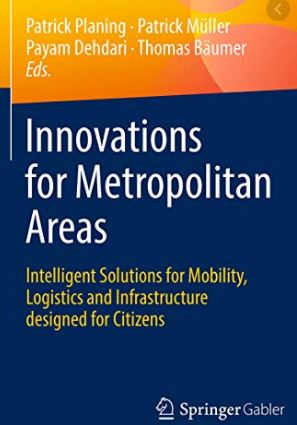
Electrified Ultralight Vehicles as a Key Element for Door-to-Door Solutions in Urban Areas
2020
Author(s): Köhler S, Norkauer A, Schmidt M, Loidl V
Finding sustainable and adaptive urban transportation solutions has the ability to shape the quality of life in cities. However, one major challenge involves reducing motorised private transportation in urban areas, which is largely responsible for noise and air pollution as well as increasingly long waiting times in congestion.