



Knowledge Hub
Assessment of leading new energy vehicle city markets in China and policy lessons
2022
Author(s): Chu Y, He H, Jin L, Wang X, Zhang J, Hao F, Li Y
Using data covering the period from 2015 to 2020, this report explores the successful experiences from leading NEV cities in China and is intended as a guide for other similar cities, both within China and around the world.
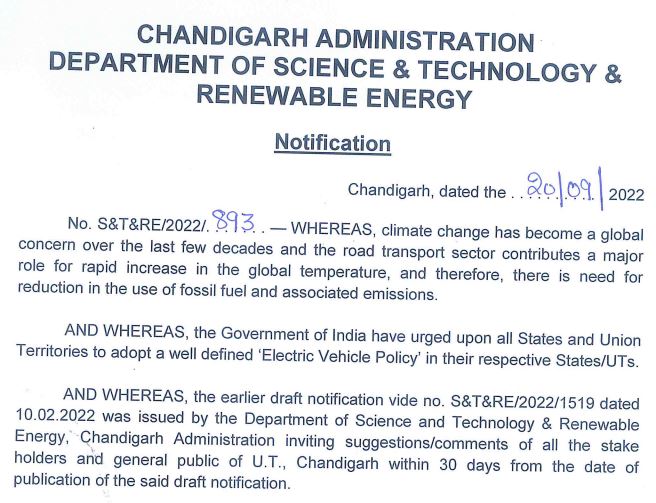
Chandigarh electric vehicle policy 2022
2022
Publisher/Organisation: Chandigarh Administration, Department of Science & Technology & Renewable Energy
The policy is framed with the mission to provide an enabling framework through incentives and initiatives for promoting zero emission mobility with societal, economic and environmental considerations at forefront.

Route Planning for Electric Vehicles
2022
Author(s): Ben Abbes S, Rejeb L, Baati L
This work addresses the multi-objective route planning and charging problem for Battery Electric Vehicles (BEVs).
Identifying Households With Electrical Vehicle for Demand Response Participation
2022
Author(s): Nandkeolyar S, Ray PK
A Hidden Markov Model (HMM) based approach similar to Machine Learning has been proposed in this paper for identifying houses with EVs.

A Battery Centralized Scheduling Strategy for Battery Swapping of Electric Vehicles
2022
Author(s): Li C, Wang N, Li W, Yi Q, Qi D
This paper presents a battery centralized scheduling strategy (BCSS) in the battery swap scenario, significantly reducing BPC and battery charging peak load (BCPL).
Paving the Way to an EV Future: Policy Recommendations for Accelerated Charging Infrastructure Development
2022
Author(s): Agora Verkehrswende
The study investigated the question of which funding and financing instruments the German government can already use to set priorities in order to support the expansion of publicly accessible charging infrastructure as quickly and comprehensively as possible. The results show that the greatest potential comes from promoting fast and high-performance charging, for example at retail locations.
A Novel Electric Vehicle Charging Chain Design Based on Blockchain Technology
2022
Author(s): Wang J
In recent years, China has actively promoted the development of new energy vehicles and achieved good results in reducing petroleum energy consumption and environmental pollution. Car ownership has surged year after year.
Electric Vehicle Charging Scheduling Considering Urgent Demand Under Different Charging Modes
2022
Author(s): Liu L, Zhou K
This study proposes a multi-objective electric vehicle (EV) charging scheduling model, aiming at minimizing both the peak-valley load difference of the power grid and the total charging cost of EV users.
Electric Vehicle User Classification and Value Discovery Based on Charging Big Data
2022
Author(s): Hu D, Zhou K, Li F, Ma D
This study proposes an integrated approach incorporating an extended RFM model, a two-stage clustering method, and the Entropy Weight Method to classify EV users. Analysis results demonstrate that 7426 EV users are divided into six groups, namely “high-value users,” “key users to maintain,” “key users to develop,” “potential users,” “new users,” and “lost users”.

Economic Feasibility of Electric Vehicles: A Case Study
2022
Author(s): Cheok Q, Husaini NH, Nauman MM
As electric vehicles are presently very rare in Brunei, this article seeks to determine the total cost of ownership of internationally popular electric vehicles (EVs) and internal combustion engine vehicles (ICEVs) to put things in perspective for the Brunei market.