
Reports
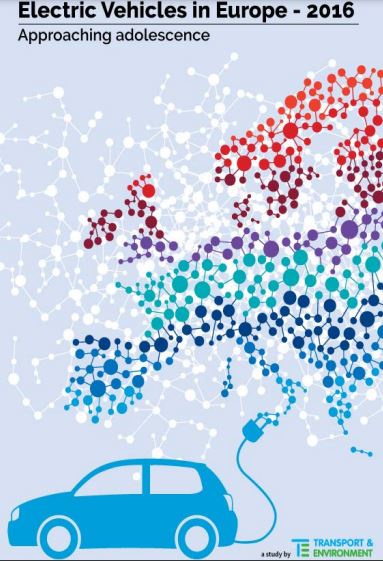
Electric vehicles in Europe- 2016: approaching adolescence
2016
Author(s): Transport & Environment
Electromobility including electric trains and trams provides the opportunity for a clean, green mobility future that assigns dirty diesel cars and trains that choke cities and commuters to the dustbin of obsolescence. The outstanding question is not if, but how quickly the disruption occurs and to what extent Europe captures the economic opportunities from this shift. Electric vehicles are in their adolescents, and about to be highly disruptive. Through constructive policy interventions at an EU, national and local level the technology and market can quickly mature and mobility become quieter, cleaner and its contribution to climate change drastically reduced.
The Bhutan electric vehicle initiative: scenarios, implications, and economic impact
2016
Author(s): Zhu D, Patella DP, Steinmetz R, Peamsilpakulchorn P
This report aims to help Bhutan think through various technical and policy issues of introducing electric vehicles in its own context. It analyses a variety of factors that will impact adoption of electric vehicles from technical, market and financial feasibility to consumer awareness and stakeholders’ capacity. It also addresses several policy questions which are at the heart of public debate such as affordability of the government to undertake the program, economic costs and benefits, distributional impact, fiscal, and macroeconomic implications.
Global EV outlook 2016: beyond one million electric cars
2016
Author(s): International Energy Agency
This report aims to provide an update on recent EV developments, providing detailed information on the recent evolution of EV registrations (vehicle sales), the number of EVs on the road, their modal coverage across the most relevant global vehicle markets. The analysis also looks at the availability and characteristics of Electric Vehicle Supply Equipment (EVSE), reporting on the evolution of deployment rates. The report includes a review and a discussion of key elements on policy support, both for EVs and EVSE.

Quick Wins on Transport, Sustainable Development and Climate Change
2016
Author(s): Peet K, Huizenga C, Gota S, Major M
The recent adoption of the 2030 Sustainable Development Goals (SDGs) and the signing of the Paris Agreement on climate change have set clearer long-term goals for transport sector.

De-carbonization of Indian Railways: Project plan (Phase I)
2016
Author(s): Ray S, Bandyopadhyay K
This report estimates the growth in passenger and freight demand in 2030-31, in three scenarios of GDP growth: optimistic, realistic and pessimistic. A four-step calculation was used to estimate energy required for passenger and freight transport.
World energy perspectives on e-mobility: closing the emissions gap
2016
Author(s): World Energy Council
This report examines to what extent electric vehicles (EV) − battery electric vehicles (BEV) and plug-in hybrid electric vehicles (PHEV) − are the latest technologies to increase average fuel efficiency in the bid to close the emissions gap and meet stringent fuel economy standards. This new frontier represents a significant opportunity for the energy sector.

ZeEUS eBus Report: An Overview of Electric Buses in Europe
2016
Author(s): UITP, The International Association of Public Transport
The ZeEUS e-bus report provides a comprehensive overview of the European market for electric buses.The ZeEUS project focuses on: Plug-in hybrid buses (PHEV), Full battery electric buses (BEV), and Battery trolley buses also referred to as dual-mode trolley buses.

Sustainable Transport’s role in Tackling Poverty and Inequity
2016
Author(s): SLOCAT Partnership
Sustainable transport is an important enabler of poverty alleviation and reducing inequality if done right. The i-STEP program was initiated to safeguard that growing support for sustainable transport in global processes and sustainable development. It fully acknowledges the importance of urban and rural transport in the alleviation of poverty, as well as the promotion of inclusive development and equality.

The East African Community (EAC) is the second largest single regional market in Africa and economically one of the fastest growing regions in sub-Saharan Africa.

This report investigates one particular scenario, ‘the large-scale deployment of shared vehicle fleets that provide on-demand transport. A different configuration where shared mobility is delivered by a fleet of six-seat vehicles (“Shared Taxis”) that offer on-demand, door-to-door shared rides in conjunction with a fleet of eight-person and 16-person mini-buses (“Taxi-Buses”) that serve pop-up stops on demand and provide transfer-free rides is examined here.