
Policies/Regulations
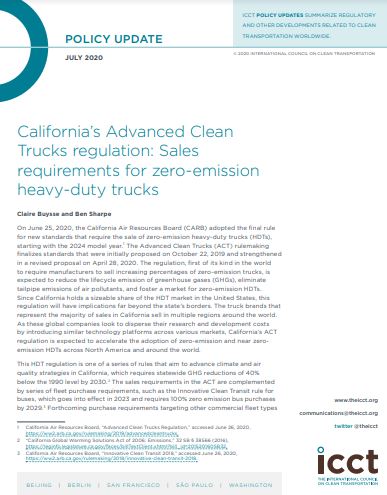
California’s Advanced Clean Trucks regulation: Sales requirements for zero-emission heavy-duty trucks
2020
Publisher/Organisation: International Council on Clean Transportation (ICCT)
On June 25, 2020, the California Air Resources Board (CARB) adopted the final rule for new standards that require the sale of zero-emission heavy-duty trucks (HDTs). The Advanced Clean Trucks (ACT) rulemaking finalizes standards that were initially proposed on October 22, 2019, and strengthened in a revised proposal on April 28, 2020. The regulation requires manufacturers to sell increasing percentages of zero-emission trucks, is expected to reduce the lifecycle emission of greenhouse gases (GHGs), eliminate tailpipe emissions of air pollutants, and foster a market for zero-emission HDTs. This HDT regulation is one of a series of rules that aim to advance climate and air quality strategies in California, which requires state-wide GHG reductions of 40% below the 1990 level by 2030. The sales requirements in the ACT are complemented by series of fleet purchase requirements, such as the Innovative Clean Transit rule for buses, which goes into effect in 2023 and requires 100% zero-emission bus purchases by 2029. This policy update summarizes key elements of the ACT rule and provides a regulatory context in California, the United States, and other major vehicle markets.

Hydrogen Fuel Cell, Notification
2020
Publisher/Organisation: Ministry of Road Transport & Highways, Government of India
The Central Government made certain rules further to amend the Central Motor Vehicles Rules, 1989 for insertion of the "Requirements for the motor vehicles running on compressed gaseous hydrogen fuel cell" specifying the rules for hydrogen fuel.

China announced 2020–2022 subsidies for new energy vehicles
2020
Publisher/Organisation: International Council on Clean Transportation (ICCT)
The Notice is the 2020 annual adjustment to China’s decade-long national subsidy program for NEVs. The Notice basically follows the overall design of the policy described in the previous policy update published in June 2019, but there are five major changes: Subsidies are extended for two years, from the end of 2020 to the end of 2022 The technical criteria for qualification are tightened The subsidy size is phased-down For the first time, vehicle price and sales limits are introduced Subsidies for FCVs are replaced by dedicated promotion packages This policy update describes a special provision regarding how the 2019 and 2020 policies connect during the transition period.
Electrification of on-demand mobility in Delhi: identifying strategic locations for public EV charging stations - summary for policymakers
2020
Publisher/Organisation: UCLA (University of California, Los Angeles) & Ola Mobility Institute
Complementing the national, state and city level decarbonisation efforts taken by the government, public and private sectors, this policy brief endeavours to address the most critical operational issue of the availability of a robust EV charging infrastructure needed for electrification of on-demand mobility services, potential costs and savings in cities. This study identifies strategic locations for the installation of EV charging stations in Delhi, through scientific modelling and a data-driven approach, that is required to meet the same ride-sharing demand with a fully electric fleet. The framework developed in the study can be applied to other cities. By strategically locating charging stations along high-demand corridors within a city, the government can also ensure high utilization of the charging stations. Overall, through the adoption of e-mobility, a city can witness a reduction in air pollution and greenhouse gas emissions while reducing costs and increasing pay-offs for both drivers and transport network companies. The study also focuses on the fact that e-mobility reduces reliance on import-dependent fossil fuels at the national level, making the country energy secure.
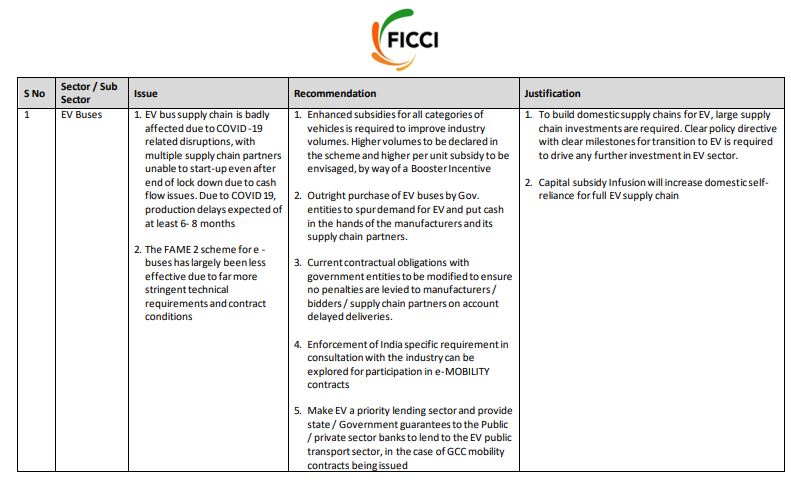
Post COVID Support Required to Electric Vehicles: FICCI Recommendations to Government
2020
Publisher/Organisation: Federation of Indian Chambers of Commerce & Industry (FICCI)
As demand and investments in the Electric Vehicles (EVs) sector are severely hit due to disruptions caused by COVID-19, FICCI has suggested to the Government, a series of measures to ensure continuity of the EV growth roadmap and achievement of the targets as envisioned by the Government for the sector in the next decade. These suggestions have been submitted to NITI Aayog, Department of Heavy Industry, Ministry of Road Transport and Highways and other relevant authorities in the Government.
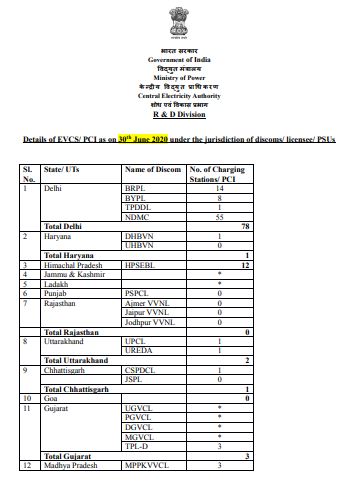
Details of EVCS/ PCI as on 30th June 2020 under the jurisdiction of discoms/ licensee/ PSUs
2020
Publisher/Organisation: Central Electricity Authority (CEA)
The Research and development division of the Central Electricity Authority (CEA) under Ministry of Power, Government of India released a list of electric vehicle charging stations/ public charging infrastructure (EVCS/ PCI) that lie under the jurisdiction of discoms/ licensee/ PSUs.
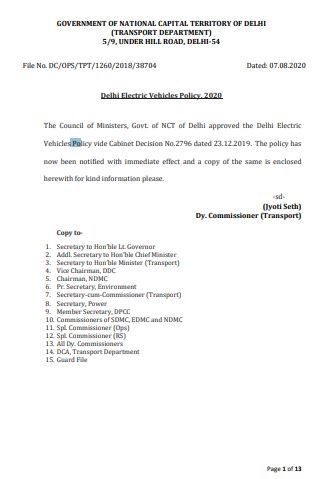
Delhi Electric Vehicles Policy 2020
2020
Publisher/Organisation: Transport Department, Government of NCT of Delhi
The Council of Ministers, Government of National Capital Territory of Delhi (in short “GNCTD”), approved the Delhi Electric Vehicles Policy vide Cabinet Decision No. 2796 dated 23-12-2019 on 07-08-2020.

Rajasthan Electricity Regulatory Commission Jaipur
2020
Publisher/Organisation: Rajasthan Electricity Regulatory Commission
The Government of India launched the National Electric Mobility Mission Plan (NEMMP), 2020 to enhance national fuel security and provide affordable and environment-friendly transportation in the Country.

China’s Vehicle Emissions Inspection and Maintenance Program
2020
Publisher/Organisation: International Council on Clean Transportation (ICCT)
China took a big step toward further reducing in-use vehicle emissions when it released a final notice of the establishment and implementation of a vehicle emissions inspection and maintenance (I/M) program in June 2020.

Solar Energy- Based Electric Vehicle Charging
2020
Publisher/Organisation: Center for Study of Science, Technology and Policy (CSTEP)
The use of energy from a rooftop photovoltaic (RTPV) system for charging electric vehicles (EV) is environmentally advantageous and forms a true approach towards green mobility. Further, if solar energy is generated in close proximity to the EV charging points, it results in lower transmission losses and helps mitigate detrimental effects of sudden rise in EV demand on the grid.