



Knowledge Hub
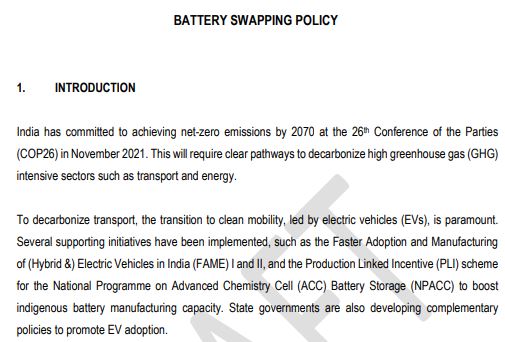
Some of the key objectives of the policy are to promote swapping of batteries with Advanced Chemistry Cell (ACC) batteries to decouple battery costs from the upfront costs of purchasing EVs, thereby driving EV adoption. Offer flexibility to EV users by promoting the development of battery swapping as an alternative to charging facilities. Establish principles behind technical standards that would enable the interoperability of components within a battery swapping ecosystem, without hindering market-led innovation etc.

Battery Energy focuses on interdisciplinary research in advanced energy materials, with an emphasis on batteries and their empowerment processes.
Shoonya is an initiative brought to you by leading private companies, NITI Aayog and RMI, which aims to improve air quality in India by electrifying vehicles for final-mile deliveries and ride-hailing services.

Connecting Battery Technologies for Electric Vehicles from Battery Materials to Management
2022
Author(s): Zhao G, Wang X, Negnevitsky M
This paper presented comprehensive discussions and insightful evaluations of conventional electric vehicle (EV) batteries (such as lead-acid, nickel-based, lithium-ion batteries, etc.) and the state-of-the-art battery technologies (such as all-solid-state, silicon-based, lithium-sulphur, metal-air batteries, etc.).
Powering Up: Understanding Traction Batteries: Technology and Standards
2022
Author(s): Bej S, Bhagyasree
Rapid improvements in battery technologies are crucial in achieving the required pace of transition to cleaner mobility. The high energy density, specific energy, and cycle life of the LiBs make these batteries outperform other available battery chemistries.

Benefits of the 2020 Multi-State Medium- and Heavy-Duty Zero-Emission Vehicle Memorandum of Understanding
2022
Author(s): Sen A, Minjares R, Miller J, Braun C
This paper estimates the multiple benefits of achieving the zero-emission medium- and heavy-duty sales targets of the Multi-state Memorandum of Understanding in select states. Without new policies, this study finds that the baseline reduction in well-to-wheel CO2 emissions of the medium- and heavy-duty fleet in these states are on a path to decline 8% below 2020 levels by 2030 and 23% below 2020 levels by 2050. NOx emissions are projected to decline through the late 2030s as the oldest generation of ICE vehicles are replaced with newer vehicles manufactured to comply with U.S. 2010 and Tier 3 emission standards.
Too Much or Not Enough?
2022
Author(s): Metais MO, Jouini O, Perez Y, Berrada J, Suomalainen E
While the transportation sector is responsible for a growing share of greenhouse gas emissions, electric vehicles (EVs) offer solutions for greener mobility. The proportion of electric vehicles in transportation fleets is increasing, but wider adoption will not be possible without an appropriate charging infrastructure.
Draft Andaman and Nicobar Islands Electric Vehicle Policy 2022
2022
Publisher/Organisation: Andaman & Nicobar Administration, Directorate of Transport
The primary objective of the A&N Islands EV Policy 2022 is to accelerate adoption of EVs for improvement in the air quality such that they contribute to 30% of the new registrations by 31st December, 2026.

Greening Polish Transportation? Untangling the Nexus Between Electric Mobility and a Carbon-based regime
2022
Author(s): Lisa A, Szymanowski R
This paper examines the multilayered process of electric mobility development in Poland with its failures and successes, which does not necessarily translate into a sustainable transition of Poland’s transportation system.
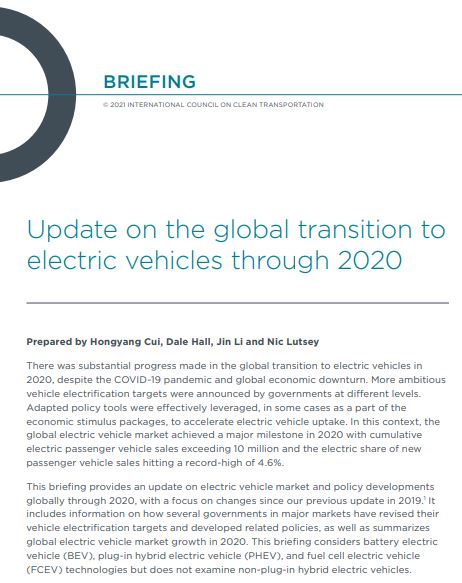
Update on the global transition to electric vehicles through 2020
2022
Author(s): Cui H, Hall D, Li J, Lutsey N
This briefing provides an update on electric vehicle market and policy developments globally through 2020, with a focus on changes since our previous update in 2019. It includes information on how several governments in major markets have revised their vehicle electrification targets and developed related policies, as well as summarizes global electric vehicle market growth in 2020. This briefing considers battery electric vehicle (BEV), plug-in hybrid electric vehicle (PHEV), and fuel cell electric vehicle (FCEV) technologies but does not examine non-plug-in hybrid electric vehicles.