
Reports

Cooling on the move: the future of air conditioning in vehicles
2019
Author(s): International Energy Agency
This report explores the current global energy consumption from mobile air conditioning systems, along with the resulting greenhouse gas emissions from the energy consumption and the leaking refrigerants. With no further policy action, energy use from mobile air conditioning may almost triple to over 5.7 million barrels of oil equivalent per day by 2050. At the same time, annual combined emissions from energy consumption and refrigerant leakage could more than triple to 1 300 million tons of CO2 equivalent.

Baseline Report On Sustainable Local Mobility in Amalgamated Hromadas of Ukraine
2019
Author(s): Zagreba V
This report is based on the inception phase results of the “Support and Development of Sustainable Mobility Services in Amalgamated Hromadas” Project implemented by Deutsche Gesellschaft für Internationale Zusammenarbeit (GIZ) GmbH(Germany) Sustainable Mobility Cluster involving Ukrainian experts as part of the U-LEAD with Europe Programme.

This report is the culmination of a three-year study to examine how the complex interactions between advanced drivetrain options, alternative fuels, refueling infrastructure, consumer choice, vehicle automation, and government policy may shape the future for personal mobility.

India has a lot to gain by converting its ICE vehicles to EVs at the earliest. Its oil-import bill would considerably reduce. ICE vehicles are a major contributor to pollution in cities and their replacement with EVs will definitely improve air quality.

Efficiency in Public Transit and the Mitigation Potential and the Transport Sector
2018
Author(s): Mettke C, Mariano P, Cruz M
This presentation was developed in the context of the TRANSfer project component in the Philippines which aims at modernizing the public transport sector and local Jeepneys.

Transport, Climate Action and Sustainable Development
2018
Author(s): SLOCAT Partnership, IsDB Technical Partner on Sustainable Transport
This report, the result of the second phase of IsDB and SLoCaT collaboration, emphasises that a successful implementation of sustainable transport measures in the context of the Paris Agreement and the 2030 Agenda must involve concerted and coordinated efforts to more closely link the processes of developing, implementing and tracking progress toward Nationally-Determined Contributions (NDCs) and Voluntary National Reviews (VNRs)

By any measure, India’s electric vehicle (EV) aspirations are steep from where we stand today. As a market, India sells only a fraction of EVs annually as the aggregate two- and four-wheeler sales daily.

Electric Mobility Paradigm Shift
2018
Author(s): TERI Team (Bhavnani C, Shekhar H, Sharma A), YES BANK
Electric mobility landscape in India is currently at a nascent stage, with significant constraints to be overcome. India require nearly eight times the existing global stock of EVs.
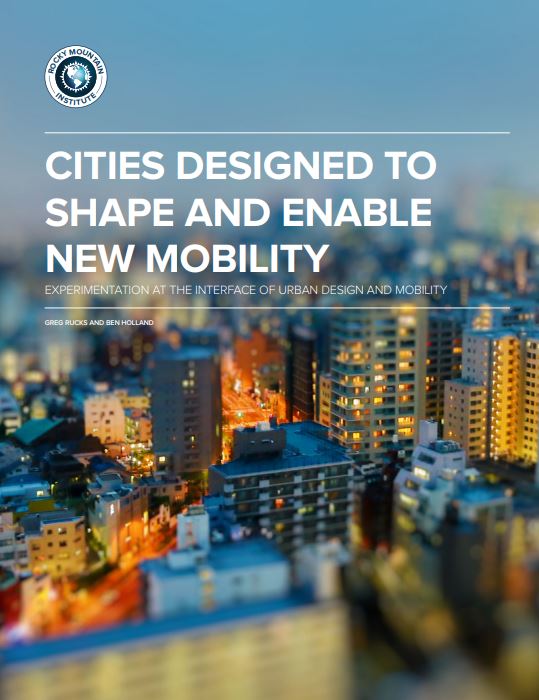
With support from the Robert Wood Johnson Foundation, RMI is exploring and testing industry interest in a concept we’re calling MOD Cities, where “MOD” is short for “modular” and “modifiable” and also stands for “mobility-oriented development.”
With support from the Robert Wood Johnson Foundation, RMI’s Mobility-Oriented Development team has been experimenting at the interface of personal mobility and urban design to develop a practical and scalable approach to reducing emissions, enhancing health, and improving equity in cities.