



Knowledge Hub
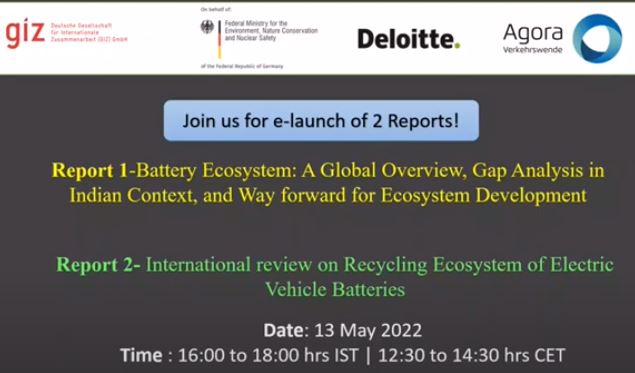
E-Launch of Reports on Battery Ecosystems & Battery Recycling Ecosystems
2022
Author(s): Deutsche Gesellschaft für Internationale Zusammenarbeit (GIZ) GmbH, Deloitte Touche Tohmatsu India LLP and Agora Verkehrswende!
At the e-launch event, GIZ India released two reports developed under the NDC-TIA India component. The reports focuses on battery ecosystem and battery recycling.

Walking on Sunshine: Pairing Electric Vehicles with Solar Energy for Sustainable Informal Public Transport in Uganda
2022
Author(s): Booysen MJ, Abraham CJ, Rix AJ, Ndibatya I
This paper examines the impact of this inevitable evolution on a city-wide scale in Kampala, Uganda. The authors present a generic simulation environment to assess the grid impact and charging opportunities, given the unique paratransit mobility patterns.
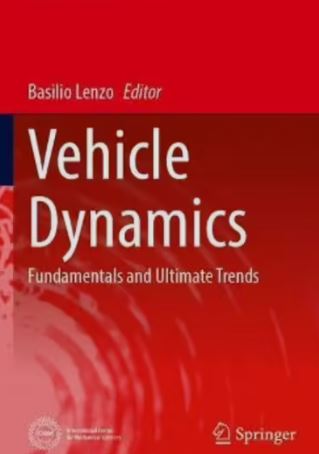
This book examines the fundamentals of vehicle dynamics, as well as the recent trends in the field, such as torque vectoring control, vehicle state estimation, and autonomous vehicles.
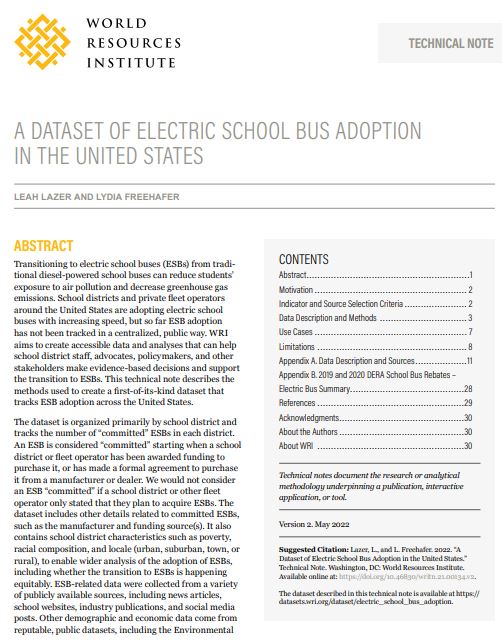
A dataset of electric school bus adoption in the United States
2022
Author(s): Lazer L, Freehafer L
This technical note describes the methods used to create a dataset that tracks electric school bus (ESB) adoption across the United States. The dataset tracks the number of “committed” ESBs at the school district level, as well as details about individual buses, including bus manufacturer and funding source(s). It also contains school district socio-economic characteristics like poverty rates and racial composition, to enable wider analysis including whether the transition to ESBs is happening equitably.

Energy Management System for Vehicle to Vehicle Power Transfer With Single Stage on Board Power Converter for Plug in Hybrid and Electric Vehicles
2022
Author(s): Parag JC
Adoption of an aggregator regulated Micro Grid charging station (MGCS) would provide energy to acceptor GEV clients from donor GEV clients through Vehicle to Vehicle (V2V) power transfer. The MGCS would also be supported by a photovoltaic system and an auxiliary battery bank. This research work focuses on the utilization of GEVs’ in supporting the MGCS through the regulation of an on-board Intelligent Energy Management System (IEMS).
How Governments Support Clean Energy Start-ups: Insights from Selected Approaches Around the World
2022
Author(s): International Energy Agency
This report presents a range of impressive policy measures from a variety of different country contexts, and identifies eight key insights for effective policy to support clean energy start-ups based on 14 detailed case studies and in-depth interviews.
Public Charging Infrastructure and Electric Vehicles in Norway
2022
Author(s): Schulz F, Rode J
This analysis is based on granular, annual information on the location of public charging infrastructure and the battery-electric vehicle ownership rate across 356 Norwegian LAU-2 municipalities between 2009 and 2019.

This presentation is intended to be a general primer on electric vehicles while some of the content in the slide deck is tailored to Bangladesh specifically.
Expert Elicitation on Paths to Advance Fuel Cell Electric Vehicles
2022
Author(s): Whiston MM, Azevedo IML, Litster S, Samaras C, Whitefoot KS, Whitacre JF
While fuel cell electric vehicles (FCEVs) fueled by hydrogen produced using low-carbon processes could considerably reduce carbon emissions from transportation, FCEVs are produced at low volume, are expensive to manufacture, and lack widespread refueling infrastructure.
Contribution of China’s Online Car-hailing Services to its 2050 Carbon Target: Energy Consumption Assessment Based on the GCAM-SE Model
2022
Author(s): Wu T, Wang S, Wang L, Tang X
This paper estimates the extent to which online car-hailing services will affect China's energy consumption and carbon emissions under several scenarios.