


Reports
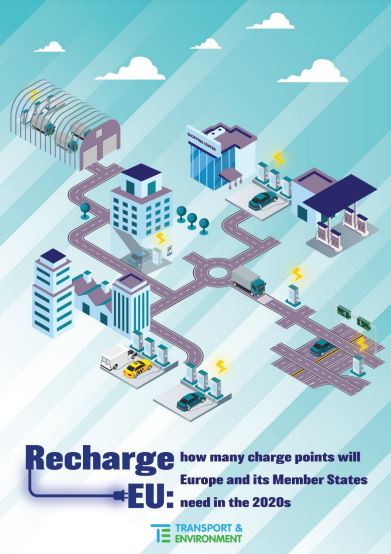
Recharge EU: how many charge points will Europe and its Member States need in the 2020s
2020
Author(s): Transport & Environment
This report outlines Transport & Environment's charging masterplan for Europe, including both the numbers of public chargers needed and the funding mechanisms to nudge the market in the right direction. A new EU policy framework for alternative fuels infrastructure (AFID) and the funding mechanisms currently discussed in the European Green Deal are the two cornerstones to deliver an ambitious EU recharging infrastructure masterplan.

Putting Electric Logistics Vehicles to Work in Shenzhen
2020
Author(s): Liu Q, McLane R, Mullaney D, Wang Z
In this report, that is part of a series, RMI provides a reference point and a goal post for governments looking to reduce the health and climate impacts of freight transport in their communities.
Envisioning 5G-enabled transport
2020
Author(s): Monserrat J F, Diehl A, Lamas C B, Sultan S
5G features will have an impact in the transport sector, contributing to transport-specific applications. When applying these new technologies to transport, changes can be expected across the sector, to some extent. While impossible to foresee all potential applications, the study predicts three likely and significant changes: (1) the rise of connected and autonomous vehicles, (2) increasingly smart and efficient logistics, and (3) improved urban transportation with the implementation of MaaS platforms.

Shifting gears: the evolving electric vehicle (EV) landscape in India
2020
Author(s): KPMG Assurance and Consulting Services LLP
The report provides an understanding of segment wise propensity to transition to EVs by analyzing use cases and Total Cost of Ownership, and estimates the EV penetration by 2025 and 2030. It evaluates the policy framework and the readiness of the enabling ecosystem for EVs i.e. charging infrastructure, ownership models, localization of production, financing, and recycling.

The Electric Vehicle Outlook is BloombergNEF’s annual long-term forecast of how electrification, shared mobility and autonomous driving will impact road transport from now out to 2040.

Forging ahead: a materials roadmap for the zero-carbon car
2020
Author(s): World Economic Forum, McKinsey & Company
The systems-wide change needed to create circularity in the automotive sector sometimes seem costly and prohibitive. However, as this report demonstrates, significant abatement is possible for the...
Used vehicles and the environment: a global overview of used light duty vehicles - flow, scale and regulation
2020
Author(s): United Nations Environment Programme
The study shows that the global fleet of light duty vehicles (LDVs) is set to at least double by 2050. Some 90 per cent of this growth will take place in non-OECD countries which import a large number of used vehicles. Despite the critical role they play in road accidents, air pollution, and efforts to mitigate climate change there are currently no regional or global agreements on the trade and flow in used vehicles.

From No Mobility to Future Mobility: Where COVID-19 has Accelerated Change
2020
Author(s): McKinsey & Company
The novel coronavirus has forced many businesses, including those in the mobility sector, to cease or slow down operations. It has also accelerated many existing mobility trends, including those related to customer preferences and regulation.

Transport and Voluntary National Reviews 2020
2020
Author(s): Yiu A, Cardama M, Dekki C, Ghai S, Hosek E
In 2020, unprecedented challenges emerged which are causing significant setbacks to the achievement of the SDGs in the transport sector. The COVID-19 pandemic is sending a shock wave through societies worldwide and is permanently changing livelihoods as. At the same time, the pandemic has pushed us to reflect on how we move people and goods, as well as what this will mean for the future of transport.
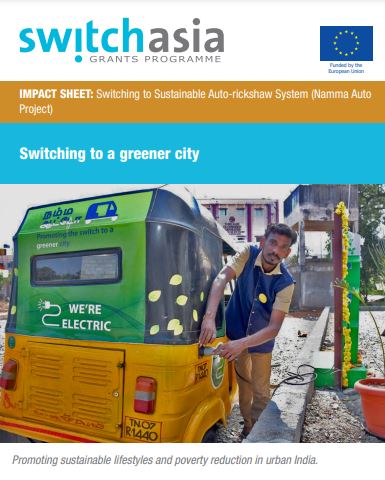
Switching to Sustainable Auto-rickshaw System (Namma Auto Project)
2020
Author(s): European Union (EU), SWITCH-Asia SCP Facility
The Switching to Sustainable Auto-rickshaw System (Namma Auto project) was designed on an “ecosystem” approach, working closely with the driver communities, giving them access to financial services, engaging with policy makers as well as industry players.