



Research Papers/Articles

Determinants of Adoption Intention of Battery Swap Technology for Electric Vehicles
2022
Author(s): Adu-Gyamfi G, Song H, Nketiah E, Obuobi B, Adjei M, Cudjoe D
In this study, the adoption intention of BST for EVs is explored as BST′ success depends on consumer acceptance to guarantee pro-environmental consumption and pollution reduction. The current study extends the theory of planned behavior (TPB) with perceived benefits and knowledge.
Life Cycle Assessment of Methanol Vehicles From Energy, Environmental and Economic Perspectives
2022
Author(s): Luo L, Wang H, Li C, Hu Y.
This paper uses the Energy, Environment, and Economy (3E) evaluation method to analyze the energy consumption, environmental emission, and economy of methanol, electric, gas, and gasoline vehicles from the whole life cycle perspective.

Synergies Between Repositioning and Charging Strategies for Shared Autonomous Electric Vehicle Fleets
2022
Author(s): Dean MD, Gurumurthy KM, de Souza F, Auld J, Kockelman KM
This study couples charging and repositioning events to improve service quality (rider wait times), reduce empty travel due to repositioning or charging, and improve fleet utilization (average daily trips per vehicle and charging queues).
Lifecycle Assessment of Diesel, Diesel-Electric and Hydrogen Fuel Cell Transit Buses With Fuel Cell Degradation and Battery Aging Using Machine Learning Techniques
2022
Author(s): Ahmadi P, Raeesi M, Changizian S, Teimouri A, Khoshnevisan A
This research conducts a dynamic simulation and a regional lifecycle assessment of a hydrogen fuel cell vehicle (FCV), a hybrid electric/diesel, and a diesel-powered transit bus.
A Systematic Review on Sustainability Assessment of Electric Vehicles: Knowledge Gaps and Future Perspectives
2022
Author(s): Onat NC, Kucukvar M.
Electric mobility is emerging worldwide to minimize environmental impacts, reduce dependency on petroleum, and diversify energy sources for transportation. Any emerging technology comes with uncertainties regarding its environmental, economic, and social impacts on global society.
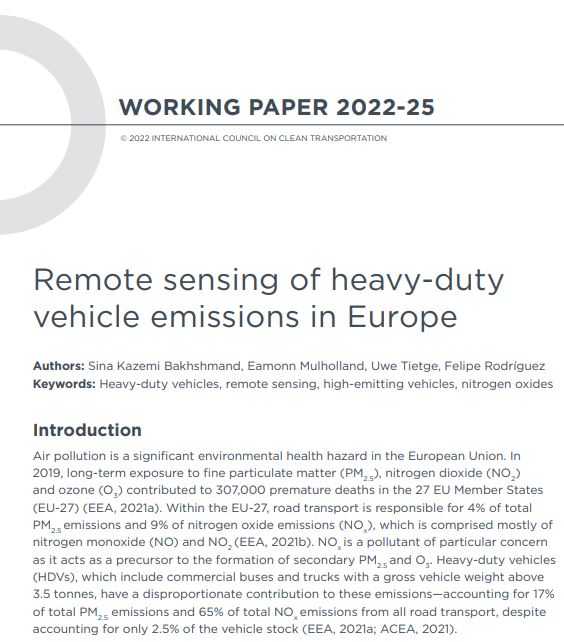
Remote sensing of heavy-duty vehicle emissions in Europe
2022
Author(s): Bakhshmand SK, Mulholland E, Tietge U, Rodríguez F
This study presents a multi-regional remote sensing analysis of 33,600 European trucks and buses to quantify the real-world level of pollutant emissions across different vehicle emission standards. It draws on data recorded from six remote sensing campaigns in Europe conducted between 2017 and 2020, covering a range of ambient temperatures and vehicle driving conditions.
Life Cycle Assessment on Energy Efficiency of Hydrogen Fuel Cell Vehicle in China
2022
Author(s): Lu Q, Zhang B, Yang S, Peng Z
Based on the analysis and research achievements of domestic and foreign scholars regarding the vehicle life cycle assessment, in combination with the research data of relevant enterprises, the research has objectively assessed the well-to-wheel energy efficiency of hydrogen fuel cell vehicles and performed a comparative analysis with conventional gasoline vehicle, conventional diesel vehicle, natural gas vehicle, methanol vehicle and battery electric vehicle

Comparative Life Cycle Assessment of Li-Sulphur and Li-Ion Batteries for Electric Vehicles
2022
Author(s): Benveniste G, Sánchez A, Rallo H, Corchero C, Amante B.
This study performs a life cycle assessment (LCA) of Li-S battery cells (under industrial development at the moment) that have been scaled up accordingly to estimate their performance as a battery for EVs.

Demand Response To Improve the Shared Electric Vehicle Planning: Managerial Insights, Sustainable Benefits
2021
Author(s): Ran C, Zhang Y, Yin Y
Massive adoption of shared electric mobility benefits people's daily commute and environment but creates overload issues into the power grid, then further causes challenges to charging service operations and power management.

Vehicle Energy Consumption in Python (Vencopy): Presenting and Demonstrating an Open-Source Tool To Calculate Electric Vehicle Charging Flexibility
2021
Author(s): Wulff N, Miorelli F, Gils HC, Jochem P
Rising electric loads necessitate energy system models that integrate their unique demand and potential flexibility as electric car fleets expand. Rising electric loads necessitate energy system models that integrate their unique demand and potential flexibility as electric car fleets expand.