


Reports

Simulating Zero Emission Vehicle Adoption and Economic Impacts in Canada
2020
Author(s): International Council on Clean Transportation (ICCT)
The adoption of zero emission vehicles or ZEVs –including battery, plug-in hybrid and hydrogen fuel cell electric vehicles – is a key action for decarbonizing Canada’s transport sector. This report, commissioned by the International Council on Clean Transportation, simulates the adoption of ZEVs in Canada through 2040.
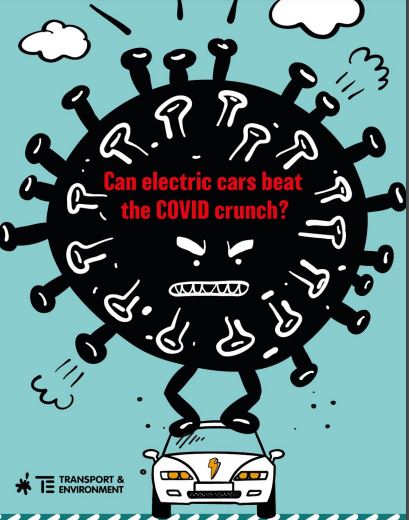
With societies months-long in confinements and factories shut, the COVID-19 pandemic has gravely impacted economies across Europe and beyond. 2020 was touted as the year of the electric car in Europe and early 2020 showed record plug-in sales. But has the COVID-19 crisis killed off the electric car momentum that was finally gaining pace in response to EU emissions regulations?

European Vehicle Market Statistics 2020/21
2020
Author(s): Diaz S, Mock P, Bernard Y, Bieker G, Pniewska I, Ragon Pierre-L, Rodriguez F, Tietge U, Wappelhorst S
The European vehicle market statistics pocketbook offers a statistical portrait of passenger car and light commercial vehicle fleets in the European Union, updated annually
Phasing-out sales of internal combustion engine vehicles
2020
Author(s): Milieu Consulting SPRL
The objective of this study is to provide a first assessment of the legal scope for EU or national measures to phase-out ICE vehicles and to identify issues where legal uncertainty remains and further investigation is needed. At national level, it examines whether it is possible for Member States to derogate from the harmonised framework for motor vehicle approval in order to adopt ICE sales or registration bans under the exception provided by Article 114(5) TFEU.

Financing India’s Transition to Electric Vehicles
2020
Author(s): Singh Vaibhav P, Chawla K, Jain S
The study assesses segment-wise electric vehicle (EV) sales, battery requirements, public charging infrastructure necessary, and the investments needed until 2030 to support India’s EV transition.
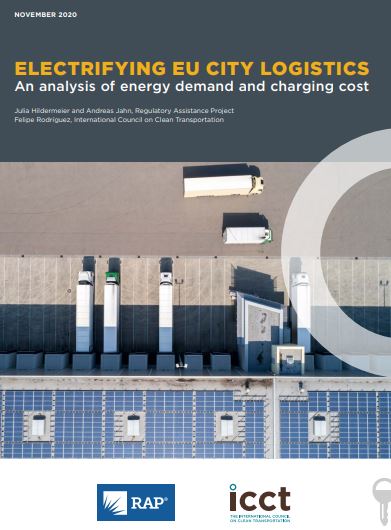
Electrifying EU City Logistics: An Analysis of Energy Demand and Charging Cost
2020
Author(s): Hildermeier J, Jahn A, Rodríguez F
This study by the International Council on Clean Transportation and the Regulatory Assistance Project examines fleet electrification, delving into the energy requirements and the various factors driving costs.
Recharge EU trucks: time to act! a roadmap for electric truck charging infrastructure deployment
2020
Author(s): Transport & Environment
The new European framework and public funding mechanisms for infrastructure should prioritise exclusively zero emission technologies. Using a key EU legislation (covering alternative fuel infrastructure)to promote infrastructure for fossil fuels such as CNG and LNG would not respect the Paris Agreement or the European Green Deal. The revised infrastructure framework planned for 2021 should take electric trucks seriously, include them in the scope of the law, and set appropriate binding targets. It should also propose a realistic and cost-effective strategy to allow hydrogen and dynamically-charged trucks to develop.

Simulator to Quantify and Manage Electric Vehicle Load Impacts on Low-voltage Distribution Grids
2020
Author(s): Xue L, Xia J
The Electric Vehicles on the Grid Simulator is intended to help individual building energy managers, facility owners, distribution service operators, charging point operators, and fleet operators.

This report presents the results of a research survey on the impact of ride hailing services on travel characteristics in Nairobi, Kenya. It is part of an international study conducted in partnership between GIZ, the World Resources Institute (WRI) Ross Centre, and the University of California (UC) Davis.

Low-carbon Energy Supply Strategy For Low Carbon & Sustainable Mobility in India
2020
Author(s): Federation of Indian Chambers of Commerce and Industry (FICCI)
The report aims to analyse the present gaps and challenges that prevent the transition to a renewable based energy supply for sustainable low carbon transport in India and propose practical recommendations, including short-term and longterm, necessitating the need of standardisation and laying standards that could aid the development of renewable sources of energy and their deployment in the Indian transport sector.