Reports

The WEO 2021 has been designed, exceptionally, as a guidebook to COP26. It spells out clearly what is at stake – what the pledges to reduce emissions made by governments so far mean for the energy sector and the climate. And it makes clear what more needs to be done to move beyond these announced pledges towards a pathway that would have a good chance of limiting global warming to 1.5 °C and avoiding the worst effects of climate change.

Key Insights into Transforming the Informal Transport Sector
2021
Author(s): International Association of Public Transport (UITP)
Governments’ responses to the COVID-19 health crisis have had strong impacts on mobility, both on a local and global level. Public transport patronage has plummeted by 90% in some parts of the world, according to UITP’s COVID-19 Task Force, and the industry has been dramatically hit.
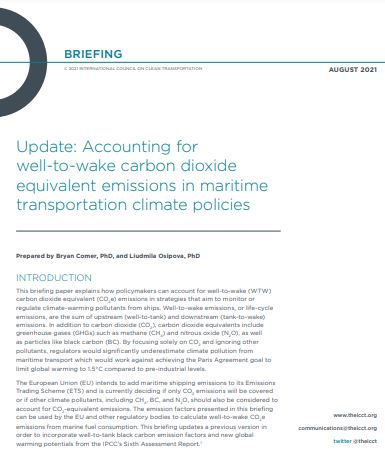
Update: Accounting for well-to-wake carbon dioxide equivalent emissions in maritime transportation climate policies
2021
Author(s): Comer B, Osipova L
This briefing paper outlines a methodology for calculating well-to-wake CO2-equivalent emissions from four fossil marine fuels: heavy fuel oil, very low sulfur fuel oil, marine gas oil, and liquefied natural gas.

Changing Automotive Work Environment
2021
Author(s): Boston Consulting Group (BCG), Agora Verkehrswende
For this study, the Boston Consulting Group (BCG) and Agora Verkehrswende examined how anticipated structural change would impact traditional automotive manufacturers, suppliers, and service providers.
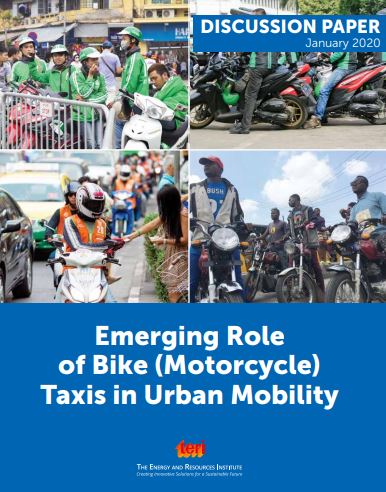
Emerging Role of Bike (Motorcycle) Taxis in Urban Mobility
2021
Author(s): Thakur P, Jain A, Harikumar A
Ride sharing and hailing services have given new dimension to urban mobility. They provide mobility as a service and promote asset utilization.

More and more municipalities are ready to strengthen environmentally friendly mobility or to distribute public space more equitably - for example by setting up bicycle lanes or traffic-calmed zones, by managing parking spaces or regulating sharing offers.

Handbook of Electric Vehicle Charging Infrastructure Implementation
2021
Author(s): NITI Aayog, Ministry of Power (MoP), Department of Science and Technology (DST), Bureau of Energy Efficiency (BEE), WRI India
The handbook provides a step-by-step approach to build out the EV charging infrastructure roadmap, moving from an assessment of EV charging requirements to location planning and arranging electricity supply to models of on-ground implementation.

Pathways to electric mobility in the Sahel: two and three-wheelers in Bamako and Ouagadougou
2021
Author(s): Fatima A, Vincent V

Five Takeaways from REN21’s Renewables 2021 Global Status Report
2021
Author(s): International Association of Public Transport (UITP)
The Renewables 2021 Global Status Report compiles developments from the past year on the market, policy and technology trends in renewable energy.
.jpg)
Status quo Analysis of Various Segments of Electric Mobility and Low Carbon Passenger Road Transport in India
2021
Author(s): Deutsche Gesellschaft für Internationale Zusammenarbeit (GIZ) GmbH, NITI Aayog
This report provides the existing status, challenges, gaps, opportunities, and way forward for low carbon road transport (LCRT) in India.