


Reports
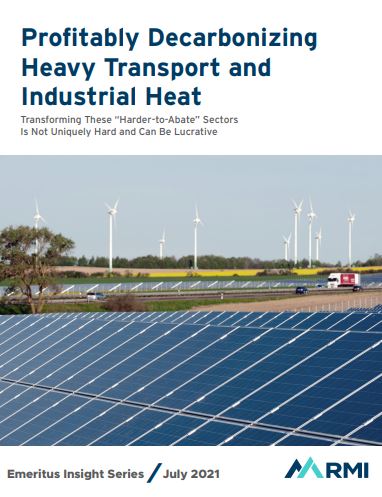
Profitably Decarbonizing Heavy Transport and Industrial Heat
2021
Author(s): Lovins Amory B.
As corporations and industries face rising public, policy, and market pressure to cut carbon emissions, the need for evidence-based solutions balancing carbon consciousness with profitability grows ever more intense.

Solar energy–based EV charging: a pilot and techno-economic study
2021
Author(s): Center for Study of Science, Technology and Policy (CSTEP)
The report outlines an intelligent bi-directional converter (PCU) that interfaces with SRTPV and battery systems (with DC coupling) to manage the energy flow with EV chargers and the grid. The prioritisation of solar energy for local consumption before feeding it to the grid, deployment of a novel charging algorithm where the EV charging load is made to follow and the solar energy generation profile. Such a method reduces the need for costly battery energy.

Hitting the EV inflection point: electric vehicle price parity and phasing out combustion vehicle sales in Europe
2021
Author(s): Bloomberg Finance L.P
Electric vehicle sales are rising fast in Europe and a growing number of governments have set targets for phasing out new internal combustion vehicle sales. A fundamental input in deciding the feasibility of such policies is how quickly battery electric vehicles can reach price parity with their internal combustion counterparts. Further improvements in lithium-ion batteries will be critical and manufacturing strategy will also play a role. This report shows trajectories of cost developments for the production of battery electric vehicles and internal combustion engine vehicles, and the implications for the adoption of electric vehicles in Europe.

Driving demand: assessing the impacts and opportunities of the electric vehicle revolution on cobalt and lithium raw material production and trade
2021
Author(s): Bridle R, Bellmann C, Loyola V, Mostafa M, Moerenhout T
This report assesses the impact and opportunities for developing countries of the boom in demand for raw materials entering into the production of electric vehicle batteries. In particular, it describes how trade policy could play an important role in helping them capture value from this expansion while managing the risks of overinvestment.
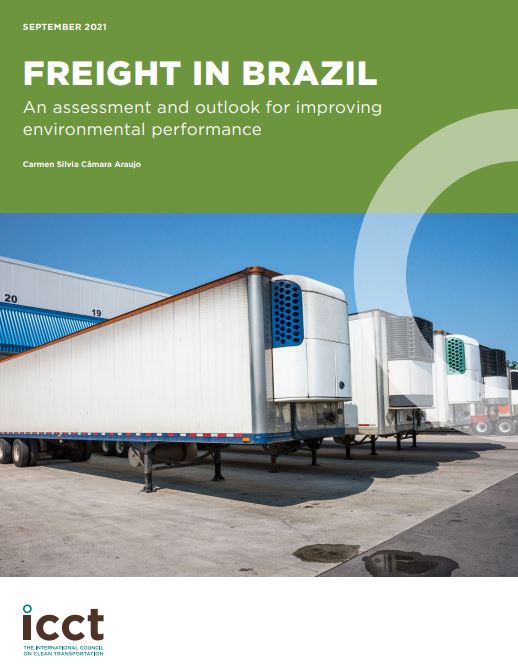
Freight in Brazil: An Assessment and Outlook for Improving Environmental Performance
2021
Author(s): Araujo Carmen Silvia C
This report is a non-exhaustive, exploratory survey of the truck market in Brazil. We considered the particularities of the road freight transportation system in an effort to evaluate possible obstacles and opportunities for the application of a green freight system similar to the EPA’s SmartWay and other initiatives related to energy efficiency and the reduction of emissions from transport.
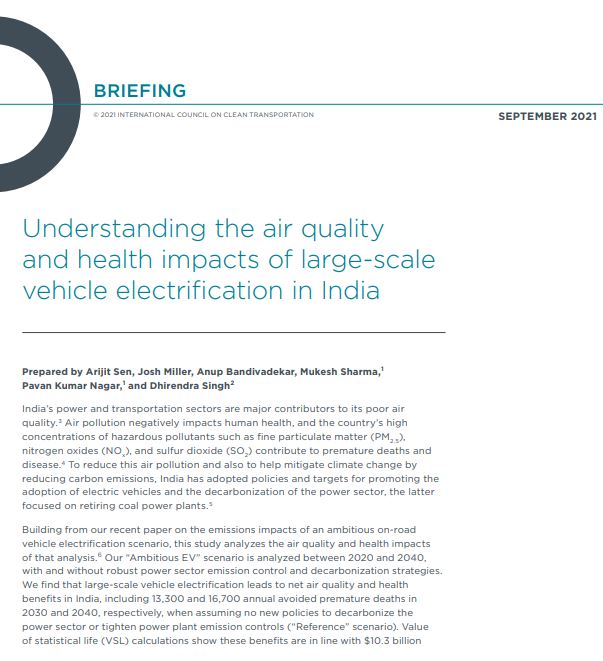
Understanding the Air Quality and Health Impacts of Large-scale Vehicle Electrification in India
2021
Author(s): Sen A, Miller J, Bandivadekar A, Sharma M, Nagar Pavan K, Singh D
This is a companion to the working paper that estimated the vehicle tailpipe and power sector emissions impacts of large-scale vehicle electrification in India through 2040 under various scenarios representing plausible evolutions of the electricity grid.

Study of electric vehicle charging infrastructure planning and rollout for Bengaluru
2021
Author(s): Singh A, Kumar A, Balasubramanyam K, Murugesan N, Suri R, Pillai R K, Sharma S
This study looks at the network of the Bengaluru Electricity Supply Company (BESCOM, Karnataka) to assess the capacity of the distribution grid to accommodate the EV load. It then provides holistic guidelines for interventions and business models for BESCOM to adopt and roll out charging infrastructure within its jurisdiction.
 Emissions from Heavy-duty Diesel, Natural Gas, and Electric Vehicles.JPG)
A Comparison of Nitrogen Oxide (NOx) Emissions from Heavy-duty Diesel, Natural Gas, and Electric Vehicles
2021
Author(s): Muncrief R
As California finalizes an omnibus rule that will require a 90% reduction in nitrogen oxide (NOx) emissions from heavy-duty vehicles in the 2024–2027 timeframe, other states, including New York, New Jersey, and Massachusetts, have indicated that they will also adopt California’s rule. Meanwhile, the United States Environmental Protection Agency (EPA) has been directed by the White House to propose by January 2022 a stringent national standard for NOx emissions from heavy-duty vehicles (HDVs) that will apply nationwide starting around 2027.
India is experiencing rapid urbanization. Urban freight transport is a crucial enabler of economic activity in cities, ensuring the flow of goods for citizens and businesses. However, urban freight systems also generate negative consequences. Freight vehicles are disproportionate contributors of carbon dioxide, particulate matter, and nitrogen oxide emissions.
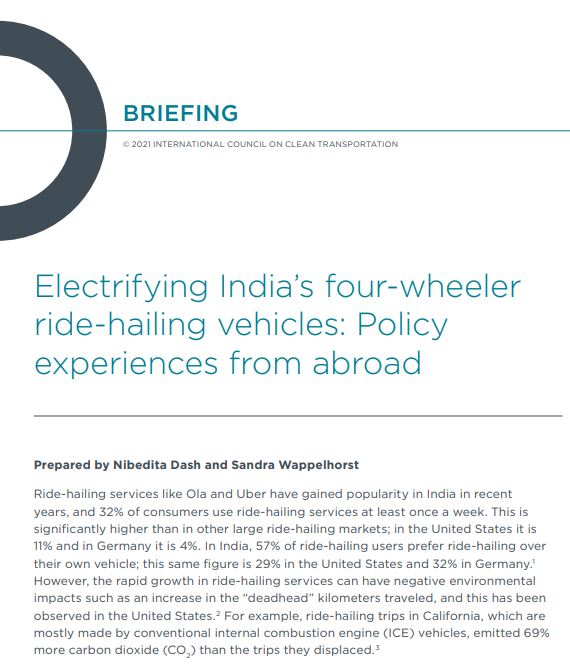
Electrifying India’s Four-wheeler Ride-hailing Vehicles: Policy Experiences from Abroad
2021
Author(s): International Council on Clean Transportation (ICCT)
The central government and several state governments in India have implemented consumer financial incentives that reduce the total cost of ownership gap between electric and conventional gasoline and diesel cars used as ride-hailing vehicles.