

Research Papers/Articles

Prospective Life-Cycle Assessment of Greenhouse Gas Emissions of Electricity-Based Mobility Options
2022
Author(s): Rüdisüli M, Bach C, Bauer C, Beloin-Saint-Pierre D, Elber U, Georges G, Limpach R, Pareschi G, Kannan R, Teske SL
Electricity-based mobility (EBM) refers to vehicles that use electricity as their primary energy source either directly such as Battery Electric Vehicles (BEV) or indirectly such as hydrogen (H2) driven Fuel Cell Electric Vehicles (FCEV) or Synthetic Natural Gas Vehicles (SNG-V).

Zero-emission vehicle deployment: Europe, Middle East, and Central & South Asia
2022
Author(s): Khan T, Kohli S, Yang Z, Miller J
This briefing gives an overview of the status of ZEV development in the Eurasian region.

Zero-emission vehicle deployment: ASEAN markets
2022
Author(s): Khan T, Kohli S, Yang Z, Miller J
This briefing gives an overview of the status of ZEV development in the ASEAN economies.
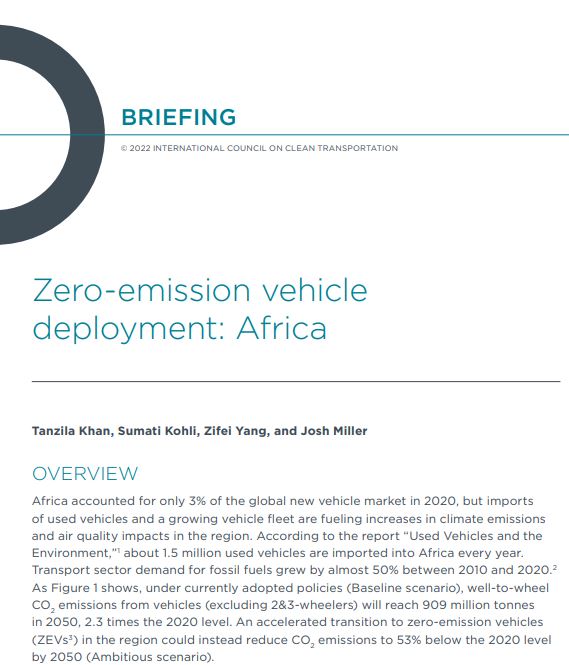
Zero-emission vehicle deployment: Africa
2022
Author(s): Khan T, Kohli S, Yang Z, Miller J
This briefing gives an overview of the status of ZEV (Zero-Emission Vehicle) development in the emerging economies of Africa.

Intelligent Approach: Smart charging strategies for electric vehicles
2022
Author(s): Kalia S, Bhagyasree, Mitra I
Smart charging refers to an optimal or intelligent way of charging of electric vehicles (EVs) considering the condition of the electricity grid and charging needs of EV users.

Green Hydrogen Is the Means to an End, Not an End in Itself
2022
Author(s): Shankar A.
If global warming is to be avoided, the world must accelerate the transition to net-zero emissions. The pathway for decarbonization of electricity can replace fossil fuels in many segments of economic activity while, at the same time, electricity itself is undergoing decarbonization, facilitating the transition to net-zero.

Who Will Adopt Electric Vehicles? Segmenting and Exemplifying Potential Buyer Heterogeneity and Forthcoming Research
2022
Author(s): Jaiswal D, Deshmukh AK, Thaichon P
The main aim of this study is to explore and identify distinct sets of potential buyer segments for EVs based on psychographic, behavioral, and socio-economic characterization by employing an integrated research framework of ‘perceived benefits-attitude-intention’.

Electric Vehicle Charging Stations Emplacement Using Genetic Algorithms and Agent-Based Simulation
2022
Author(s): Jordán J, Palanca J, Martí P, Julian V
The increasingly evident incorporation of the electric vehicle in urban environments is an already undeniable change. Electric vehicles are appearing on the market with more autonomy and lower prices, which is facilitating the progressive change of the vehicle fleet.
A Techno-Economic Energy Management Strategy for Electric Vehicles in Public Parking Lot Considering Multi-Scenario Simulations
2022
Author(s): Firouzjah KG
This study aims to look at the issue of charging and discharging electric vehicles in public parking lots while optimizing the parking benefit. A regulated charging/discharging scheduling technique is presented in this regard.
Resilience Enhancement Strategies For and Through Electric Vehicles
2022
Author(s): Hussain A, Musilek P
Electric vehicles (EVs) have the potential to reduce transportation-related emissions while simultaneously delivering a variety of services to the power system, including resilience during power outages.