
Reports
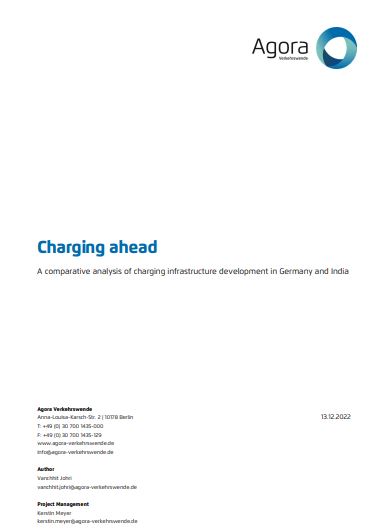
Charging Ahead: A Comparative Analysis of Charging Infrastructure Development in Germany and India
2022
Author(s): Johri V
This report examines how the Indian charging infrastructure ecosystem could benefit from lessons learned from a more advanced EV market such as Germany. It highlights the importance of a data-driven approach to facilitate investment decisions and to ramp up the nascent EV charging industry in India.
Paving the Way to an EV Future: Policy Recommendations for Accelerated Charging Infrastructure Development
2022
Author(s): Agora Verkehrswende
The study investigated the question of which funding and financing instruments the German government can already use to set priorities in order to support the expansion of publicly accessible charging infrastructure as quickly and comprehensively as possible. The results show that the greatest potential comes from promoting fast and high-performance charging, for example at retail locations.

A number of studies have already been conducted on how the energy transition will impact employment in the automotive sector. This study broadens the consideration of employment effects by exploring how the transformation will impact employment not only in the automotive industry but also in related sectors.

Strategy to Electrify Three-Wheeled Passenger and Goods Vehicles in Cities of Odisha
2022
Author(s): Roychowdhury A, Roy S
This ground-level assessment in the capital region of Odisha bears out the opportunities for accelerated electrification of this segment and the challenges associated with implementation that need to be addressed for rapid transformation.
Towards a Zero-emissions Mandate Policy: Analysis of Stakeholder Perceptions
2022
Author(s): Centre for Science and Environment, CITIES Forum.
The report highlights while the Government of India has taken several steps toward faster adoption of EVs, several challenges and gaps exist in the EV ecosystem that must be addressed to build the confidence of consumers and the industry.

Decoding State Electric Vehicle Policies: Are They Designed for Scale and Performance?
2022
Author(s): Roychowdhury A, Srivastava S, Mohanty M
This report asks the question, are there adequate and appropriate policy strategies in place to support and drive this ambition?
Roadmap for 100% delivery electrification in Delhi: unlocking insights from the deliver electric Delhi pilot
2022
Author(s): Dialogue and Development Commission of Delhi, RMI, RMI India
This report highlights insights from the design, implementation, and consultation phases of the Deliver Electric Delhi Pilot, and compiles these findings into a roadmap for scaling final-mile delivery vehicle adoption. The Pilot identified ways in which policies, charging infrastructure, and access to finance can help private and public sector players fully electrify final-mile delivery vehicles. The report compares the costs and performance of EVs to their fossil fuel counterparts and outlines the economic case for fleet electrification.

Report on twentieth electric power survey of India, Volume 1
2022
Author(s): Central Electricity Authority
The 20th Electric Power Survey covers Discom/State/Union Territory/Region wise and all-India electricity demand projection for the next 20 years viz, year-wise projections from 2021-22 to 2031-32 and perspective electricity demand projections for the years 2036-37 and 2041-42.

This policy paper assesses the emerging trends in the e-bus market and examines how bus operation models are being reinvented, indicating a departure from the way Internal Combustion Engine (ICE) buses are purchased, managed and operated.

Decarbonizing China’s Road Transport Sector: Strategies Toward Carbon Neutrality
2022
Author(s): Xue L, Liu D
China’s road transport sector plays an important role in meeting carbon early peaking and carbon neutrality goals. This study examines how the sector might be decarbonized by modelling five scenarios using the LEAP model. It aims to inform China road transport sector’s emission reduction target, identification of cost-effective measures that deliver on the sectoral emission reduction targets, facilitation of low-carbon investments and identification of decarbonization measures with air pollution reduction co-benefits.