

Reports
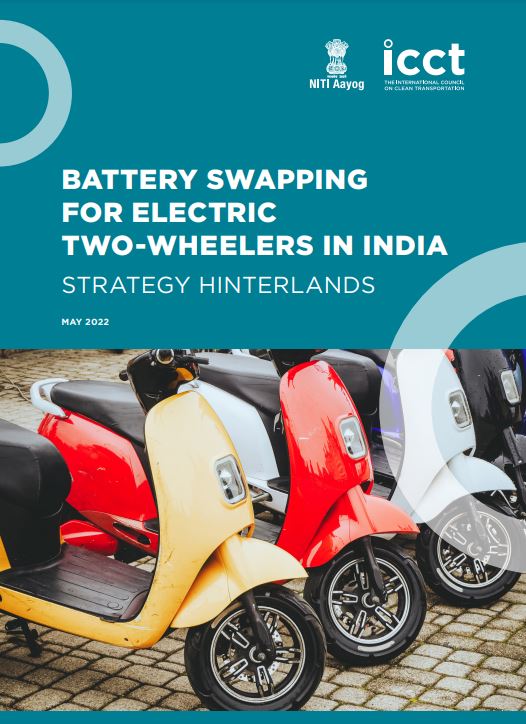
Battery Swapping for Electric Two-wheelers in India: Strategy hinterlands
2022
Author(s): Gode P, Bhatt A, Sinha S, Kohli S, Callahan J
This research helps create an agenda for future strategy that supports the battery-swapping business model in India. Because lower battery prices in the future would diminish the cost benefits of acquiring an E2W without the battery, early policy could focus on things less likely to change in the near and medium term, such as the value of time saved on charging and on supporting battery swapping operators (BSOs) in maintaining best practices for operational safety and end-of-life care. That means things like extending future FAME subsidies to two-wheelers sold without pre-fitted batteries and relevant operational and safety standards for BSOs.
Electric Vehicle Charging Infrastructure and its Grid Integration in India: Status Quo, Critical Analysis and Way Forward
2022
Author(s): Rather Z, Nath A, Lekshmi D, Banerjee R
This study focuses on EV charging infrastructure, related policy and regulatory measures, grid integration of EVs, and the way forward for smooth EV adaption in the Indian EV ecosystem.
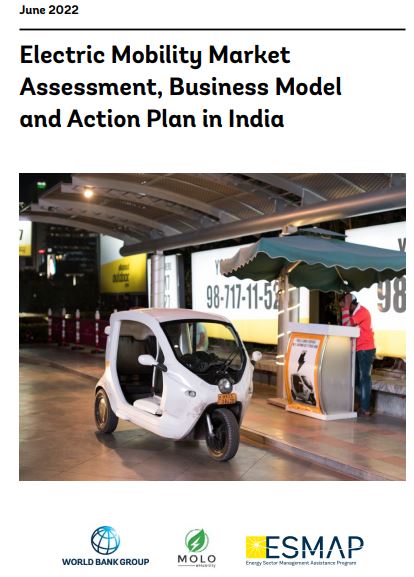
Electric mobility market assessment, business model and action plan in India
2022
Author(s): World Bank
This report evaluates each vehicle and market segment considering their unique characteristics. Analytical models based on key cost drivers for each segment were used to project market penetration in a range of scenarios (from business-as-usual or “BAU” to comprehensive implementation of recommendations). A deep dive analysis was undertaken for three states (Maharashtra, Tamil Nadu, and Madhya Pradesh) across ten of their largest cities, then aggregated at the state and national levels for a comprehensive picture.
Life cycle analysis comparison: electric and internal combustion engine vehicle
2022
Author(s): Fuels Institute
Ricardo Strategic Consulting conducted a life cycle assessment study for the Fuels Institute to study the life cycle emissions and total cost of ownership of internal combustion engine (ICE) vehicles and electric vehicles. The study involved an extensive literature review of the research work in this field and a customized life cycle analysis (LCA) model development by Ricardo.
Global EV outlook 2022: securing supplies for an electric future
2022
Author(s): International Energy Agency
The increase in EV sales in 2021 was primarily led by the People’s Republic of China, which accounted for half of the growth. More vehicles were sold in China in 2021 (3.3 million) than in the entire world in 2020. Sales in Europe showed continued robust growth (up 65% to 2.3 million) after the 2020 boom, and they increased in the United States as well (to 630 000) after two years of decline.

Understanding investment, trade, and battery waste management linkages for a globally competitive EV manufacturing sector
2022
Author(s): Moerenhout T, Goldar A, Ray S, Shingal A, Goel S, Agarwal P, Jain S, Thakur V, Tarun, Gaurav K, Aneja D A, Bansal A
This study attempts to comprehend various challenges in trade, investment and battery waste management of EVs in India and identifies diverse solutions to aid India’s EV transition.
The report provides a comprehensive assessment of the global gap in climate action across the world’s highest-emitting systems, highlighting where recent progress made in reducing GHG emissions, scaling up carbon removal, and increasing climate finance must accelerate over the next decade to keep the Paris Agreement’s goal to limit warming to 1.5°C within reach.

Progress and potential for electric vehicles to reduce carbon emissions
2022
Author(s): Leard B, McConnell V
This report details the current role that EVs play in reducing greenhouse gas emissions (GHG) in the US transportation sector. It also looks forward to 2025 and beyond to assess the potential for EVs to reduce future GHG emissions.

How to Manual: Siting Electric Vehicle Charging Stations in Indian Cities
2022
Author(s): Natural Resources Defense Council (NRDC)
Increasing the fleet of electric vehicles (EV) and charging infrastructure in India are key to improving air quality in cities, enhancing energy security by reducing dependence on imported crude oil, and fighting climate change. India aims to have at least 30 percent of new vehicle sales be electric by 2030 and could potentially have 102 million EVs on the road.
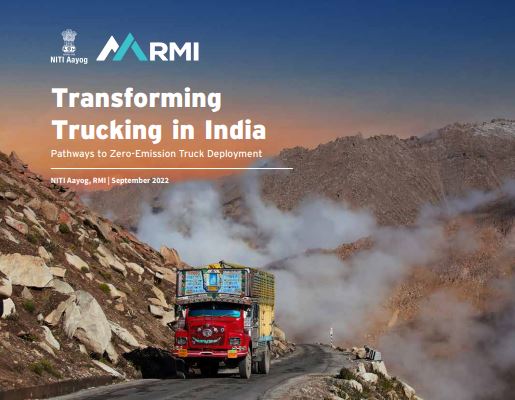
Transforming trucking in India: pathways to zero-emission truck deployment
2022
Author(s): NITI Aayog, RMI
This report outlines the economic case for scaling ZET adoption and presents a blend of near-term and long-term strategies and solutions including policy, financing, access to charging, and technology innovation that can enable India to capitalize on the far-reaching benefits of a zero-emissions trucking future. The report also shows that the estimated total cost of ownership for medium-duty ZETs under a mature production scenario is lower than diesel trucks and could feasibly reach parity in the heavy-duty truck segment by 2027.