

Reports
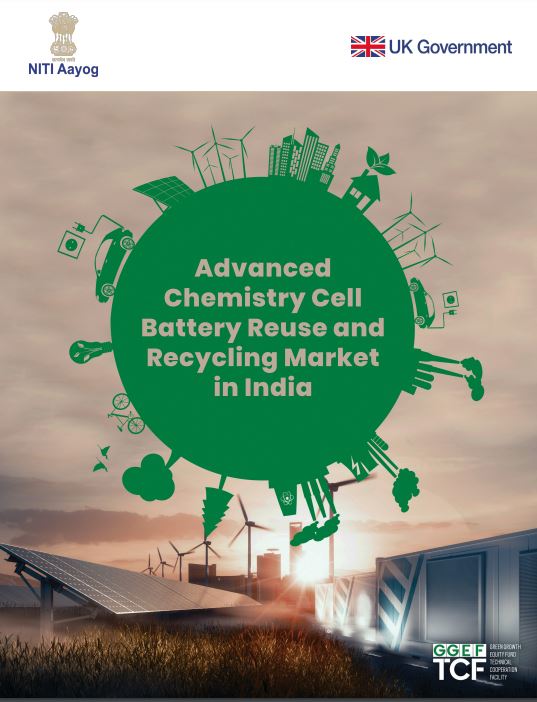
Advanced chemistry cell battery reuse and recycling market in India
2022
Author(s): Gattu A, Agrawal A, Chatterjee A, Mittal D, Khan M S, Bagdia R, Singh R, Khan S M, Singh V
Nations around the world are producing plans to achieve net zero by adopting disruptive low-emission and energy-efficient pathways to reduce dependence on fossil fuels. These pathways include electrification of the transport sector and having a higher share of renewable energy (RE) in the energy mix.
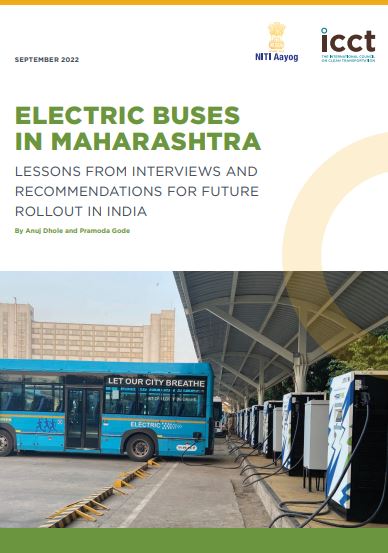
Electric buses in Maharashtra: lessons from interviews and recommendations for future rollout in India
2022
Author(s): Dhole A, Gode P
The study result shows that electric buses are reliable. Transit authorities are already experiencing the numerous benefits that electric buses offer, including zero tailpipe emissions, fewer maintenance requirements, and better driver and passenger experience.
Forecasting penetration of electric two-wheelers in India: a bottom-up analysis
2022
Author(s): Srivastava P, Sardar A, Shishir K G, Saraswat V K, Singh R
The report provides important insights into the required infrastructure, manufacturing capability, policies, and technology-development priorities in the area. The scenarios can be used by government agencies, the industry, and academic/R&D institutions for evidence-based analysis of policies, market scenarios and technology development strategies.
Battery Ecosystem: A Global Overview, Gap Analysis in Indian context, and Way Forward for Ecosystem Development
2022
Author(s): Mandal A (Deloitte India), Dikshit C (Deloitte India), Singha H (Deloitte India), Parihar A (Deloitte India), Tripathy A (Deloitte India), Mohapatra P (Deloitte India)
The aim to attain energy security, reduce dependency on international markets for oil and the urgent need to prohibit carbon emission from the transportation sector is promoting a rapid shift towards electrified mobility.

Readiness and capacity needs assessment for electric vehicle adoption in Indian Cities
2022
Author(s): The Energy and Resources Institute
TERI conducted a city-level analysis of four cities – New Delhi, Panaji, Bengaluru, and Guwahati to assess EV planning and deployment action chains. These shortlisted cities were assessed with regard to a set of seven relevant criteria and indicators viz., Institutional/policy readiness, Economic readiness, Infrastructural readiness, Technological readiness, Innovation readiness, Social readiness, and Environmental readiness. In each city, key stakeholders were identified, interviewed, and surveyed on each criterion shaping the EV ecosystem.
International Review on Recycling Ecosystem of Electric Vehicle Batteries
2022
Author(s): Bej S (GIZ), Zhimomi T (GIZ), Hochfeld C (Agora Verkehrswende), Riehle EB (Agora Verkehrswende), Rather Z (Indian Institute of Technology Bombay), Bradiya MR (Indian Institute of Technology Bombay), Maity S (Indian Institute of Technology Bombay)
This study focuses on the recycling ecosystem of batteries. Batteries up until recently were primarily used in electronic appliances. However, with the advent of EVs, batteries for traction applications have become synonymous with battery recycling and needs careful and in-depth study.
Diving ambitions: the business case for circular economy in the car industry
2022
Author(s): Dror M B, Gupta A, Deloison T, Schmidt A, Holst A, Machur W, Lacy P, Reers J
The circular economy approach enables automotive companies to increase revenues per vehicle by 15-20 times the sales price and significantly improve profitability by maximizing lifetime performance.

Handbook for electric vehicle charging infrastructure implementation
2022
Author(s): NITI Aayog
The Handbook provides a systematic and a holistic approach for adoptions by implementing authorities and other stakeholders involved in planning, authorisation and execution of EV charging infrastructure.
A dataset of electric school bus adoption in the United States
2022
Author(s): Lazer L, Freehafer L
This technical note describes the methods used to create a dataset that tracks electric school bus (ESB) adoption across the United States. The dataset tracks the number of “committed” ESBs at the school district level, as well as details about individual buses, including bus manufacturer and funding source(s). It also contains school district socio-economic characteristics like poverty rates and racial composition, to enable wider analysis including whether the transition to ESBs is happening equitably.
Decarbonizing China’s road transport sector: strategies toward carbon neutrality
2022
Author(s): Xue L, Liu D
Within the transport sector, road transport represented the largest share 84.1 percent of transport related GHG emissions in China in 2014 (MEE 2020a). To meet its carbon neutrality goal, China’s road transport sector needs explicit sectoral emission reduction targets, actionable strategies, and cost-effective policy instruments. This study examines how the transport sector might be decarbonized in China.