


Opinions/Videos

New Study Claims Diesel Emissions Take Heavy Toll on Global Health
2017
Author(s): CGTN America
A new study claims emissions from diesel vehicles cause tens of thousands of premature deaths a year worldwide, many of them in China. One major reason: the inadequate testing of those vehicles.

“Make People Happy, Not Cars”: An interview with Jan Gehl about the urban transformation already underway in many places.
2017
Author(s): Agora Verkehrswende
In an interview with Agora Verkehrswende, Gehl observes that the transformation of the transport sector is already underway in many cities, but municipal planners often lack a strategy for supporting it. He believes that liveable cities not only are good for people but also for promoting economic development.
Beyond Electric Cars: As China Leads in Electric Buses, India Could Follow Suit in Electric Motorcycles
2017
Author(s): Shastry S, Lu L
China has seen a remarkable increase in electric buses.Transitioning to electric buses will help China's commitment to reduce its climate intensity by 60-65 percent from 2005 levels by 2030, and help address growing concerns about rising air pollution.
Mr Amit Bhatt, Director, Urban Transport, WRI India shares his views on how poor air quality is a big concern to not just India but the entire world and how using proven solutions such as using more public transport and less private vehicles can make Indian cities more resilient to new challenges and bring the economic environment and social benefits to people.

DE.CA.rbonize Transportation – The German–Californian Conference for Zero Emission Transportation
2017
Author(s): Agora Verkehrswende
The two-day conference, jointly organized by the Institute of Transportation Studies (ITS) at the University of California, Davis (UC Davis) and Agora Verkehrswende, took place in Berlin on January 30–31, 2018. The following video gives an insight into some of the event’s highlights.

4 Lessons on Scaling Up Sustainable Transport in US and Chinese Cities
2016
Author(s): Xue L
Transportation is a major source of CO2 emissions in both China and the United States—at 20 percent and 30 percent, respectively. The percentage of people traveling by car is increasing in Chinese cities, rising from 15 percent to 34 percent in Beijing between 2002 and 2013, creating air pollution and fuelling climate change.

DC’s Metro Closure Shows Why Creating Trust in Public Transit Matters
2016
Author(s): Dasgupta A
Public transit is essential to an environmentally sustainable urban future. But it requires public confidence in the transit system. To get people out of their personal cars, there needs to be an attractive alternative.
New Urban Transport Models Can Help Create Sustainable Cities
2016
Author(s): Dalkmann H, Hidalgo D, Tun Thet H
Urban leaders met to set the global agenda for the future of cities at the United Nations Conference on Housing and Sustainable Urban Development, known as Habitat III. In the World Resources Report (WRR) on sustainable cities, WRI offers real-world research that aims to convert plans into implementation to create cities that live, move and thrive.
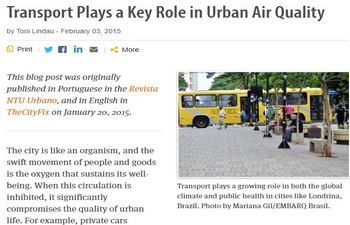
Transport sector accounted for 46.9 percent of Brazil’s energy-related carbon dioxide emissions. Rapid global urbanization comes with the potential to accelerate current climate change trends, and transport emissions may even triple by 2050.
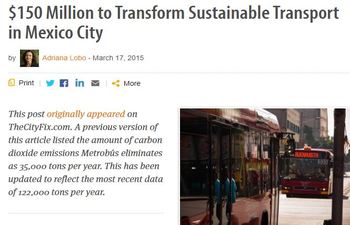
$150 Million to Transform Sustainable Transport in Mexico City
2015
Author(s): Lobo A
With a metropolitan population of more than 21 million people and growing quickly Mexico City faces distinct challenges in delivering sustainable urban mobility.