



Knowledge Hub
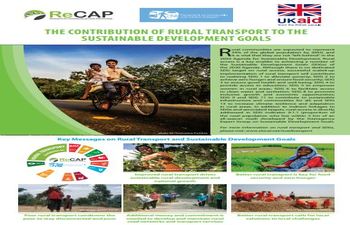
The contribution of rural transport to the Sustainable Development Goals
2017
Author(s): The SLoCaT Partnership
This factsheet was developed by the SLoCaT in partnership with, and support of the UK Aid-funded Research for Community Access Partnership (ReCAP) on a set of key messages on rural transport and SDGs. The factsheet also highlights the Sustainable Mobility for All (SuM4ALL) initiative, which was established in 2017 with the aim to act as a platform for advocacy to influence policies on sustainable mobility at global to local levels. The initiative works to facilitate the delivery of four primary objectives of sustainable transport, which include Universal Access, Efficiency, Safety, and Green Mobility. Rural Access and Urban Access are the two sub-objectives under the SuM4All Universal Access objective.
Key Factors for the Development of Electro Mobility
2017
Author(s): Kolz D, Schwartz M
Electro mobility provides the basis for a fundamental, worldwide change when it comes to individual mobility. This change goes far beyond just using vehicles with an electric engine. Specific criteria that affect the success of e-mobility can only be met if they are clearly identified.

Solar Powered Electric Vehicle Using Brushless DC Motor Drive
2017
Author(s): Bharathi Sankar A
The use of solar vehicle is a step towards reducing dependency on the conventional energy, utilizing the non-renewable sources of power for various applications . This work focuses on the application of solar energy to power up the electric vehicle.
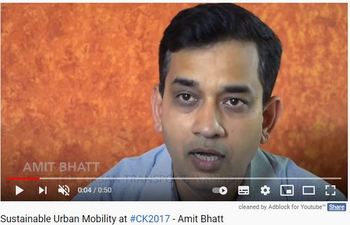
Mr Amit Bhatt, Director, Urban Transport, WRI India shares his views on how poor air quality is a big concern to not just India but the entire world and how using proven solutions such as using more public transport and less private vehicles can make Indian cities more resilient to new challenges and bring the economic environment and social benefits to people.
Towards Decarbonising Transport
2017
Author(s): Vieweg M, Bongardt D, Dalkmann H, Hochfeld C, Jung A, Scherer E
This report was developed in cooperation with Agora Verkehrswende in order to spotlight the crucial importance of the transport sector for climate policy.

An Exploratory Policy Analysis of Electric Vehicle Sales Competition and Sensitivity to Infrastructure in Europe
2017
Author(s): Harrison G, Thiel C
This research contributes to discussions about policy interventions to stimulate the transition of vehicle technology. Concentrating on passenger cars, an extensive system dynamics based market agent model of powertrain technology transitions within the EU up to 2050 is employed.
Path Creation in Nordic Energy and Road Transport Systems – The Role of Technological Characteristics
2017
Author(s): Hansen T, Klitkou A, Borup M, Scordato L, Wessberg N
This paper reviews path-creation processes in road transport systems in the Nordic countries: e-mobility in Denmark, hydrogen and fuel-cell electrical vehicles in Norway, and advanced biofuels in Finland and Sweden.
Mobilise Your City - Monitoring & Reporting Approach for GHG Emissions
2017
Author(s): Eichhorst U, Bongardt D
This paper sets out the greenhouse gas monitoring and reporting principles for the Mobilise Your City Partnership.
The Electric Battery:Charging Forward to a Low-Carbon Future
2017
Author(s): Jones KB, Jervey B B, Roche M, Barnowski S
The book provides an unprecedented and easy-to-understand explanation of both the policy issues and technological challenges facing the battery in the quest to significantly reduce humanity's collective "carbon footprint" on the earth.
Regarding Amendment in BS VI emission norms
2017
Publisher/Organisation: Ministry of Road Transport & Highways, Government of India
This draft document of Certain rules was published by the Central Government to amend the Central Motor Vehicles Rules, 1989 with the addition of the sub-rule (17-A) Mass Emission Standards (Bharat Stage IV) for quadricycle (Category L7) as mentioned in this document.