



Knowledge Hub
Clean Cargo is the leading buyer-supplier forum for sustainability in the cargo shipping industry. Members are major brands, cargo carriers, and freight forwarders that share a vision of a shipping industry that is a responsible part of sustainable supply chains, which supports clean oceans, healthy port communities, and global climate goals.
Charging the future: challenges and opportunities for electric vehicle adoption
2018
Author(s): Lee H, Clark A
Electric vehicles (EVs) have advanced significantly this decade, owing in part to decreasing battery costs. Yet EVs remain more costly than gasoline fueled vehicles over their useful life. This study analyzes the additional advances that will be needed, if electric vehicles are to significantly penetrate the passenger vehicle fleet.

Economic Analysis of Public Transportation Services in Kolkata
2018
Author(s): Siddiqui Sahin Z.H.
The centralized transport system of Kolkata Metropolitan City exhibits the dependency on mass transport services. In the multimodal mass transport system of Kolkata, both road based modes viz. buses, both state owned and private, mini buses, trams; and rails viz. suburban, circular and metro act as major modes of mass transport services.
This monograph adresses the challenge of the environmental assessment of leightweight electric vehicles.

A Comprehensive Policy and Technology Strategy for Mitigating Emissions from Heavy-Duty Vehicles in Brazilian Urban Centres
2017
Author(s): Alvares O
This presentation by Olimpio Alvares, CAF was presented in the "Strategies for mitigating air pollution" Workshop on 18 &19 January 2017 at Centro Histórico, Ciudad de México, México.
Planning Shared Corporate Mobility Services
2017
Author(s): Enzi M, Biesinger B, Knopp S, Parragh SN, Prandtstetter M
In a corporate context, individual mobility of employees is often addressed by 'owning cars' instead of 'using mobility' - at least in Austria. This paper introduces an integer linear programming model targeting important aspects of mobility in a corporate context.

This book includes all the steps for building safe, effective custom lithium battery packs.
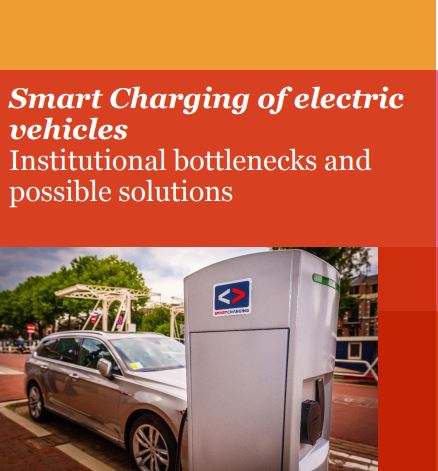
The study is a follow-up to the PwC study into Tax barriers for Smart Charging (2017), commissioned by stichting ElaadNL. This study has been broadened with an overview of other institutional bottlenecks that impede the development of Smart Charging.
Effective Technologies for Mitigating Emissions from Light-Duty Vehicles
2017
Author(s): Lyons A
This presentation by Allen Lyons presents the Strategies for Reducing LightDuty Vehicle Emissions and talks about the Benefits of New Vehicle Standards, Early Fleet Modernization and Higher Performance Aftermarket Catalysts.
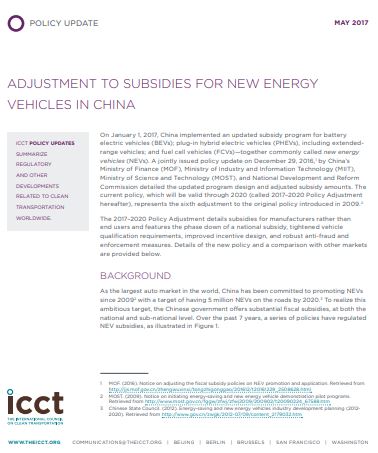
Adjustment to subsidies for new energy vehicles in China
2017
Publisher/Organisation: International Council on Clean Transportation (ICCT)
On January 1, 2017, China implemented an updated subsidy program for battery electric vehicles (BEVs); plug-in hybrid electric vehicles (PHEVs), including extended-range vehicles; and fuel cell vehicles (FCVs)—together commonly called new energy vehicles (NEVs). A jointly issued policy update on December 29, 2016, by China’s Ministry of Finance (MOF), Ministry of Industry and Information Technology (MIIT), Ministry of Science and Technology (MOST), and National Development and Reform Commission detailed the updated program design and adjusted subsidy amounts. The current policy, which will be valid through 2020 (called 2017–2020 Policy Adjustment hereafter), represents the sixth adjustment to the original policy introduced in 2009. The 2017–2020 Policy Adjustment details subsidies for manufacturers rather than end-users and features the phase down of a national subsidy, tightened vehicle qualification requirements, improved incentive design, and robust anti-fraud and enforcement measures. Details of the new policy and a comparison with other markets are also included in this document.