



Knowledge Hub
Regarding Background colour of registration plates for Electric vehicles
2018
Publisher/Organisation: Ministry of Road Transport & Highways, Government of India
This document, Central Motor Vehicles (10th Amendment) Rules, 2018, was issued by the Central Government in the exercise of the powers conferred by section 64 of the Motor Vehicles Act, 1988 (59 of 1988) with the insertion of the rules regarding Background colour of registration plates for Electric vehicles.
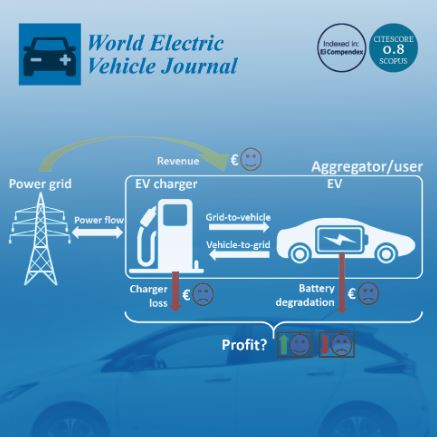
Sustainability and Gender: A Mixed-Method Analysis of Urban Women’s Mode Choice With Particular Consideration of E-Carsharing
2018
Author(s): Martin D, Kuhl N, Stryja C, Haude J
Women in urban areas have specific requirements for their daily mobility. Car sharing services are mostly used by men as shown in studies from different countries. This study aims for understanding...

Integrated Infrastructure for Electro Mobility Powered by the Arrowhead Framework
2018
Author(s): Peceli B, Singler G, Theisz Z, Hegedus C, Szepessy Z, Varga P
Electro Mobility is a rapidly growing and evolving application domain of the Internet of Things, with a huge market potential in various areas. It incorporates many stakeholders - from manufacturers to the players of the energy market - with all sorts of physical and virtual resources.
This comprehensive guide illustrates existing methodologies for greenhouse gas quantification of different types of transport mitigation actions. It is a volume of the UNFCCC’s Compendium on GHG Baselines and Monitoring series.
Telangana Traiff Order 2018-19
2018
Publisher/Organisation: Telangana State Electricity Regulatory Commission (TSERC)
This tariff order was passed by the Telangana State Electricity Regulatory Commission on 15th November 2018 in the matter of determination of Special Category and Tariff for Electric Vehicle charging Stations/ Battery Swap in Telangana State.
Stasis, Dynamism and Emergence of the E-Mobility System in China: A Power Relational Perspective
2018
Author(s): Tyfield D, Zuev D
Efforts at urban e-mobility transition in China are of crucial global significance. Exploring these developments, however, demands significant reframing of dominant theories of socio-technical system transition to accommodate the strikingly different socio-political context of China to that of the global North where these theories have been developed.
Efficient Future Mobility With Intelligent Drivetrain Systems for Hybrids and EVs
2018
Author(s): Zink M
Using the motto "efficient future mobility", are supporting and shaping the path towards electric mobility with close customer collaboration. These activities are primarily focused on consistently optimizing the internal combustion drivetrain, on hybrid modules and on components and modules for E-Mobility.
Retro-fitment of Hybrid Electric System or Electric Kit to Motor Vehicles
2018
Publisher/Organisation: Ministry of Road Transport & Highways, Government of India
This draft of certain rules was proposed by the Central Government regarding Retro-fitment of Hybrid Electric System or Electric Kit to Motor Vehicles on 7th August 2018.

Electric Vehicle Conductive Charging System Part 1 General Requirements
2018
Publisher/Organisation: Bureau of Indian Standards (BIS)
This part of IS 17017 (Part 1): 2018, applies to electric road vehicle (EV) supply equipment for charging electric road vehicles, with a rated supply voltage up to 1 000 V a.c. or up to 1 500 V d.c. and a rated output voltage up to 1 000 V a.c. or up to 1 500 V d.c. Electric road vehicles (EV) cover all road vehicles, including plug-in hybrid road vehicles (PHEV), that derive all or part of their energy from on-board rechargeable energy storage systems (RESS). This standard also applies to EV supply equipment supplied from on-site storage systems (for example, buffer batteries).
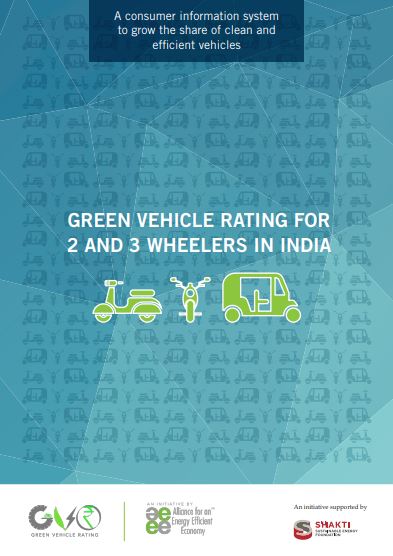
Green Vehicle Rating for 2 and 3 Wheelers in India
2018
Author(s): Kumar S, Yadav N, Das S, Mathew S
While traditional wisdom would count the 80% share of two and three-wheelers in India’s vehicle fleet as a hurdle in curbing vehicular energy and environmental burdens but thought otherwise, it presents an opportunity as large as the massive consumer base which is yet to be tapped with simple and open information for the bottom-up shift to cleaner and efficient vehicles.