



Knowledge Hub

Incentivizing Smart Charging: Modeling Charging Tariffs for Electric Vehicles in German and French Electricity Markets
2018
Author(s): Ensslen A, Ringler P, Dörr L, Jochem P, Zimmermann F, Fichtner W
Over the past few years, registration figures of plug-in electric vehicles have increased rapidly in industrialized countries. This could cause considerable mid- to long-term effects on electricity markets. To tackle potential challenges specific to electric power systems, the authors develop a load-shift-incentivizing electricity tariff that is suitable for electric vehicle users and analyze the tariff scheme in three parts.

Experiences From an E-Mobility Project in a Local Power Grid With Redox-Flow Energy Storage System. Project Report
2018
Author(s): Hommel S, Blumhagen C, Leonhardt S, Werler P, Bodach M, Zacharias L, Demmler F, Bilsing F
The project report presented would highlight the challenges and synergy impact of increasing electric mobility and renewable energy on the local power grid. In order to align local energy output and requirements, the implemented redox flow storage system was used.

Fast Charging Battery Monitoring System for Lead-Acid Batteries
2018
Author(s): Jaiswal S, Patil U, Gambhir A
India is currently the world's second largest two-wheeler market, Asia's third largest market for passenger vehicles, and the fifth largest market for buses and trucks in the world. Because of this, India currently ranks 4th on the CO2 emissions scale.

Fostering Share&Charge Through Proper Regulation
2018
Author(s): Vanrykel F, Ernst D, Bourgeois M
This article studies the emergence of Share&Charge, a German platform that organizes the sharing of charging stations for electric vehicles (EVs) and the billing for the energy transactions. Share&Charge follows a peer-to-peer fashion, enabling direct transactions between charging station owners and EV drivers

Harmonized Standards for Electric Vehicle-Grid-User System
2018
Author(s): Amditis A, Theodoropoulos T, Brusaglino G, Oceano A, Rodella G, Rizzo R, Di Noia LP
As a primary factor in human activity, the transport system plays a role in the context of the use of electricity on environmental impact and on social health. In compliance with the EU mandate, electric mobility will contribute to the transport system with user-friendly means and solutions, thus reducing negative effects in these areas.

Impact of Fast-Charging and Regenerative Braking in LiFePO4 Batteries for Electric Bus Applications
2018
Author(s): Carrilero I, Ansean D, Viera JC, Fernandez Y, Pereirinha PG, Gonzalez M
The role of electric buses (EBs) is crucial in public transit of reducing urban pollution and greenhouse gas emissions and, thus, global warming. To design a cost effective, energy efficient, sustainable EBs fleet, the EB batteries and the charging infrastructure must be correctly selected.

Intelligent Transportation Systems Enabled ICT Framework for Electric Vehicle Charging in Smart City
2018
Author(s): Cao Y, Ahmad N, Kaiwartya O, Puturs G, Khalid M
Electric vehicles (EVs) are expected to be widely adopted in modern cities as personal, commercial, and public fleets in the future. The popularity of EVs would have a significant impact on urban cities' sustainable and economic growth.

Ensuring a Sustainable Supply of Raw Materials for Electric Vehicles : A Synthesis Paper on Raw Material Needs for Batteries and Fuel Cells
2018
Author(s): Agora Verkehrswende
This study examines the supply situation for raw materials required to make electric vehicle batteries and fuel cells and also incorporates the latest findings and data in this area, which have been used to calculate future raw material demand in two different scenarios.
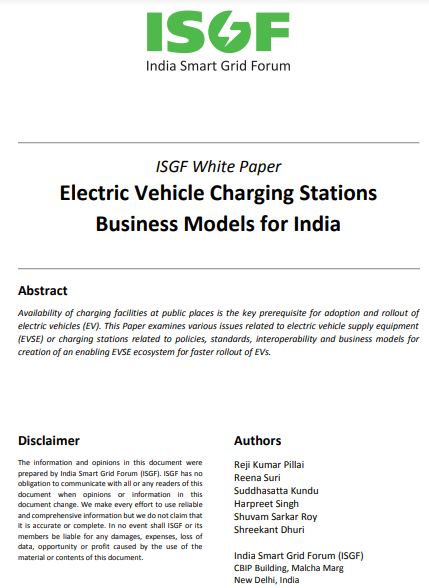
Electric Vehicle Charging Stations Business Models for India
2018
Author(s): Pillai RK, Suri R, Kundu S, Singh H, Roy SK, Dhuri S
This Paper examines various issues related to electric vehicle supply equipment (EVSE) or charging stations related to policies, standards, interoperability and business models for creation of an enabling EVSE ecosystem for faster rollout of EVs.

The Demographics of Decarbonizing Transport: The Influence of Gender, Education, Occupation, Age, and Household Size on Electric Mobility Preferences in the Nordic Region
2018
Author(s): Sovacool BK, Kester J, Noel L, de Rubens GZ
This paper argue that a deeper understanding of the social and demographic perspectives of electric vehicles (in comparison to other modes of transportation, such as conventional cars) is required.