



Knowledge Hub
This presentation by Dr Raimonds Aronietis, Policy Analyst International Transport Forum (ITF) was presented in the Decarbonising Road Freight expert workshop on 28 June 2018 in Paris, France.

This presentation by Philippe Divine Renault on Access to the Cities with Renault Electric range, push the boundaries talks about the EV ecosystem at Renault and Renault electric vehicles.
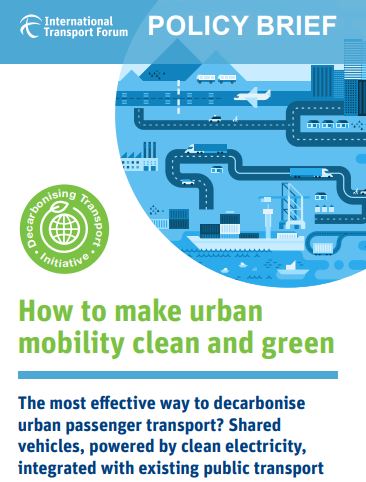
How to make urban mobility clean and green
2018
Publisher/Organisation: International Transport Forum (ITF)
This policy brief by the International Transport Forum (ITF) highlights the most effective way to decarbonise urban passenger transport with the integration of Shared vehicles, powered by clean electricity, with existing public transport.
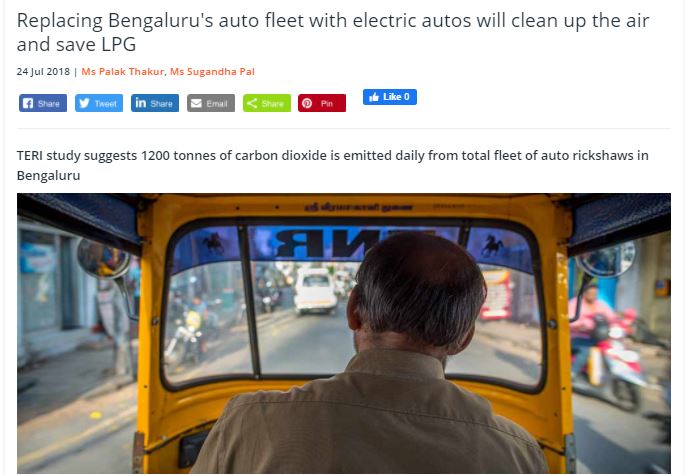
Replacing Bengaluru’s Auto Fleet With Electric Autos Will Clean Up the Air and Save LPG
2018
Author(s): Thakur P, Pal S
A recent research paper released by TERI estimates and describes the status of tail pipe emissions in the form of carbon dioxide, particulate matter 10 (PM10) and nitrogen oxide emitted by two-stroke and four-stroke autos plying in Bengaluru.
The Global Electric-Vehicle Market Is Amped Up and on the Rise
2018
Author(s): Hertzke P, Müller N, Schenk S, Wu T
Pure electric vehicles (BEV) currently make up 66 percent of the global EV market. BEV sales are growing faster than those of plug-in hybrid vehicles (PHEV). The Chinese market expanded by 72 percent over the previous year in 2017.
.JPG)
China’s new energy vehicle mandate policy 2018 (final rule)
2018
Publisher/Organisation: International Council on Clean Transportation (ICCT)
China’s Ministry of Industry and Information Technology (MIIT) finalized the New Energy Vehicle (NEV) mandate policy on September 27, 2017. The NEV mandate in China is a modified version of California’s Zero Emission Vehicle (ZEV) mandate, with goals of promoting new energy vehicles and providing additional compliance flexibility to the existing fuel consumption regulation. This policy applies only to passenger cars and will formally take effect on April 1, 2018. The rule specifies NEV credit targets for two years - 10% of the conventional passenger vehicle market in 2019 and 12% in 2020. In this update, the document provides a general introduction to working of NEV mandate policy, evaluates the potential impacts of this policy and highlights the major differences between the final rule and the interim proposal.
Coordinating E-Mobility Charging for Frequency Containment Reserve Power Provision
2018
Author(s): Schlund J, Steinert R, Pruckner M
All over the world, both the energy and transport sector are in a process of change. This paper present a novel approach of coordinating battery electric vehicle charging processes as an ancillary service for the grid.

Approaching Net Zero Energy Housing Through Integrated EV
2018
Author(s): Doroudchi E, Alanne K, Okur Ö, Kyyrä J, Lehtonen M
The zero‐energy concept has been developed and widely used in energy policy making with an aim at designing and building sustainable buildings and communities. Electric vehicle (EV) contributes in providing the building energy demand when it is available in the building site and its energy is applicable.
Electric Vehicle Costs and Consumer Benefits in Colorado in the 2020–2030 Time Frame
2018
Author(s): Lutsey N, Nicholas M
This study responds to two Zero-emission vehicle (ZEV) regulation questions: How quickly are electric vehicle costs declining and what are the resulting consumer benefits compared to gasoline vehicles? This paper analyzes these two questions in the context of Colorado’s potential adoption of a zero-emission vehicle regulation for new light-duty vehicles from 2023 through 2030.

Optimal scheduling of plug in hybrid electric vehicles with distributed generations for different vehicle trip models
2018
Author(s): Suganya S
The EV technology is not a recent innovation. In fact, the EVs are built during the 19th century after the development of lead-acid batteries.