



Knowledge Hub
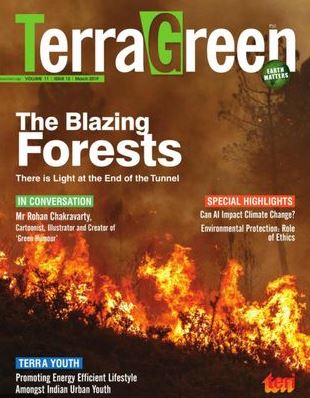
Two-stroke Autos in Bengaluru: Estimation and Status of Tailpipe Emissions
2018
Author(s): Thakur p, Pal S
Auto rickshaws play a crucial role in meeting the mobility requirements in Bengaluru city, and if switched to cleaner fuel technology-based solutions, these can contribute to the emission reduction within the city. This paper was developed by TERI and its objective is to estimate the vehicular emissions in the form of CO2, PM10, and NOx emitted by the auto-rickshaws plying in Bengaluru City.
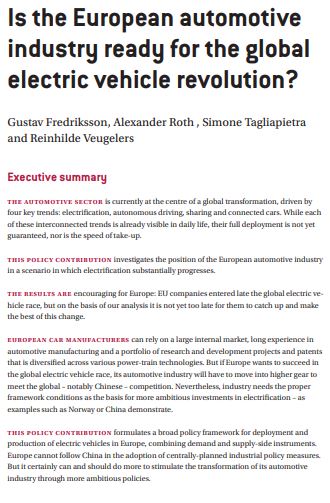
Is the European automotive Industry ready for the global electric vehicle revolution?
2018
Publisher/Organisation: Bruegel
The automotive sector is currently at the centre of a global transformation, driven by four key trends - electrification, autonomous driving, sharing and connected cars. This Policy Contribution investigates the position of the European automotive industry and envisages that the industry will have to move into higher gear to meet the global – notably Chinese – competition. This policy contribution formulates a broad policy framework for the deployment and production of electric vehicles in Europe, combining demand and supply-side instruments. While Europe cannot follow China in the adoption of centrally-planned industrial policy measures, it can do more to stimulate the transformation of its automotive industry through more ambitious policies.
Towards Smarter Service Provision for Smart Cities: Accounting for the Social Costs of Urban Service Provision
2018
Author(s): Markandya A, Sagar A, Shastry S, Goswami S, Ray I, Aziz Z, Paul S, Pai M, Tagat A, Chatterjee A
Through a case study of four Indian cities, this work examines the current unmanaged growth (business as usual urbanisation) and the costs associated with it. This paper has been jointly prepared by Indian Council for Research on International Economic Relations (ICRIER) and World Resources Institute (WRI) under the aegis of New Climate Economy the flagship project of The Global Commission on the Economy and Climate. The project has been overseen and led by Rajat Kathuria (Director & CE, ICRIER) and Ani Dasgupta (Global Director, WRI Ross Center for Sustainable Cities).
Report of the Committee on Technical Aspects of Charging Infrastructure for Electric Vehciles
2018
Publisher/Organisation: Central Electricity Authority (CEA)
This report provides the details of the discussion points of the meeting corresponding to all the Terms of the Reference and the recommendations of the Committee on Technical Aspects, set up by the Ministry of Power regarding Electric Vehicles on 2nd January 2018, to address the issues and draw the roadmap for setting up charging infrastructure.
This presentation by Energy Efficiency Services Limited (EESL), A joint venture (JV) of PSUs under the Ministry of Power (MoP), Government of India gives an overview of EESL, its key business models and initiatives and a brief about EESL’s EV Program.
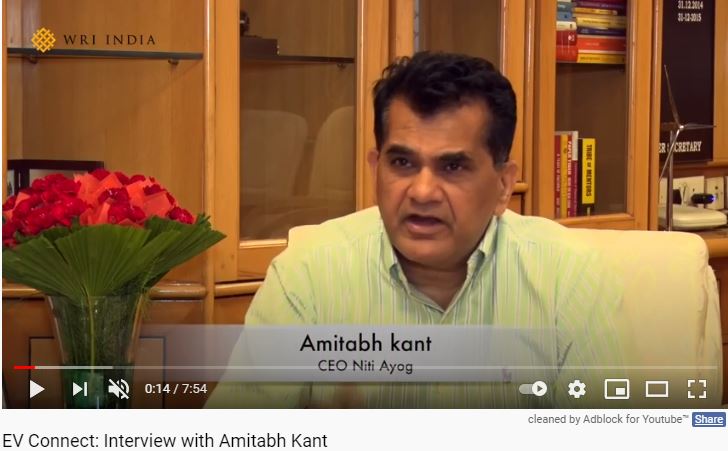
This interview was conducted by WRI India with Amitabh Kant, CEO of NITI Aayog, India, about the potential of electric vehicles (EV) in the Indian landscape.
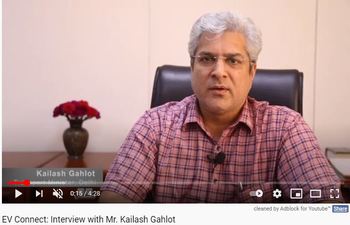
The World Resources Institute (WRI) conducted a candid conversation with Mr. Kailash Gahlot, Transport Minister, Government of NCT of Delhi on the issues related to electric mobility in Delhi and the way forward.
The new EU regulation on CO2 emissions from cars and how it impacts carbon targets in Germany’s transport sector
2018
Publisher/Organisation: Agora Verkehrswende
This document by Agora Verkehrswende provides an analysis of the European Commission’s recent legislative proposal for new CO2 emissions standards for cars, along with two possible variations on the proposal. The document highlights the importance of these standards in meeting Germany’s transport sector targets and in furthering the roll-out of low and zero-emissions vehicles.
International Evaluation of Public Policies for Electromobility in Urban Fleets
2018
Author(s): Slowik P, Araujo C, Dallmann T, Façanha C
This evaluation of international electric mobility public policies is focused on light-duty passenger vehicles including public and private fleets, buses, and urban delivery vehicles from the major markets in North America, Europe, Brazil and Asia, and the analysis highlights emerging developments in India when relevant.
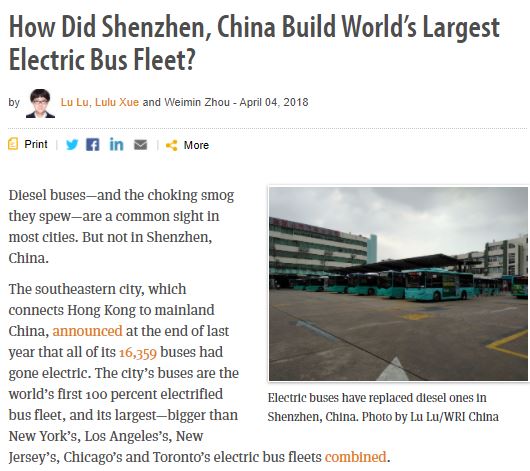
How Did Shenzhen, China Build World’s Largest Electric Bus Fleet?
2018
Author(s): Lu L, Xue L, Zhou W
The southeastern city, which connects Hong Kong to mainland China, announced at the end of last year that all of its 16,359 buses had gone electric.