



Knowledge Hub

Optimal Planning and Impact Analysis of Electric Vehicle Fast Charging Stations in Distribution Systems
2019
Author(s): Shukla, Akanksha
This thesis attempts to address the major issues of load modelling, planning and impact analysis of Fast Charging Stations with renewable on the performance of distribution system.

In this research work, a power management system is developed to effectively utilize power from both smaller size fixed batteries and larger size batteries to supply energy demanded by drivetrain of EVs.
Moving the Masses: Bus-Rapid transit (BRT) policies in low income Asian cities
2019
Author(s): Wijaya S E, Imran M
Public transport in low-income Asian (LIA) cities fails to meet people's mobility needs, generates high greenhouse gas (GHG) emissions and worsens social exclusion. This book investigates policy tensions by examining the planning and attempted implementation of BRT projects, taking Bandung and Surabaya in Indonesia as case studies

Wind Energy Conversion System for a Moving Vehicle
2019
Author(s): Gururaj HC, Hegde V
India has the second largest road network in the world, since the highway is wide open space there will not be any obstruction for the wind flow. When the vehicle is moving at a faster rate on a highway, the velocity of the wind on top of the vehicle will be high, which can be used to produce electricity.
Augmentation of Charging Infrastructure for Electric Vehicles Growth in India
2019
Author(s): Goswami R, Tripathi GC
This study aims to appraise the impact of different adoption rates of EVs on the additional power and charging infrastructure requirement. To achieve this goal, it plans to use electric cars (EVs) to the tune of 30% by 2030.

Modelling Effects of the Distributed Generation Supporting E-Mobility on the Operation of the Distribution Power Network
2019
Author(s): Tomasov M, Motyka D, Kajanova M, Bracinik P
The essential idea to support an e-mobility from available electricity point of view is to use distributed generation to produce free electricity to charge e-vehicles. In recent years, the use of electric vehicles is increasing as a solution for reduction of air pollution and global warming, so the need for electricity is also increasing.
PMSM Control for Electric Vehicle Based on Fuzzy PI
2019
Author(s): Chen Q, Kang, S, Zeng L, Xiao Q, Zhou C, Wu M.
The mathematical model of permanent magnet synchronous motor (PMSM) in d-q reference frame is established, fuzzy PI speed controller is designed based on fuzzy control theory, and simulation models of PMSM based on fuzzy PI control theory and sliding mode control theory are built in this paper.
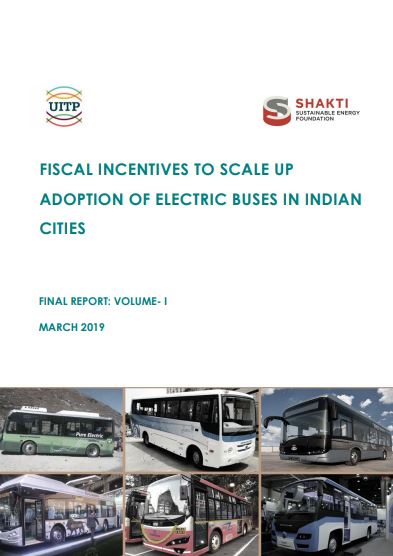
Fiscal Incentives to Scale up Adoption of Electric Buses in Indian Cities
2019
Author(s): Gadepalli R, Cheriyan C, Kumar S, Singh J, Nandy R
The Faster Adoption and Manufacturing of Electric Vehicles (FAME) scheme launched in the 2015, kick-started the adoption of electric vehicles in India by providing financial incentives for Electric Vehicle (EV) purchase, charging infrastructure deployment and Research and Development (R&D) of electric vehicles.

Allocation of E-Car Charging: Assessing the Utilization of Charging Infrastructures by Location
2019
Author(s): Baresch M, Moser S
This paper aims to examine the distribution of the allocation of future charges to the various types of charging stations in order to provide a starting point for the evaluation of the need for charging infrastructure, i.e. its number, design and cost-effectiveness.
This document summarizes the grant programme for funding electric transit buses by the Federal Ministry for the Environment, Nature conservation and Nuclear Safetey (BMU) in English.