



Knowledge Hub
Electric surge: carmakers' electric car plans across Europe 2019-2025
2019
Author(s): Transport & Environment
Electric cars are about to go mainstream in Europe, and 2020/2021 is likely to be a tipping point for the market. Until recently, the EV market was limited to a niche of early adopters but tomorrow’s landscape will be very different as EVs enter a new phase and near the mass market. This report shows where the future electric cars and batteries will be produced in Europe, and analyses the expected production trends, and whether or not these are enough to meet the EU demand up until 2025.
Global energy outlook 2019: the next generation of energy
2019
Author(s): Newell RG, Raimi D Aldana G
This report provides an analysis of long-term energy projections from governmental, intergovernmental, and private organizations using a unique methodology that allows for “apples-to-apples” comparisons. These projections agree that—absent ambitious climate policies—global energy consumption will grow 20–30% or more through 2040 and beyond, led largely by fossil fuels.
A Simulation Tool for Energy Management of E-Mobility in Urban Areas
2019
Author(s): Ferrara M, Monechi B, Valenti G, Liberto C, Nigro M, Biazzo I
In this paper the authors describe a simulation tool developed to study city wide scenarios of e-mobility. The tool is intended to support e-mobility stakeholders in finding effective solutions to facilitate a widespread and sustainable EV adoption in urban areas.
India’s electric mobility transformation: progress to date and future opportunities
2019
Author(s): NITI Aayog and Rocky Mountain Institute (RMI)
The report is intended to support continued conversation and action towards India’s accelerated transition to electric mobility. It provides a summary of key policy and industry initiatives to support rapid adoption of electric mobility. Analyse the impacts of FAME II with respect to emissions, oil consumption, and overall EV adoption trends. It further propose possible actions that industry and government can take in continued support of the faster deployment of EVs.

E-Mobility: Safety, Service Continuity and Penetration of Charging Systems
2019
Author(s): Mauromicale G, Raciti A, Rizzo SA, Susinni G, Parise G, Parise L
This paper has presented the kinds of electric vehicles that need to be charged through residential charging systems or public charging stations and the basic types of charging systems. International guidelines have defined various aspects relating to electric vehicles that also this paper presents briefly.
Erollin’ on Green: A Case Study on Eco-Feedback Tools for Emobility
2019
Author(s): Cech F, Wagner M
This case study, evaluated the transformative potential of eco-feedback tools for sustainable mobility practices utilizing an action-research based methodology. Utilizing an action-research based methodology, the authors engage the local community in cooperation with the aspern.mobil LAB to co-design a digital interactive tool visualizing the participants' personal CO2-footprint.
Retrofitting of Sensors in BLDC Motor Based E-Vehicle – A Step Towards Intelligent Transportation System
2019
Author(s): Pothirasan N, Pallikonda Rajasekaran M
Human life is the precious one which cannot be recoverable unlike other properties. Every year many lives have been lost due to these road accidents. This paper mainly focuses on road accidents occurring due to drowsy state and drunken state of drivers.

European Innovation for Next Generation Electrified Vehicles and Components
2019
Author(s): Armengaud E, Hegazy O, Brandstatter B, Ivanov V, Tatschl R, De Gennaro M, Sorniotti A, Van Mierlo J, Schernus C
Electrification of road transport is a key challenge to reach the emission targets while enabling efficient mobility for persons and goods. Even though solutions already exist on the market, e-mobility is still a niche market.
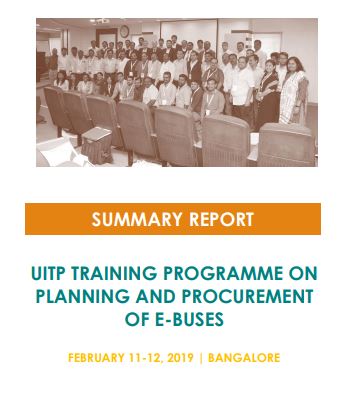
UITP Training Programme on Planning and Procurement of E-Buses
2019
Author(s): International Association of Urban Transport (UITP), Shakti Sustainable Energy Foundation
Indian cities are pursuing ambitious electric bus deployment targets to reduce the emissions and improve efficiency of transport systems. Some cities have already initiated electric bus roll-out through the FAME I scheme, while many others are at different stages of planning and implementation.
Blockchain Technology in the Energy Sector: A Systematic Review of Challenges and Opportunities
2019
Author(s): Andoni M, Robu V, Flynn D, Abram S, Geach D, Jenkins D, McCallum P, Peacock A
This work provides a comprehensive overview of fundamental principles that underpin blockchain technologies, such as system architectures and distributed consensus algorithms. This study reviews 140 blockchain research projects and startups from which the authors construct a map of the potential and relevance of blockchains for energy applications.