



Knowledge Hub
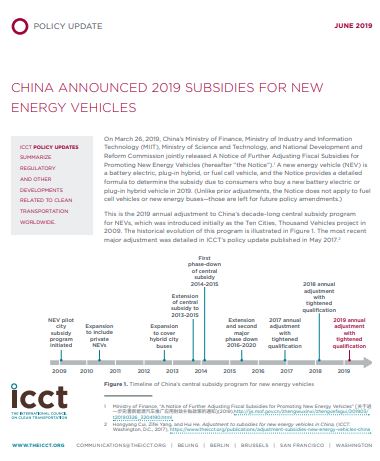
China announced 2019 subsidies for new energy vehicles
2019
Publisher/Organisation: International Council on Clean Transportation (ICCT)
China’s Ministry of Finance, Ministry of Industry and Information Technology (MIIT), Ministry of Science and Technology, and National Development and Reform Commission on March 26, 2019, jointly released A Notice of Further Adjusting Fiscal Subsidies for Promoting New Energy Vehicles. A new energy vehicle (NEV) is a battery-electric, plug-in hybrid, or fuel cell vehicle, and the Notice provides a detailed formula to determine the subsidy due to consumers who buy a new battery electric or plug-in hybrid vehicle in 2019. The Notice outlines tightened requirements to qualify for the subsidy and provide a revised formula to determine the subsidy’s size. Further, it includes guidance regarding the paired incentive from local governments, and a few provisions to enhance the overall effectiveness of the program. The last section of this policy update describes a special provision regarding how the current and new policies connect during the transition period.
Mobility Choice Blueprint
2019
Author(s): Denver Metro Chamber of Commerce, Denver Regional Council Of Governments, Colorado Department of Transportation, RTD
To maintain the economic competitiveness and livability of communities, the Denver region’s major multimodal agencies have agreed to develop a Mobility Choice Blueprint — a coordinated strategy for how one can enable more accessible and effective transportation mobility choices to enhance the quality of life now and in the future.
Quantifying the Electric Vehicle Charging Infrastructure Gap Across U.S. Markets
2019
Author(s): Nicholas M, Hall D, Lutsey N
This report quantifies the gap in charging infrastructure to power more than 3 million expected electric vehicles by 2025. Based on the expected growth across the 100 most populous U.S. metropolitan areas, the authors estimate the amount of charging of various types that will be needed to power these vehicles.
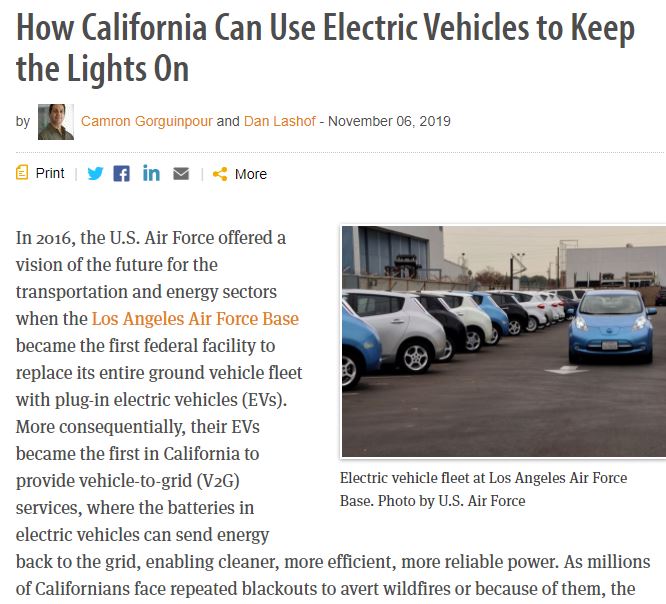
How California Can Use Electric Vehicles to Keep the Lights On
2019
Author(s): Gorguinpour C, Lashof D
In this blog post, WRI, in reference to the Los Angeles Air Force Base, talks about how electric vehicle batteries can be used to keep the power on in shelters, emergency response centres or other key areas of need during a disaster.

Investigation on Rattle Noise Reduction in Motor Assisted Electric Power Steering
2019
Author(s): Pastin Sony Sundar Y
Quality is an important element in the design aspects of aggressive Automobile and Mechanical Industry. The noise generated by specific elements and mechanics in the reduction unit worm shaft wheel mechanism and motor of Column electric power steering may play a significant function in determining the perceived quality of the overall noise and in turn the perceived quality of these Automobile structures.
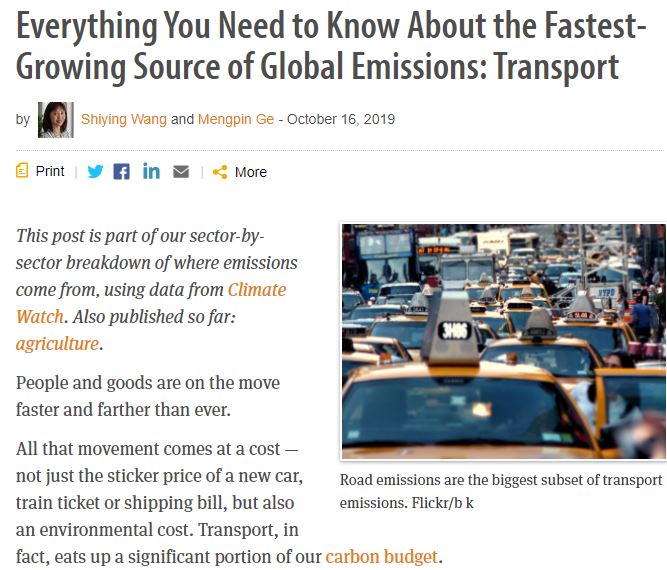
Everything You Need to Know About the Fastest-Growing Source of Global Emissions: Transport
2019
Author(s): Wang S, Ge M
Decarbonization of the transport sector would create a cleaner, healthier and more affordable future for everyone. And it can be done without sacrificing the interconnectedness we've come to expect from modernity. But what exactly are transport emissions? How are countries already addressing them, and where are the further opportunities for decarbonization? To better understand those questions, WRI uses Climate Watch to take a closer look at the data.
Early Steps in the Transition to Electric Vehicles in the Midwest
2019
Author(s): Nicholas M
This briefing takes an in-depth look at the 2018 market for electric vehicles in the 12-state Midwest region of the United States.

Electric Vehicle Capitals: Showing the Path to a Mainstream Market
2019
Author(s): Hall D, Cui H, Lutsey N
This briefing assesses metropolitan area-level data on electric vehicle registrations and identifies the 25 largest electric vehicle markets, which together represent 42% of new passenger electric vehicle sales globally through 2018.
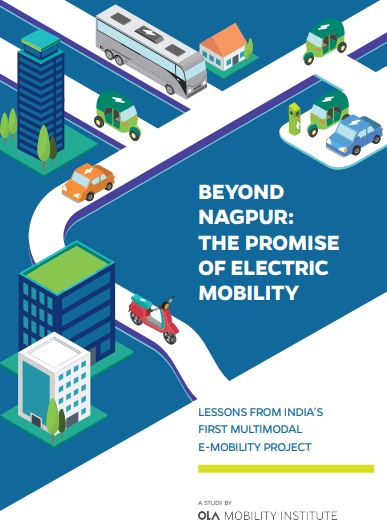
Ola Mobility Institute (OMI) studied India’s first multimodal electric mobility project in Nagpur through a pilot in May 2017. The pilot focused primarily on ensuring usage of EVs - or simply put, clean kilometres travelled – to test the viability of EVs on economic metrics. The study found that the pilot required a broad set of actions. This report takes into account data points from all aspects of EV operations spread over 18 months of the Nagpur pilot providing a detailed overview of the study.
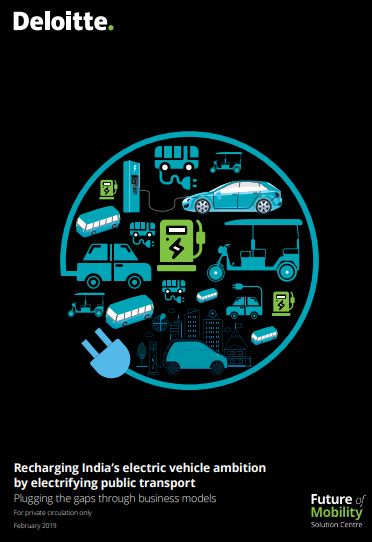
Recharging India’s Electric Vehicle Ambition by Electrifying Public Transport
2019
Author(s): Deloitte
Rapid urbanisation stimulates mobility needs and augments travel demand, creating a surge in the demand for vehicles. Rising number of vehicles impacts air quality and increases the country’s dependence on crude oil leading to higher import bills.