



Knowledge Hub
Assessing the Business Case for Hosting Electric Vehicle Charging Stations in New York State
2019
Author(s): Atlas Public Policy
The goal of the report is to harness real-world experience to establish an understanding of current charging behavior and inform future efforts to expand the EV market in New York. The main findings from the analysis are that user fees are essential to cover costs, workplace charging stations have the highest utilization among various location types, and charging stations must be used more than once per day to achieve profitability.

Analysis of Microgrids for Plug in Hybrid Electric Vehicles Charging Stations
2019
Author(s): Ahmad F
The present lifestyle of mankind thrives on consumption of electric energy thereby making it an inevitable necessity. The increasing population has led to ever-growing energy demand.

Multimodal Choice Model for E-mobility Scenarios
2019
Author(s): Ferrara M, Liberto C, Nigro M, Trojani M, Valenti G
This paper focuses on the definition, calibration and testing of a simulation model that is able to represent multimodal choice behaviours for electric vehicles.
A Review of Spatial Localization Methodologies for the Electric Vehicle Charging Infrastructure
2019
Author(s): Pagany R, Ramirez Camargo L, Dorner W
The present paper provides a comprehensive overview of the state-of-the-art literature for CS location analysis. It categorizes the literature with view to the modeling approach and provides specific information, especially with regard to the criteria applied for identifying CS locations.
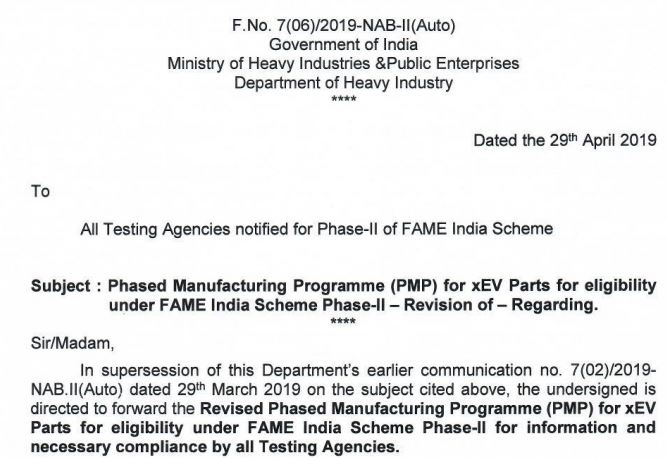
Phased Manufacturing Programme (PMP) for xEV parts for eligibility under FAME India Scheme Phase-II- Revision of - Regarding
2019
Publisher/Organisation: Ministry of Heavy Industries and Public Enterprises, Government of India
This document was issued by the Department of Heavy Industry dated 2nd May 2019 on Phase Manufacturing Programme (PMP) for xEV parts for eligibility under FAME India Scheme Phase-II.
Integrated Transport Planning: From Supply- to Demand-Oriented Planning. Considering the Benefits
2019
Author(s): Schwedes O, Hoor M
The idea of integrated transport planning is widely accepted in the research community as well as in the field of transport policy. Acknowledging the gap between concept and reality, the benefits of a demand-oriented approach have to be reconsidered by the various stakeholders in politics, the economy, planning and civil society.
In India, the building sector contributes to consumption of about 33% of the total energy produced in the country which is second highest after industrial sector which accounts for 45% of net production.
Comparison of Decarbonisation Strategies for India’s Land Transport Sector
2019
Author(s): Center for Study of Science, Technology and Policy (CSTEP), Council on Energy, Environment and Water (CEEW), Integrated Research for Action and Development (IRADe), Pacific Northwest National Laboratory (PNNL), The Energy and Resources Institute (TERI)
This report provides the results of an inter-model comparison exercise undertaken by five modelling teams to analyse the future growth of India’s transport sector and to evaluate the role of various transport sector policies in reducing transport related energy emissions in India.

Electrical Modeling of Nickel-Metal Hydride Batteries for Personal Electric Vehicles
2019
Author(s): Prabpal P, Bhumkittipich K, Haraguchi T
This article presents the electrical modeling of the nickel-metal hydride battery ( NiMH) used in electric vehicles. According to the battery life cycle, the physical and electrical models of the proposed battery should be analyzed in detail for the condition to control the electric vehicle's operation.
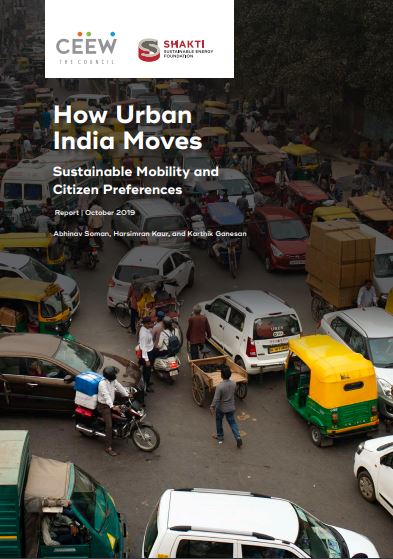
The urban mobility landscape in India is rapidly evolving. Population growth, rising income levels, increasing motorisation and changing preferences are among the factors driving change in how people move in a city.