



Knowledge Hub
Adopting the Topology Optimization in the Design of High-Speed Synchronous Reluctance Motors for Electric Vehicles
2020
Author(s): Credo A, Fabri G, Villani M, Popescu M
This article deals with the design of high-speed synchronous reluctance motors for electric vehicle applications. The need to enhance the power density and to lower the cost leads to research on high-speed motors with a reduced amount of rare earth.
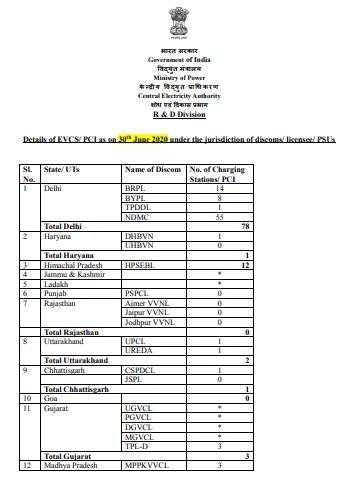
Details of EVCS/ PCI as on 30th June 2020 under the jurisdiction of discoms/ licensee/ PSUs
2020
Publisher/Organisation: Central Electricity Authority (CEA)
The Research and development division of the Central Electricity Authority (CEA) under Ministry of Power, Government of India released a list of electric vehicle charging stations/ public charging infrastructure (EVCS/ PCI) that lie under the jurisdiction of discoms/ licensee/ PSUs.
Raising ambitions: a new roadmap for the automotive circular economy
2020
Author(s): World Economic Forum, Accenture Strategy
A meaningful transition to the circular economy will require playe...

An Algorithm for the Ancillary Services Provision by E-Mobility-based Virtually Aggregated Mixed Units
2020
Author(s): Falabretti D, Gulotta F
The present paper deals with the provision of ancillary services to the power system through the scheduling of the charging requests of electric vehicles. The scheduling process is based on a hybridization of the Artificial Bee Colony algorithm (h-ABC).
Data-Driven Smart Charging for Heterogeneous Electric Vehicle Fleets
2020
Author(s): Frendo O, Graf J, Gaertner N, Stuckenschmidt H
In this work, the authors propose a data-driven approach for integrating a machine learning model to predict arbitrary charge profiles into a smart charging algorithm.

Comparison of Energy Consumption of Short and Long City Buses in Terms of Assessing the Needs for e-Mobility
2020
Author(s): Burdzik R, Konieczny Ł, Jaworski R, Laskowski D, Polak R
An important means of transport in urban agglomerations are buses. The article presents the results of simulation studies, the aim of which was to compare comparative energy consumption of short and long city buses in terms of assessing the needs for e-mobility.
EleMA: A Reference Simulation Model Architecture and Interface Standard for Modeling and Testing of Electric Vehicles
2020
Author(s): Granrath C, Meyer MA, Andert J, Ewald J, Klink R, Stroh C, Pham T, Phillips R, Hettig C, Santaroni L, Deppe M, Hegazy O
This paper presents a reference simulation model architecture for electric vehicles, which is offered as a standard for closed-loop simulations in real-time and non-real-time. The proposed Electric Modeling Architecture (EleMA) is intended as an extension of standardized model exchange formats by defining standardized, functional and signal-based interfaces of electric vehicle simulation models.
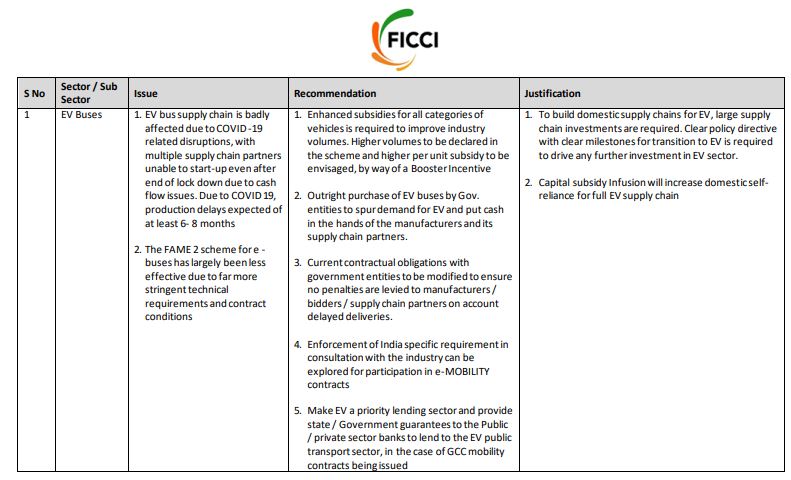
Post COVID Support Required to Electric Vehicles: FICCI Recommendations to Government
2020
Publisher/Organisation: Federation of Indian Chambers of Commerce & Industry (FICCI)
As demand and investments in the Electric Vehicles (EVs) sector are severely hit due to disruptions caused by COVID-19, FICCI has suggested to the Government, a series of measures to ensure continuity of the EV growth roadmap and achievement of the targets as envisioned by the Government for the sector in the next decade. These suggestions have been submitted to NITI Aayog, Department of Heavy Industry, Ministry of Road Transport and Highways and other relevant authorities in the Government.
This report highlights the key trends in the automotive sector and how it is shaping the consumer perceptions. According to the study, even as 80% of survey respondents in India are excited about using connected vehicles and are convinced of its benefits, concerns over security remain constant.

Understanding the Impact That Potential Driving Bans on Conventional Vehicles and the Total Cost of Ownership Have on Electric Vehicle Choice in Germany
2020
Author(s): Letmathe P, Suares M
This study analyzes the penetration by battery electric vehicles (BEVs) in Germany and examines two influential factors – policy measures and disclosing consumer-oriented total cost of ownership (TCOC) information.