



Knowledge Hub

Implementation Framework for Automotive Technology: How to Introduce Hybrid and Electric Vehicles Into Automotive Production Lines
2020
Author(s): Otto WL, Dirkse van Schalkwyk T, Schutte CSL
In 2016 Mercedes-Benz SA introduced hybrid vehicles into their East London factory, pioneering high-voltage automotive manufacturing in the country. When the implementation decision was made, the factory was given less than a year to introduce this dangerous new technology at a level that met stringent international safety and quality standards, against a backdrop of a lack of applicable local legislation.
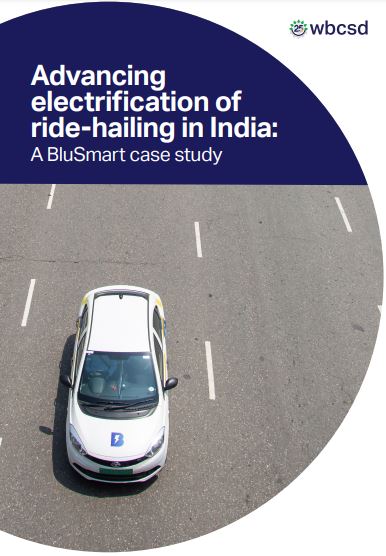
Advancing electrification in ride-hailing in India: A BluSmart case study
2020
Author(s): World Business Council for Sustainable Development
With the key objective of accelerating EV adoption in the ride-hailing market, this report aims to highlight: BluSmart’s journey in integrating and operating EVs; Challenges in integrating EVs into ride-hailing operations and Learnings for other existing and prospective ride-hailing companies
The Global EV Outlook is an annual publication that identifies and discusses recent developments in electric mobility across the globe. It is developed with the support of the members of the Electric Vehicles Initiative (EVI).
Market Development of Autonomous Driving in Germany
2020
Author(s): Kaltenhäuser B, Werdich K, Dandl F, Bogenberger K
This paper presents a model to predict the market penetration of autonomous cars for passenger transportation, focussing on autonomous taxis without a steering wheel. For this, a discrete system dynamics model was created and evaluated where the input parameters have been taken from the literature and a survey.

Low-carbon Energy Supply Strategy For Low Carbon & Sustainable Mobility in India
2020
Author(s): Federation of Indian Chambers of Commerce and Industry (FICCI)
The report aims to analyse the present gaps and challenges that prevent the transition to a renewable based energy supply for sustainable low carbon transport in India and propose practical recommendations, including short-term and longterm, necessitating the need of standardisation and laying standards that could aid the development of renewable sources of energy and their deployment in the Indian transport sector.
Electrified Ultralight Vehicles as a Key Element for Door-to-Door Solutions in Urban Areas
2020
Author(s): Köhler S, Norkauer A, Schmidt M, Loidl V
Finding sustainable and adaptive urban transportation solutions has the ability to shape the quality of life in cities. However, one major challenge involves reducing motorised private transportation in urban areas, which is largely responsible for noise and air pollution as well as increasingly long waiting times in congestion.
Energy Demand Assessment for Long Term Operation of Vehicles
2020
Author(s): Sitnik LJ
The work is about energy demand assessment for long term operation of vehicles in everyday conditions, with mileage measured in thousands of kilometers over a period of several years. The work concern mainly battery electric vehicles (BEVs).

Certain Investigations on the Improvement of Hybrid Electric Vehicle Performance through System Optimization
2020
Author(s): Gowrishankar T
In this research, an analysis on Parallel HEV to reduce fuel usage and improve emission control performance, in addition to optimizing the size of its key components has been performed. The optimization of the parallel HEV is performed using both the analytical and heuristic approach and their pros and cons were discussed.
Road Map for Electrification of Urban Freight in India (Part-I)
2020
Author(s): The Energy and Resources Institute (TERI)
This report looked into the definition of urban freight and the types of vehicles that are deployed for the purpose.
Road Map for Electrification of Urban Freight in India (Part-II)
2020
Author(s): The Energy and Resources Institute (TERI)
This study looks into the case cities – Delhi, Bengaluru and Surat, and sub-sectors in the urban freight sectors. The sub-sectors studied in this report are (i) delivery of posts and parcels by India Post in Bengaluru, (ii) organized service providers undertaking fleet level operations in Bengaluru, (iii) transport service providers for the textile industry in Surat, (iv) management and movement of solid waste in Surat, and (v) distribution of fruits and vegetables originating from the Azadpur and Okhla wholesale markets in Delhi.