



Knowledge Hub

Economic Effects of an E-Mobility Scenario–Input Structure and Energy Consumption
2020
Author(s): Ulrich P, Lehr U
The development of a strong domestic market for E-mobility is given a high priority and it is counted as an impulse for the transformation towards a Green Economy in Germany. Replacing the combustion engine by alternative drives can trigger a variety of macroeconomic effects.

Power Loss Analysis and Thermal Assessment on Wireless Electric Vehicle Charging Technology: The Over-Temperature Risk of Ground Assembly Needs Attention
2020
Author(s): Niu S, Yu H, Niu S, Jian L
Wireless electric vehicle charging (WEVC) emerges as a promising technology due to convenience characteristics and the mitigation of range anxiety to enable e-mobility. Recently, the safety issues on WEVC systems have drawn considerable attention. In light of thermal safety, the most critical part of WEVC systems is the surface of ground assembly (GA).

Emissions Reduction From Passenger Cars With RCCI Plug-In Hybrid Electric Vehicle Technology
2020
Author(s): Benajes J, García A, Monsalve-Serrano J, Martínez-Boggio S
This work investigated the potential of implementing the dual-fuel Reactivity Controlled Compression Ignition (RCCI) combustion mode in a plug-in hybrid vehicle platform. The results are compared against other electrifications levels and no-hybrid vehicles under the Worldwide Harmonized Light Vehicle Test Procedure (WLTP) normative.
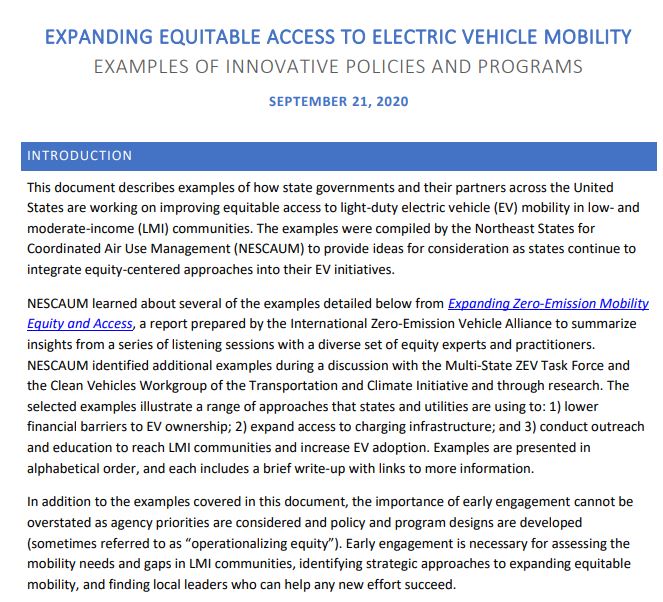
This document describes examples of how state governments and their partners across the United States are working on improving equitable access to light-duty electric vehicle (EV) mobility in low- and moderate-income (LMI) communities.

Investigation on Converter Topologies and Energy Management Schemes for Light Electric Vehicle
2020
Author(s): Devi VS
This thesis explores the performance of EV with Hybrid Energy Storage System (HESS) employing Li-ion battery and Ultracapacitor (UC). A comprehensive modelling of various system components of 3-wheeled Light Electric vehicle (LEV) based on Indian Driving Cycle (IDC) is presented to aid in the sizing of ESS.
The Economic Case for Electric Vehicles in Public Sector Fleets: An Italian Case Study
2020
Author(s): Danielis R, Scorrano M, Giansoldati M, Alessandrini S
The paper investigates whether it makes economic sense to use electric vehicles (EVs) in the public sector fleet.

Optimal scheduling of electric vehicle aggregator in electricity markets
2020
Author(s): Dharampal S S
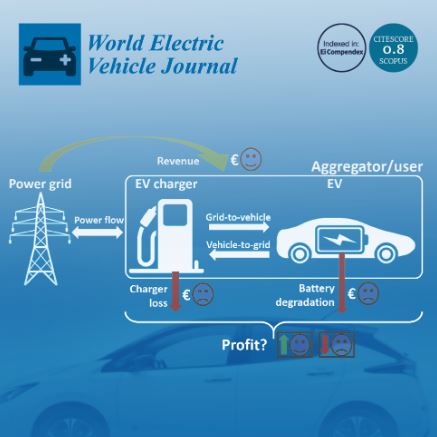
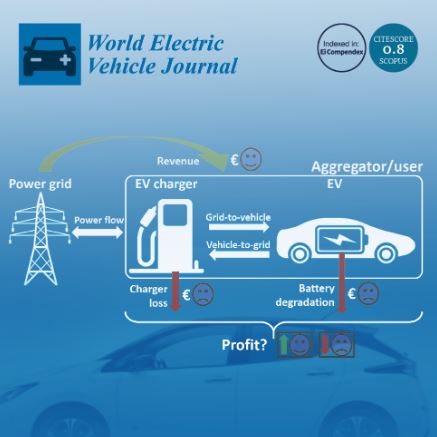
The main objective of this work is to introduce G2V scheduling in multiple electricity markets and to review important problems in the current G2V scheduling problem such as reduction of the EV owner cost, support the power grid, monetize and capture EVs’ value, generate revenues for EVA. The streams or stacks of value can be monetized by charging customers’ batteries when wholesale prices are low, or discharging them when the opposite is true; and by supporting local distribution networks at times when they are stressed.
E-Mobility Scheduling for the Provision of Ancillary Services to the Power System
2020
Author(s): Gulotta F, Rancilio G, Blaco A, Bovera F, Merlo M, Moncecchi M, Falabretti D
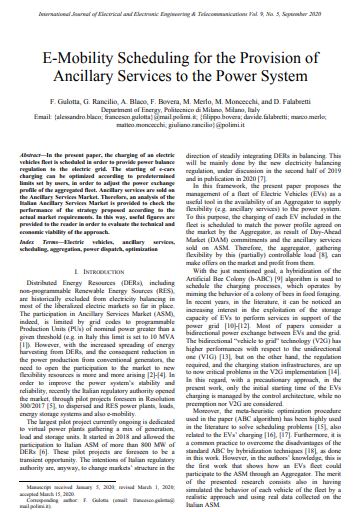
In the present paper, the charging of an electric vehicles fleet is scheduled in order to provide power balance regulation to the electric grid. The starting of e-cars charging can be optimized according to predetermined limits set by users, in order to adjust the power exchange profile of the aggregated fleet. The

Evaluating the Impact of Electric Vehicle Integration on an Urban Distribution Network
2020
Author(s): Dimovski A, Josifovska H, Falabretti D, Merlo M
The developments of technologies related to Renewable Energy Sources, together with the advancements in the e-mobility sector, have led to the need for a paradigm shift toward a new smart grid scenario.
Cloud-Based Big Data Platform for Vehicle-to-Grid (V2G)
2020
Author(s): Grée F, Laznikova V, Kim B, Garcia G, Kigezi T, Gao B
Over the last few years, battery electric vehicles (BEVs) have become more common. BEVs can be regarded as a grid load and as a way to support the grid (energy buffering), provided this extensive battery usage does not affect the BEV’s performance.