



Knowledge Hub
Battery Waste Management Rules, 2020
2020
Publisher/Organisation: Ministry of Environment, Forest and Climate Change (MoEFCC)
This notification of Draft Battery Waste Management Rules, 2020 was published by the Ministry of Environment, Forest and Climate Change (MoEFCC) on 20th February 2020.
Comments and Suggestions on Finalized Draft on “Specific Requirements for Electric Power Train of Vehicles”
2020
Author(s): Alliance for an Energy Efficient Economy (AEEE)
In this "Comments and Suggestions on Finalized Draft on “Specific Requirements for Electric Power Train of Vehicles” document, AEEE expressed its views on the safety concern that the draft does not take into consideration.
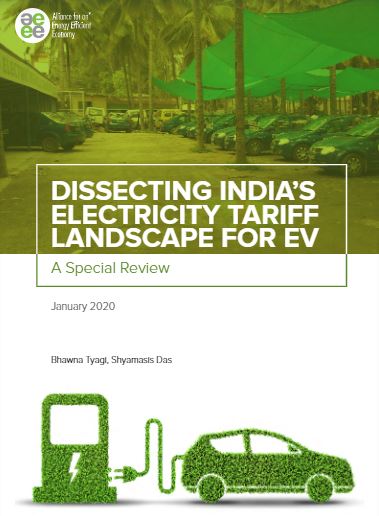
Dissecting India's Electricity Tariff Landscape for EV
2020
Author(s): Tyagi B, Das S
This review provides the state-wise energy charges and demand charges for EV charging at public charging stations along with a comparison of the EV tariffs with residential (i.e. subsidised category) and commercial tariffs (i.e. nonsubsidised category) of those states.
Comments on Draft Electricity (Rights of Consumers) Rules, 2020
2020
Author(s): Alliance for an Energy Efficient Economy (AEEE)
The Ministry of Power has proposed a new set of rules for the rights of consumers and prosumers. The draft rules specify a common minimum standard of performance for the utilities across the nation, with an objective to provide consumers with better services.
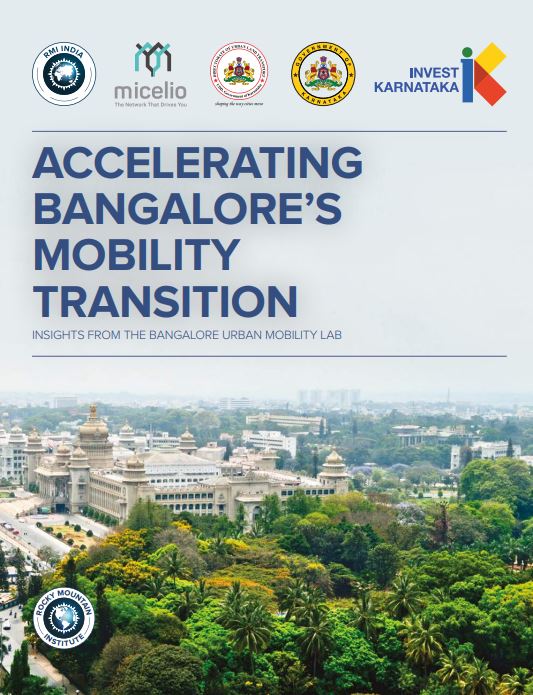
Accelerating Bangalore’s Mobility Transition
2020
Author(s): Rocky Mountain Institute, RMI India, Micelio
Cities across India are witnessing rapid urbanization and growing mobility demand. Developing and deploying shared, clean, and citizen-centric mobility solutions will be critical to ensure this demand is met in a sustainable manner that provides safe, accessible, and reliable transportation for citizens.
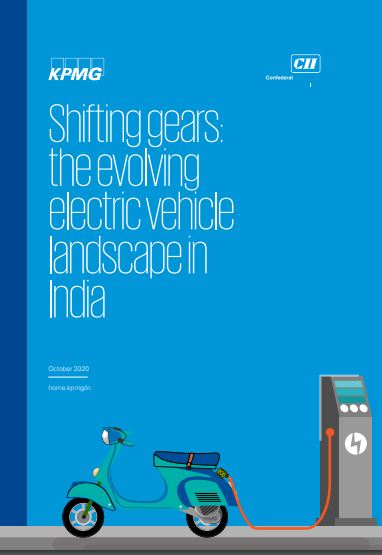
Shifting Gears: the Evolving Electric Vehicle Landscape in India
2020
Author(s): KPMG Assurance and Consulting Services LLP
The report provides an understanding of segment wise propensity to transition to EVs by analyzing use cases and Total Cost of Ownership, and estimates the EV penetration by 2025 and 2030.
Punjab Tariff Order FY 2020-21
2020
Publisher/Organisation: Punjab State Electricity Regulatory Commission (PSERC)
This Tariff Order was issued by the Punjab State Electricity Regulatory Commission on 1 st June 2020 in approval of the petition No. 29 of 2019 filed by Punjab State Transmission Corporation Limited (PSTCL).
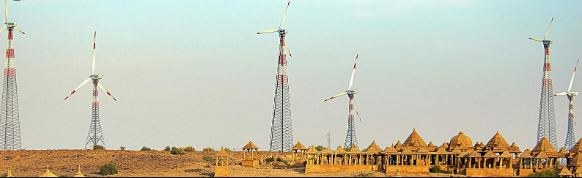
India, along with other parts of the world, is facing significant social and economic challenges after implementing measures to contain the spread of COVID-19. In response to the economic fallout, India announced a Rs 20 lakh crore (US$266 billion) relief package—one of the largest stimulus packages in the world as a share of gross domestic product (GDP).
Electric Vehicle Conductive Charging System Part 2 Plugs, Socket Outlets, Vehicle Connectors and Vehicle Inlets Section 3 Dimensional compatibility and interchangeability requirements for d.c. and a.c./d.c. pin and contact-tube vehicle couplers
2020
Publisher/Organisation: Bureau of Indian Standards (BIS)
This Standard (Part 2/Sec 3) is applicable to vehicle couplers with pins and contact- tubes of standardized configuration, herein also referred to as accessories, intended for use in electric vehicle conductive charging systems which incorporate control means, with rated operating voltage up to 1 500 V d.c. and rated current up to 250 A, and 1 000 V a.c. and rated current up to 250 A.
Electric Vehicle Conductive Charging System Part 2 Plugs, Socket, Outlets, Vehicle Connectors and Vehicle Inlets Section 2 Dimensional compatibility and interchangeability requirements for a.c. pin and contact-tube accessories
2020
Publisher/Organisation: Bureau of Indian Standards (BIS)
This section of IS 17017(Part 2) covers requirements of plugs, socket-outlets, vehicle connectors and vehicle inlets with pins and contact-tubes of standardized configurations, herein referred to as accessories, with nominal rated operating voltage not exceeding 415 V a.c., 50 Hz and a rated current not exceeding 63 A three-phase or 70 A single-phase, for use in conductive charging of electric vehicles.