



Knowledge Hub
Different Scenarios of Electric Mobility: Current Situation and Possible Future Developments of Fuel Cell Vehicles in Italy
2020
Author(s): Ala G, di Filippo G, Viola F, Giglia G, Imburgia A, Romano P, Castiglia V, Pellitteri F, Schettino G, Miceli R
The aim of the paper is to recognize whether fuel cell technology may be an enabling solution to overcome pollution problems and respect for the environment.

Can Product Service Systems Support Electric Vehicle Adoption?
2020
Author(s): Ensslen A, Gnann T, Jochem P, Plötz P, Dütschkee E, Fichtner W
This research focuses on the question whether e-mobility product service systems (i.e. plug-in electric vehicles, interconnected charging infrastructure as well as charging platform and additional services) are supportive to plug-in electric vehicle adoption in professional environments.

Development of an Off-Grid Electrical Vehicle Charging Station Hybridized With Renewables Including Battery Cooling System and Multiple Energy Storage Units
2020
Author(s): Al Wahedi A, Bicer Y
This study proposes, and thermodynamically assesses, a grid-independent and renewable energy-based, stand-alone electrical vehicle charging station consisting of CPV/T, wind turbine and biomass combustion-based steam Rankine cycle plant.
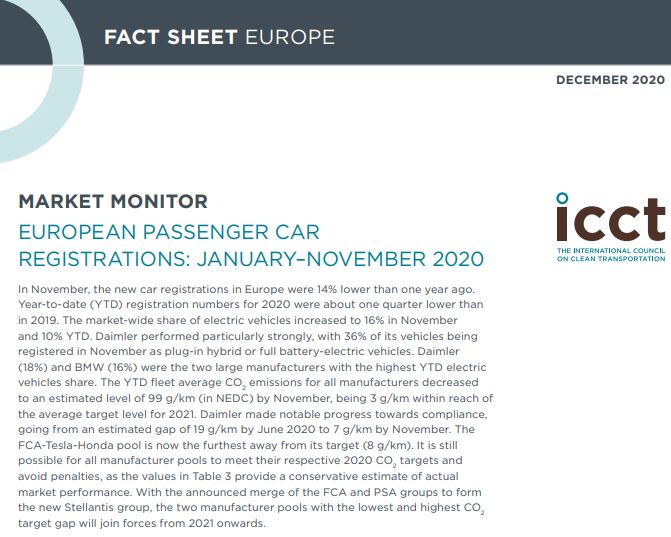
Market Monitor: European Passenger Car Registrations, January–November 2020
2020
Author(s): International Council on Clean Transportation (ICCT)
In November, the new car registrations in Europe were 14% lower than one year ago.Year-to-date (YTD) registration numbers for 2020 were about one quarter lower than in 2019.

Decentralized Master Production and Recycling Scheduling of Lithium-Ion Batteries: A Techno-Economic Optimization Model
2020
Author(s): Scheller C, Schmidt K, Spengler TS
Due to the rapid growth of e-mobility, increasing amounts of lithium-ion batteries are produced and returned after their lifetime. However, these returns will lead to new challenges for manufacturers and recyclers, considering the end-of-life.
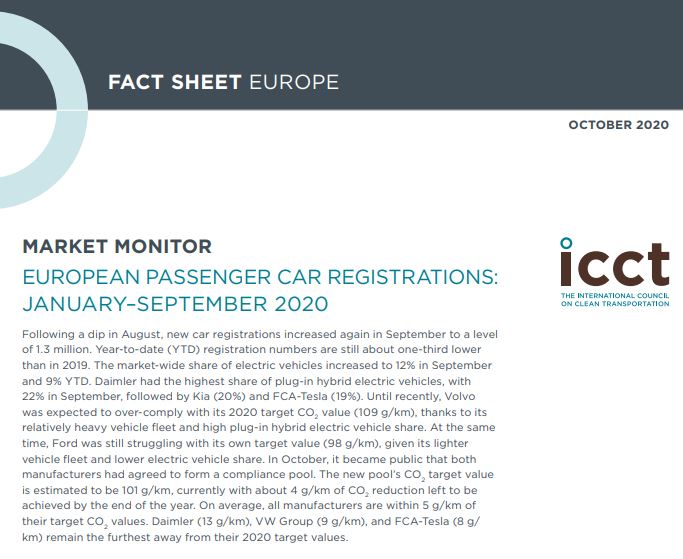
Market Monitor: European Passenger Car Registrations, January–September 2020
2020
Author(s): International Council on Clean Transportation (ICCT)
Following a dip in August, new car registrations increased again in September to a level of 1.3 million. Year-to-date (YTD) registration numbers are still about one-third lower than in 2019.

Conceptual Development of Electromobility in Conditions of Slovak Municipalities
2020
Author(s): Hrudkay K, Jaroš J
Development of electromobility depends on several factors. Framework conditions are usually defined at the national level, typically by government, but sometimes the national conditions are also affected by the European framework.
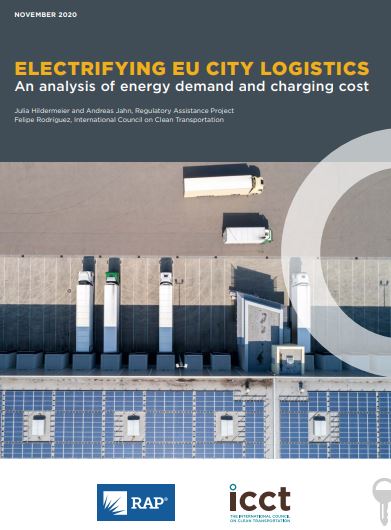
Electrifying EU City Logistics: An Analysis of Energy Demand and Charging Cost
2020
Author(s): Hildermeier J, Jahn A, Rodríguez F
This study by the International Council on Clean Transportation and the Regulatory Assistance Project examines fleet electrification, delving into the energy requirements and the various factors driving costs.
Sizing of Lithium-Ion Battery/Supercapacitor Hybrid Energy Storage System for Forklift Vehicle
2020
Author(s): Paul T, Mesbahi T, Durand S, Flieller D, Uhring W
Nowadays, electric vehicles are one of the main topics in the new industrial revolution, called Industry 4.0. The transport and logistic solutions based on E-mobility, such as handling machines, are increasing in factories.
Synergies Between E-Mobility and Photovoltaic Potentials – A Case Study on an Urban Medium Voltage Grid
2020
Author(s): Vopava J, Bergmann U, Kienberger T
To reduce CO2 emissions, it is necessary to cover the increasing energy demand of e-mobility with renewable energy sources. This paper presented results from a case study for the city of Leoben (Austria), which investigates the synergy effects between e-mobility charged only at work and photovoltaic (PV) potentials.