



Knowledge Hub

Optimal Sizing of Portable Modular Batteries for Electric Vehicles
2020
Author(s): Gong J, Wang Y, Zhao A, Zhao Z
In Europe and Asia, where most people live in high-rise buildings, electric vehicles (EVs) powered by portable batteries overcome two major deployment issues. The first is a lack of power-charging infrastructure, which makes an American-style charging model that works in the garage of a detached or attached single-family home impractical.
California’s Advanced Clean Trucks regulation: Sales requirements for zero-emission heavy-duty trucks
2020
Publisher/Organisation: International Council on Clean Transportation (ICCT)
On June 25, 2020, the California Air Resources Board (CARB) adopted the final rule for new standards that require the sale of zero-emission heavy-duty trucks (HDTs). The Advanced Clean Trucks (ACT) rulemaking finalizes standards that were initially proposed on October 22, 2019, and strengthened in a revised proposal on April 28, 2020. The regulation requires manufacturers to sell increasing percentages of zero-emission trucks, is expected to reduce the lifecycle emission of greenhouse gases (GHGs), eliminate tailpipe emissions of air pollutants, and foster a market for zero-emission HDTs. This HDT regulation is one of a series of rules that aim to advance climate and air quality strategies in California, which requires state-wide GHG reductions of 40% below the 1990 level by 2030. The sales requirements in the ACT are complemented by series of fleet purchase requirements, such as the Innovative Clean Transit rule for buses, which goes into effect in 2023 and requires 100% zero-emission bus purchases by 2029. This policy update summarizes key elements of the ACT rule and provides a regulatory context in California, the United States, and other major vehicle markets.
Charging forward on powering vehicles: economic and policy drivers for electric vehicle charging infrastructure in India – preliminary results
2020
Publisher/Organisation: Natural Resources Defense Council (NRDC)
In order to attract increased investments in charging infrastructure, policy interventions are needed that can improve the economics of EVs and charge, including reducing cost hurdles and other barriers. In the absence of government policies, insufficient charging infrastructure often presents a challenge for stakeholders. This factsheet presents recommendations on economic and policy drivers for scaling-up EV charging infrastructure to support a robust EV market in India for 2-wheelers, 3-wheelers, ride-hailing vehicles, and private buses. The preliminary results and findings presented in this factsheet are based on the model analysis of the Hyderabad EV ride-hailing taxi example. The analysis and policy recommendations from this example are indicative of the other vehicle segments. Since the analysis was conducted in 2019 and before the COVID-19 pandemic, some of the vehicle segment use cases have had reduced ridership, such as shared mobility and ride-hailing taxis.
Electric Vehicles
2020
Author(s): Datta A, Rodrigues N, Kumar M, Sharma J, Krishan R, Rawat A, Sharma Ashish K, Vyas S
To facilitate a sustainable electric mobility ecosystem in India, the role of power utilities will be a leading one, especially in deploying Electric Vehicle Charging Infrastructure (EVCI) within their license areas.
California Shows How the U.S. Can Reduce Transport Emissions
2020
Author(s): Lashof D, Saha D
How the United States addresses emissions from the transportation sector will largely determine if the country can meet its climate targets. In this post, WRI unpacks some of the factors driving the transportation sector and examine the differences among the states in emission trends and policy.
Analyzing Policies to Grow the Electric Vehicle Market in European Cities
2020
Author(s): Wappelhorst S, Hall D, Nicholas M, Lutsey N
This report analyzes market trends and key national and local electric vehicle promotion policies across Europe. Electric vehicle uptake and policies for passenger cars are assessed for 15 metropolitan areas: Amsterdam, Berlin, Birmingham, Brussels, Copenhagen, Hamburg, Helsinki, London, Madrid, Oslo, Paris, Rotterdam-The Hague, Stockholm, Vienna, and Zurich.
Phasing-out sales of internal combustion engine vehicles
2020
Author(s): Milieu Consulting SPRL
The objective of this study is to provide a first assessment of the legal scope for EU or national measures to phase-out ICE vehicles and to identify issues where legal uncertainty remains and further investigation is needed. At national level, it examines whether it is possible for Member States to derogate from the harmonised framework for motor vehicle approval in order to adopt ICE sales or registration bans under the exception provided by Article 114(5) TFEU.

With a population of 1.4 billion and one of the world’s fastest-growing major economies, India will be vital for the future of the global energy markets. The Government of India has made impressive progress in recent years in increasing citizens’ access to electricity and clean cooking.
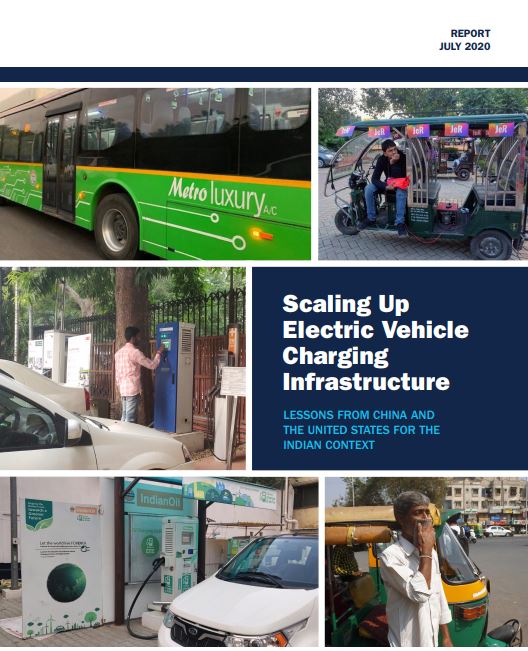
Scaling Up Electric Vehicle Charging Infrastructure
2020
Author(s): Natural Resources Defense Council (NRDC)
To expand India’s charging infrastructure, this report provides best practices from two of the largest EV markets – China and the United States – for the Indian context.
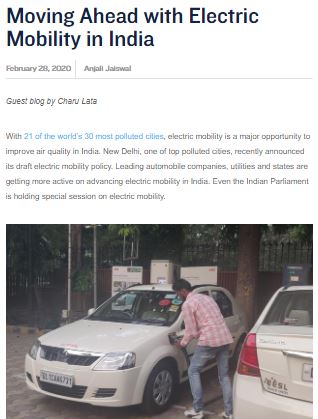
The transport sector is a significant and growing contributor to spiking air pollution in India. In 2015, transportation tailpipe emissions attributed to 1800 premature deaths in New Delhi. Recently, New Delhi announced its draft electric mobility policy. Electric mobility is considered a major opportunity to improve air quality in India. E-mobility solutions are essential for reducing emissions from the transport sector – both for air pollution and climate change.