



Knowledge Hub
A rapid and fundamental shift is required in transport to enable the decarbonisation required to meet the objectives of the Paris Climate Agreement, with actors in both the energy and transport sectors working together.
India Roadmap on Low Carbon and Sustainable Mobility
2020
Author(s): Federation of Indian Chambers of Commerce and Industry (FICCI)
This report indicates the clear thrust needed on public transportation, shifting paradigm to movement of people more than the paradigm of movement of vehicles as the effective means to reduce congestion, air pollution, and vehicle kilometres.

Multi Objective Optimal Tracking Control of Vehicle Active Suspension System
2020
Author(s): Das RR
In this research, to deal with the conflicting control objectives of active suspension system (ASS) including ride comfort, suspension travel, and road handling, the control design is reformulated as an optimization problem and the linear quadratic control framework and model predictive control strategy have been explored.
COP 26 Webinar Series: Future of E-Mobility in India: Strategies to Drive Demand
2020
Author(s): The Energy and Resources Institute (TERI)
This webinar by the British High Commission (BHC) and TERI, discussed ways to boost clean and resilient economic recovery through an e-mobility revolution in India. The discussions explored the following: 1. How to generate demand for electric vehicles using innovative awareness campaign strategies, policies, technologies and financial models? 2. How to accelerate the adoption of electric mobility through partnership models reflecting international best practices?
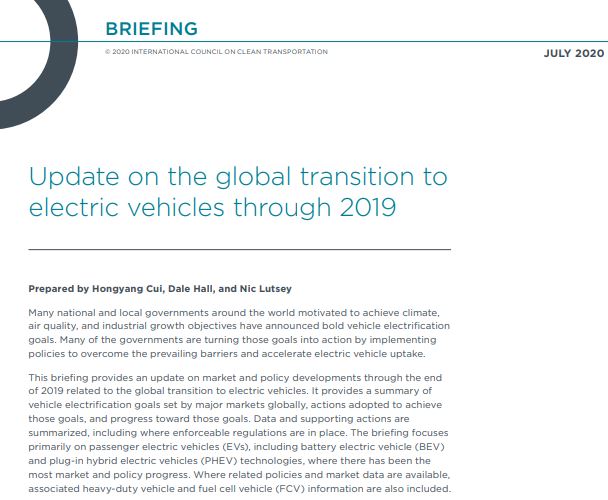
Update on the Global Transition to Electric Vehicles Through 2019
2020
Author(s): Cui H, Hall D, Lutsey N
This briefing provides an update on market and policy developments through the end of 2019 related to the global transition to electric vehicles. It provides a summary of vehicle electrification goals set by major markets globally, actions adopted to achieve those goals, and progress toward those goals.
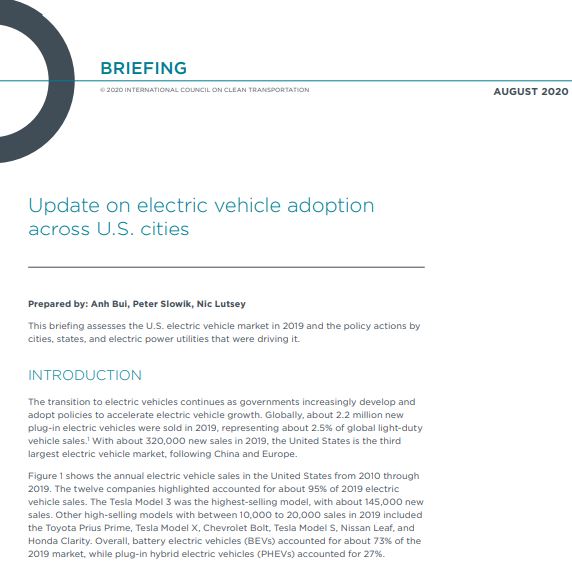
Update on Electric Vehicle Adoption Across U.S. Cities
2020
Author(s): Bui A, Slowik P, Lutsey N
This briefing assesses the U.S. electric vehicle market in 2019 and the policy actions by cities, states, and electric power utilities that were driving it.
Strategies for Deploying Zero-Emission Bus Fleets: Development of Real-World Drive Cycles to Simulate Zero-Emission Technologies Along Existing Bus Routes
2020
Author(s): Jin L, Delgado O, Gadepalli R, Minjares R
A route-level total cost-of-ownership (TCO) modeling framework can determine the total cost of the vehicles and infrastructure required to transition a single route entirely to zero-emission technology. This paper presents the methods for development of representative drive cycles of urban bus fleet operations, the first step in a multi-step route-level TCO modeling framework.
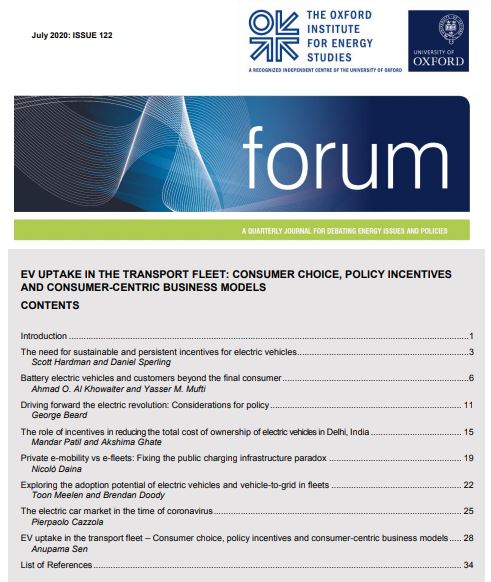
Role of Incentives in Reducing Total Cost of Ownership of Electric Vehicles in Dehi
2020
Author(s): Patil M, Ghate A
In India’s transition towards clean and sustainable transportation, increased use of electric vehicles (EVs) is a crucial element.

Prioritization based control strategy for Grid Ancillary support using Plug In Electric Vehicles Charging and Discharging
2020
Author(s): Ramakrishna Reddy K
This work mainly focuses at DA level where load flattening using PEV’s storage is the main objective.
COP 26 Webinar Series: Green Finance for Enhancing Climate Ambition
2020
Author(s): The Energy and Resources Institute (TERI)
This webinar by The Energy and Resources Institute (TERI) on the theme ‘Green Finance for Enhancing India’s Climate Ambition’ was designed to focus on how broader economic and social development concerns can be addressed in green investments, the role of financial mechanisms and instruments in catalysing much needed private capital for green finance and how India can transition to a resilient, ‘greener’ financial system incorporating global standards on disclosures and risk management.