



Knowledge Hub
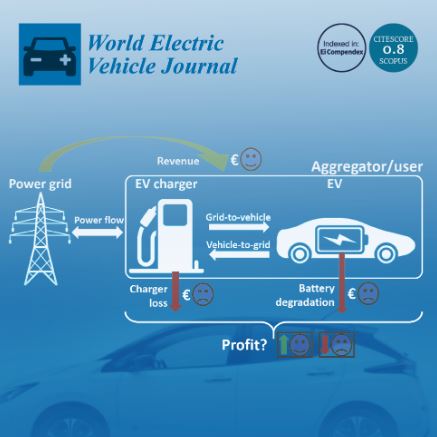
Electric Vehicle Charging Fault Monitoring and Warning Method Based on Battery Model
2021
Author(s): Zhang Y, Li T, Yan X, Wang L, Zhang J, Diao X, Li B
A method for the monitoring and warning of electric vehicle charging faults based on a battery model is proposed in this paper.
A Review on Barrier and Challenges of Electric Vehicle in India and Vehicle to Grid Optimisation
2021
Author(s): Goel S, Sharma R, Rathore A K
Electric Vehicles (EVs) are becoming a promising channel for improving air quality, energy protection, and economic opportunity in India, thanks to the rapid growth of the automobile industry. Electric vehicles are an important option for reducing emissions of greenhouse gases.
Study of the Reality on Electric Vehicle in Indian Scenario
2021
Author(s): Kar B, Pal TK, Bhattacharyya S
In this work, the estimation of the actual CO2 emission of a conventional IC engine vehicle and an electric vehicle have been studied in different phases and those vehicles are in same segmented also.
E launch of GIZ report on E mobility & Low Carbon Passenger Road Transport
2021
Author(s): Deutsche Gesellschaft für Internationale Zusammenarbeit (GIZ) GmbH
Under the regional technical assistance programme NDC-TIA, the study “Status quo analysis of various segments of Electric mobility and low carbon passenger road transport in India” was undertaken.
Potential Biofuel Production Pathways in Indonesia
2021
Author(s): Kristiana T, Baldino C
Because of its abundant biofuel feedstocks, Indonesia has the potential to produce biofuels via a number of pathways, including using different technologies and feedstocks to create different fuels.
Accounting for Well-To-Wake Carbon Dioxide Equivalent Emissions in Maritime Transportation Climate Policies
2021
Author(s): Comer B, Osipova L
This briefing paper outlines a methodology for calculating well-to-wake CO2-equivalent emissions from four fossil marine fuels: heavy fuel oil, very low sulfur fuel oil, marine gas oil, and liquefied natural gas. Well-to-wake emissions, or life-cycle emissions, are the sum of upstream (well-to-tank) and downstream (tank-to-wake) emissions.
.jpg)
Status quo Analysis of Various Segments of Electric Mobility and Low Carbon Passenger Road Transport in India
2021
Author(s): Deutsche Gesellschaft für Internationale Zusammenarbeit (GIZ) GmbH, NITI Aayog
This report provides the existing status, challenges, gaps, opportunities, and way forward for low carbon road transport (LCRT) in India.

Pathways To Decarbonize Passenger Transportation: Implications to India’s Climate Budget
2021
Author(s): Das D, Kalbar PP, Velaga NR.
The present study focuses on assessing contribution of electric vehicles (EVs) with improving electricity grids’ efficiency (EGs) and minimizing ‘transmission and distribution’ (T&D) losses in reducing carbon dioxide (CO2) emissions and fulfilling emission targets for 2030 and 2050.
Spatial Dimensions of Electric Mobility—Scenarios for Efficient and Fair Diffusion of Electric Vehicles in the Milan Urban Region
2021
Author(s): Pucci P
The main aim of this study is to investigate the spatial pattern of potential demand for electric vehicles in the Milan Urban Region (North Italy), and its relevance in defining diversified and site-based EV policies for promoting a fair transition towards low carbon mobility.
Getting to India’s Electric Vehicle Targets Cost-Effectively: To Subsidize or Not, and How?
2021
Author(s): Shrimali G
In the context of India’s ambitious electric vehicle targets, the author examines two related questions. First, which electric vehicles should be funded based on lifetime costs? Second, which subsidy option would be the most cost-effective based on lifetime subsidies?