
Reports

Towards a national active mobility strategy and an indicator system for active-mobility friendly cities in China
2023
Author(s): Lei L (China Academy of Transportation Science), Qian G (Sino Carbon)
This report examines the local conditions in Chinese cities and draws on international experiences to put forward a strategy for the advancement of Active Mobility Friendly Cities in China.
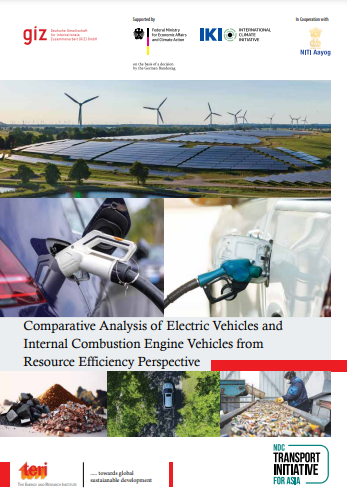
Comparative Analysis of Electric Vehicles and Internal Combustion Engine Vehicles from Resource Efficiency Perspective
2023
Author(s): Sinha S J (NITI Aayog), Teja J (NITI Aayog), Sharma G (NITI Aayog), Bhattacharjya S (TERI), Kaushik T (TERI), Pandey A (TERI), Singh M (TERI), Zhimomi T (GIZ)
This study assesses the various environmental performance of EV’s and ICEV’s (petrol, diesel and CNG) across 18 mid-point impacts and 3 end-point impacts.

Roadmap of Standards and Codes for Electric Vehicles at Scale
2023
Author(s): American National Standards Institute (ANSI)
The roadmap’s primary focus is on light-duty, on-road plug-in electric vehicles (PEVs) that are recharged via a connection to the electrical grid, as well as the supporting charging infrastructure needed to power them.

Towards Decarbonising Transport 2023: A Stocktake on Sectoral Ambition in the G20
2023
Author(s): Riehle E, Claire EL, Rublack E, Schmidt T, Sinha SJ, Teja J, Sharma G
This publication analyses the current state of decarbonisation and climate ambition in the transport sectors of G20 countries. G20 countries are responsible for the lion’s share of global transport emissions.

This report focuses on policies that support the most effective strategy to limit the harms from battery supply chains: reducing the type and amount minerals needed.

Facilitating Decarbonisation in Emerging Economies Through Smart Charging
2023
Author(s): International Energy Agency
This report looks at how deployment of digitalisation smart charging can contribute to improve grid security and decarbonisation and provides a set of policy and regulatory recommendations relevant within the context of emerging and developing economies.

Powering the Future of Transportation: Creating an Ethical, Sustainable Battery Supply Chain
2023
Author(s): Plug In America
This report focuses on strategies, policies, and programs that industry and government can develop to ensure that supply chains for EVs and their batteries are secure, circular, and reduce the need for mining virgin minerals, thus reducing adverse impacts on the planet and its people.

India’s signing of the declaration on 100 per cent transition to zero-emission vehicles by 2030-40 at the 26th Conference of Parties in Glasgow-with special focus on two - and three-wheelers-foreshadows more disruptive and transformative changes in the sector. The full force of this change needs to unfold within this decade. But is India really prepared to walk the talk?

Highly Resolved Projections of Passenger Electric Vehicle Charging Loads for the Contiguous United States
2023
Author(s): Yip A, Hoehne C, Jadun P, Ledna C, Hale E, Muratori M
This report documents enhancements made to the Transportation Energy & Mobility Pathway Options™ (TEMPO) model to project spatially, demographically, and temporally resolved national-scale electric vehicle (EV) charging load profiles.

Long-term Climate Compatible Growth for India: Modeling Low-carbon Pathways and Policies for India’s Power, Industry, and Transport Sectors
2023
Author(s): Gupta S, Mitra A, Uppal S, Misri A, Malyan A, Natarajan R, Kumar P, Batra H, Keswani S, Basu B, Srinivasan S, Chakraborty P, Chitkara P, Chaturvedi V, Singh M, Damini Thakur D
This study is grounded in the concept of carbon budgets and determines India’s fair share of the global carbon budget using four budget allocation approaches.