



Knowledge Hub

Circular Waste Management of Electric Vehicle Batteries: Legal and Technical Perspectives From the EU and the UK Post Brexit
2021
Author(s): Malinauskaite J, Anguilano L, Rivera XS
EVs have the ability to help decarbonize the transportation sector and combat climate change by emitting less greenhouse gases (GHGs) over their lifetime than traditional vehicles. In view of climate change, interdisciplinary strategies are needed to deal with end-of-life lithium-ion batteries (LIBs) used in electric vehicles (EVs) to prevent a possible waste crisis.

The E-Mobility Index, now in its tenth year, provides a regular overview of the global automotive industry.
Fuel Consumption From Light Commercial Vehicles in India, Fiscal Year 2018–19
2021
Author(s): Deo A
This paper examines the fuel consumption of new light commercial vehicles (LCVs) sold in India in fiscal year (FY) 2018–19. These vehicles are the N1 segment in India, and passenger vehicles are the M1 category.
Spain’s Electric Vehicle Infrastructure Challenge: How Many Chargers Will Be Required in 2030?
2021
Author(s): Nicholas M, Wappelhorst S
This working paper assesses the electric vehicle charging infrastructure necessary in Spain by 2030 versus what was installed at the end of 2019. Two vehicle uptake scenarios—50% and 70% of light duty passenger vehicle registrations by 2030—are explored.

Understanding Travel Preferences for User-Based Relocation Strategies of One-Way Electric Car-Sharing Services
2021
Author(s): Curtale R, Liao F, van der Waerden P
This study looks into travel preferences for ECS and the willingness to collaborate with the ECS operators in user-based relocation strategies. To ensure balanced supply–demand of shared cars in the operational areas, ECS operators tend to explore user-based relocation strategies in addition to the costly operator-based ones.
City Charging Infrastructure Needs To Reach Electric Vehicle Goals: The Case of Seattle
2021
Author(s): Hsu C-W, Slowik P, Lutsey N
This report evaluates the charging infrastructure needs for Seattle to reach its goal of having 30% of its vehicle stock be electric. It quantifies the number, type, and distribution of home, workplace, and public charging across Seattle and assesses several sociodemographic factors to inform more equitable deployment in the near term.

A Consortium Blockchain-Enabled Secure and Privacy-Preserving Optimized Charging and Discharging Trading Scheme for Electric Vehicles
2021
Author(s): Li Y, Hu B
This article utilizes consortium blockchain to design a decentralized, secure, and privacy-preserving scheme for bidirectional power trading between electric vehicles (EVs) and the power grid.

Online Electric Vehicle Charging With Discrete Charging Rates
2021
Author(s): Martijn HH, Uiterkamp S, Marco ET, Hurink GL
This paper presents an online EV scheduling approach based on discrete charging rates that does not require detailed predictions of this uncertain data. Instead, the approach requires only a prediction of a single value that characterizes an optimal offline EV schedule.

Residential Electric Vehicle Charging Datasets From Apartment Buildings
2021
Author(s): Sørensen AL, Lindberg KB, Sartori I, Andresen I
The publication "Analysis of household EV energy flexibility potential based on real-world charging reports and smart metre data" is the source of this data. Residential electric vehicle (EV) charging in apartment buildings is the subject of the datasets presented.
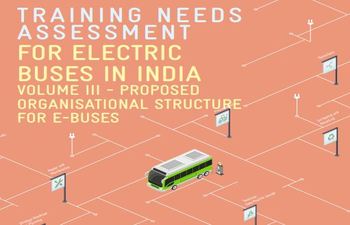
Training Needs Assessment for Electric Buses in India: Volume III - Proposed Organisational Structure for E-Buses
2021
Author(s): Deutsche Gesellschaft für Internationale Zusammenarbeit (GIZ) GmbH
The Volume – III report, considers two operating models for e-Buses, namely 1) PTAs (Public Transport Authorities) with all inhouse e-Bus operations and 2) PTAs (Public Transport Authorities with SPV structure and PPP model, requiring no Central Workshop.