



Knowledge Hub
Electrification of Public Transport: A Case Study of the Shenzhen Bus Group
2021
Author(s): World Bank
This case study on the electrification of buses and taxis is part of a larger effort by the World Bank Transport Global Practice to share China’s experience in rolling out electric mobility to the international community so that other governments can make more informed decisions, avoid potential risks, save resources, and connect to experts in the field and build capacity. The case study is organized into four main parts: Part I: The Policy and Enabling Environment of Electrification of Buses in Shenzhen; Part II: The Business Model and Implementation of SZBG’s Transition to Electric Mobility; and Part III: Assessing the Costs and Benefits of SZBG’s Transition to Electric Mobility.
Climatic episode 2.1: electric mobility talk show
2021
Author(s): Asian Development Bank
In this episode, a top regional EV manufacturer and a panel of VCs and industry experts discuss how EVs are reshaping the Asia Pacific transportation industry.
Pole-Mounted Electric Vehicle Charging: Preliminary Guidance for a Low-Cost and More Accessible Public Charging Solution for U.S. Cities
2021
Author(s): Werthmann E, Kothari V
In the United States, PMCs are a solution growing in popularity, but there remains uncertainty regarding best practices and guidance for cities interested in assessing its feasibility. This paper aims to fill that gap and encourage cities to assess feasibility of PMCs in their local context.
Electrifying Ride-Hailing in the United States, Europe, and Canada: How To Enable Ride-Hailing Drivers To Switch to Electric Vehicles
2021
Author(s): Lazer L, Wachche S, Sclar R, Cassius S
This paper identifies the largest barriers that prevent ride-hailing drivers from accessing EVs and analyzes ways that governments, industry and other stakeholders can tackle those barriers. It includes city scorecards that evaluate 10 U.S., European and Canadian cities on their progress towards dismantling these barriers, using an original WRI methodology and data from Uber.
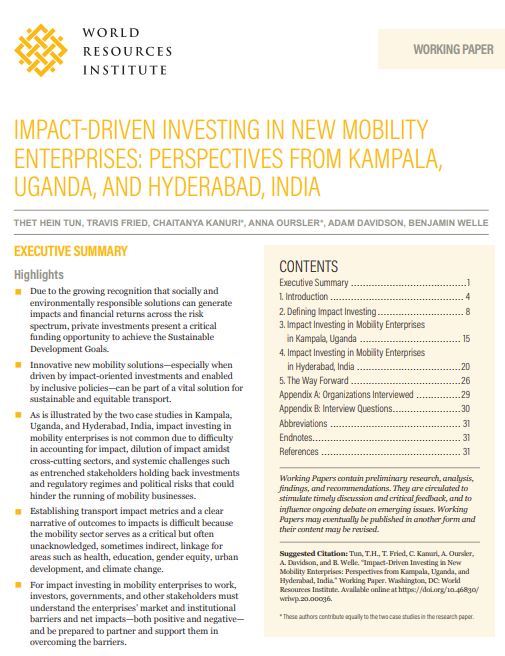
Impact-Driven Investing in New Mobility Enterprises: Perspectives From Kampala, Uganda, and Hyderabad, India
2021
Author(s): Tun T H, Fried T, Kanuri C, Oursler A, Davidson A, Welle B
The purpose of this paper is to evaluate the compatibility between impact investing and the mobility sector, and identify opportunities and barriers to amplifying net-positive impacts among new mobility enterprises, illustrated through two case cities of Kampala, Uganda, and Hyderabad, India.
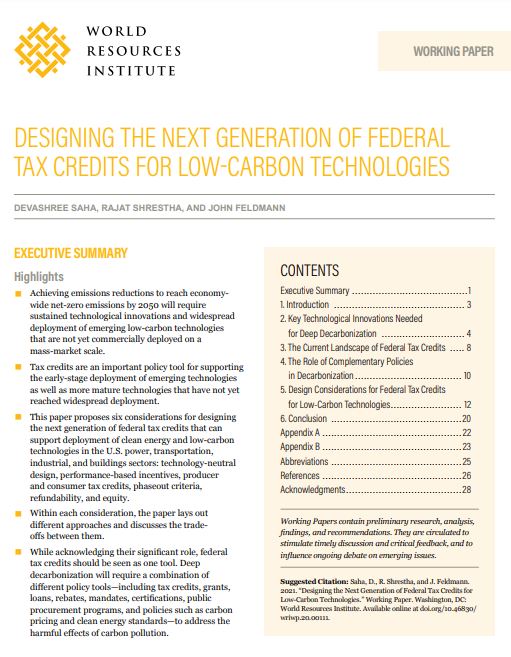
Designing the Next Generation of Federal Tax Credits for Low-Carbon Technologies
2021
Author(s): Saha D, Shrestha R, Feldmann J
This working paper evaluates key considerations for the next generation of federal tax credits that can incentivize innovation and accelerate the deployment of low-carbon and clean energy technologies across the U.S. power, transportation, industrial, and buildings sectors.

Some Investigations on Integration of Electric Vehicles in Distribution System
2021
Author(s): Singh, Jyotsna
The main objective of this thesis is to study in detail the impact of scheduling strategies including different vehicle to grid (V2G) services available from EVs. Furthermore, the coordination of scheduling strategies with existing operative tools in distribution system is also studied.
The Global Diffusion of Electric Vehicles: Lessons from the First Decade
2021
Author(s): Li S, Wang B, Yang M, Zhang F
Investment in charging infrastructure would have been much more cost-effective than consumer purchase subsidies in promoting electrical vehicle adoption. This finding highlights the importance of expanding charging infrastructure in the next phase of deeper electrical vehicle diffusion.
This case study uses the 5-step method from Ashby et al., 2015 to examine the sustainable development of an electric vehicle. The objectives, stakeholders, facts, analysis, and reflection of this engineering design challenges are examined.

Intelligent Control of Shared Electric Vehicle Charging Robots
2021
Author(s): Khan, MA
The study results obtained from simulations show that a mobile autonomous charging station can provide many benefits. Apart from having a low upfront investment cost as compared to static chargers, a smart mobile charger also has reduced upgradation costs and allows greater flexibility.