



Research Papers/Articles

Forecasting the Diffusion of Hydrogen EV Refuelling Infrastructures in Italy
2019
Author(s): Viola F, Zaninelli D, Ala G, Schettino G, Castiglia V, Miceli R
The revolution of electric vehicles has arrived in Italy, but it still has trouble taking off. At the moment, hybrid technology, particularly due to range anxiety, would appear to be the most quoted. The aim of this work is to understand if the fuel cell technology can find place in Italy.

Exploration of Artifical Intelligence Approaches for the Integration of E-Mobility Energy Storage Systems Into Virtual Power Plants
2019
Author(s): Rädle S, Mast J, Gerlach J, Bringmann O
The growing proportion of electric vehicles, as a side effect of the mobility factor, provides a decentralized electric storage network that can be used as an alternative to traditional central storage systems for buffering fluctuations in power generation and balancing the reliability of the power grid.

Evaluating Technology Innovation for E-Mobility
2019
Author(s): Aversa R, Di Martino B, Venticinque S, Natvig M, Jiang S, Sard RE
GreenCharge is an European research project that aims at integrating and deploying innovative technologies and associated business models to facilitate the transition towards electro mobility (e-mobility).
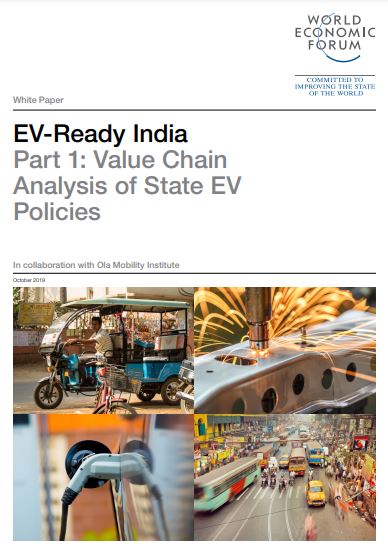
EV-Ready India Part 1: Value Chain Analysis of State EV Policies
2019
Author(s): World Economic Forum
This White paper uses a Value Chain Framework to analyse the EV policies in 10 Indian States. The Value Chain framework pays attention to the multisectoral and multistakeholder aspects of EV-policies - separated into three different value chains; the value chain of electric vehicles, the value chain of charging, and the value chain of the surrounding network. It ensures that overall sustainability is considered from cradle to grave.

European Innovation for Next Generation Electrified Vehicles and Components
2019
Author(s): Armengaud E, Hegazy O, Brandstatter B, Ivanov V, Tatschl R, De Gennaro M, Sorniotti A, Van Mierlo J, Schernus C
Electrification of road transport is a key challenge to reach the emission targets while enabling efficient mobility for persons and goods. Even though solutions already exist on the market, e-mobility is still a niche market.
Erollin’ on Green: A Case Study on Eco-Feedback Tools for Emobility
2019
Author(s): Cech F, Wagner M
This case study, evaluated the transformative potential of eco-feedback tools for sustainable mobility practices utilizing an action-research based methodology. Utilizing an action-research based methodology, the authors engage the local community in cooperation with the aspern.mobil LAB to co-design a digital interactive tool visualizing the participants' personal CO2-footprint.

E-Mobility: Safety, Service Continuity and Penetration of Charging Systems
2019
Author(s): Mauromicale G, Raciti A, Rizzo SA, Susinni G, Parise G, Parise L
This paper has presented the kinds of electric vehicles that need to be charged through residential charging systems or public charging stations and the basic types of charging systems. International guidelines have defined various aspects relating to electric vehicles that also this paper presents briefly.

E-Mobility Impact on Supply in Distribution Grid
2019
Author(s): Kurfirt M, Kaspirek M, Hlavnicka J
The paper evaluates the impact of chargers measured on the charger cable connection to the distribution grid. The paper describes characteristic points and methods of charging electric cars with AC and DC current.

Working Towards Greener Golf Carts – A Study on the Second Life of Lead-Acid Batteries
2019
Author(s): Dulout J, Villa LFL
E-mobility requires a high power capability from the batteries to supply the necessary torque to engines. If a battery can no longer supply this power, it is no longer fit to be used in e-mobility.

Visual Legal Analytics – A Visual Approach to Analyze Law-Conflicts of E-Services for E-Mobility and Transportation Domain
2019
Author(s): Burkhardt D, Nazemi K
In this paper the authors introduce a new approach to identify and analyze legal conflicts based on a business model or plan against existing laws. The intention is that an early awareness of critical legal aspect could enable an early adoption of the planned service to ensure its legality.